Quick answer
The federal 25C tax credit doesn't cover heat pumps installed in 2026. The main federal help left is HEEHR (formerly HEAR), a state-run rebate of up to $8,000 for a heat pump ($14,000 per household) for incomes up to 150% of area median. Since May 29, 2026, it pays only for upgrades from existing electric equipment or in new construction, not for replacing gas, oil or propane. HOMES and utility rebates may also help. Get approved before you install.
Pricing a heat pump this year? Expect different numbers from what you saw in 2025. The federal tax credit that most guides still mention is gone for systems installed in 2026. Heat pump rebates in 2026 now come from two state-run federal programs, HEEHR (formerly HEAR) and HOMES, plus whatever your utility or state adds. One rule runs through all of it: in most cases you have to be approved before the installer starts work.
The short answer
- No federal tax credit for 2026 installs. The 25C credit covers only equipment placed in service by the end of 2025.
- HEEHR is the biggest pot left, but not for gas homes. It pays up to $8,000 toward a heat pump and up to $14,000 per household, only for upgrades from electric equipment (or new construction). You need a household income at or below 150% of your area’s median, and your state’s program has to be open.
- HOMES pays for measured energy savings. It pays up to $8,000, based on modeled savings of at least 20%.
- Utility and state rebates are separate. They can often be added on top.
- Don’t install first. Federal rules don’t allow retroactive rebates.
What changed for 2026
From 2023 through 2025, the Energy Efficient Home Improvement Credit (25C) took up to $2,000 a year off your taxes for a qualifying heat pump. The IRS now says the credit applies only to property placed in service before the end of 2025. A heat pump installed in January 2026 or later doesn’t qualify.
Two related credits ended too. The Residential Clean Energy Credit (25D) covered geothermal heat pumps, and it stopped after December 31, 2025. The EV charger credit (30C) stopped after June 30, 2026. That second one matters only if you were planning a charger as part of the same electrical upgrade.
The rebates are a different kind of program, and they did not end with the credits. Congress funded them as grants to states in 2022. Each state energy office designs and runs its own version. DOE’s program page says the rebates “are now available in select states.” That’s the honest summary: real money, but only in some places so far.
The May 2026 rule change: no more fuel switching
On May 29, 2026, DOE issued Program Notice 26-2. It changed the federal electrification rebate in five ways that matter to homeowners:
- New name. Home Electrification and Appliance Rebates (HEAR) is now High-Efficiency Electric Home Rebates (HEEHR).
- No more fuel switching. The rebate no longer pays to replace gas, oil or propane equipment. It covers upgrades from existing electric equipment to more efficient electric equipment, plus HVAC and electric appliances in new construction.
- Insulation first. Homes must use the rebates for insulation and air sealing before heating and cooling upgrades, unless they’re already insulated and sealed to a DOE-approved, state-specified level.
- Approved reservations still count. Reservations approved under the old rules can still be paid. New ones must follow the new rules.
- States had three months to switch. North Carolina and Wisconsin both changed their rules on September 1, 2026.
If your home heats with gas, oil or propane, the federal rebate won’t cover a switch to a heat pump. HOMES and utility rebates may still apply.
Three places the money comes from
| Source | Who runs it | Income limit | How you get paid | Can it combine? |
|---|---|---|---|---|
| HEEHR, formerly HEAR (electrification rebates) | Your state energy office | 150% of area median income or less. Electric-to-electric upgrades only | Instant discount or post-purchase rebate, depending on the state | Not with HOMES or any other federal rebate for the same project |
| HOMES (efficiency rebates) | Your state energy office | No federal income cap. Bigger rebates below 80% | Based on modeled energy savings | Not with another federal rebate for the same upgrade |
| Utility and state programs | Your utility or state | Varies | Varies | Usually yes. Check each program’s terms |
If your home already heats with electricity, HEEHR can pay for the heat pump and a utility rebate may sit on top. If you heat with gas, oil or propane, HEEHR no longer covers the switch. HOMES and utility rebates may still apply, so check both. HOMES fits better when the heat pump is one part of a bigger efficiency project, like insulation, air sealing and new equipment, and the whole job cuts the home’s energy use by at least 20%.
HEEHR (formerly HEAR): the electrification rebate
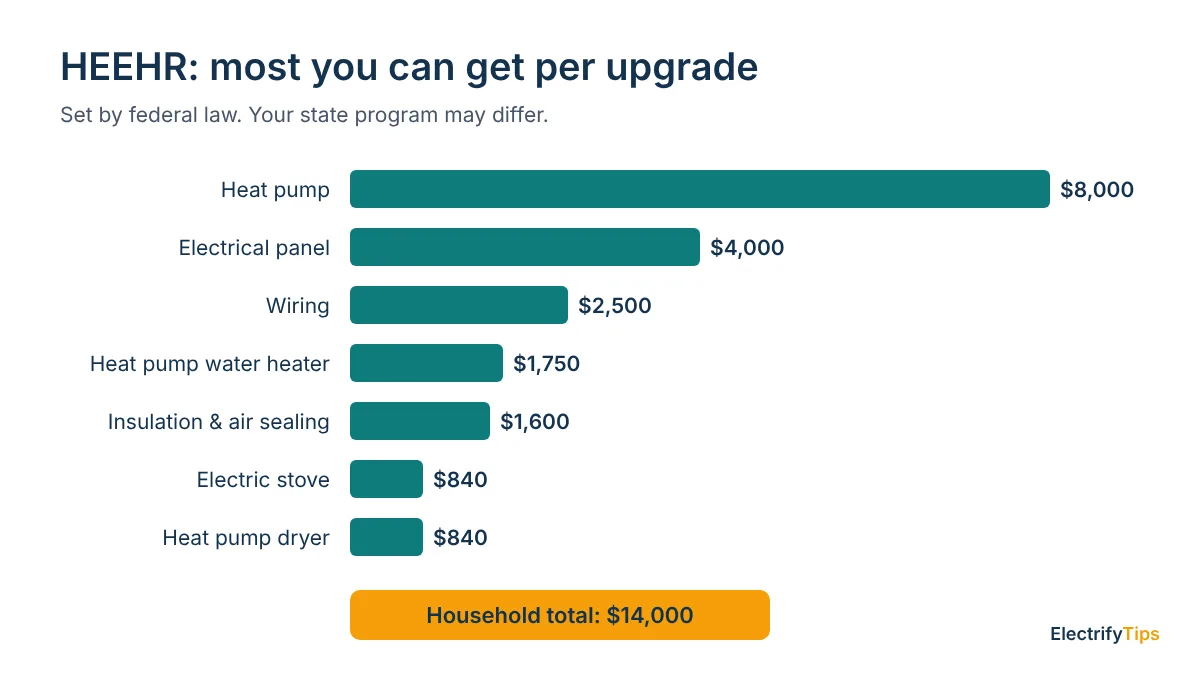
In May 2026, DOE renamed the Home Electrification and Appliance Rebates (HEAR) the High-Efficiency Electric Home Rebates (HEEHR). Some states still use the old name. The law sets a maximum for each upgrade, and DOE’s notice didn’t change these:
| Upgrade | Maximum rebate |
|---|---|
| Heat pump for heating and cooling | $8,000 |
| Electrical panel (“load service center”) | $4,000 |
| Electric wiring | $2,500 |
| Heat pump water heater | $1,750 |
| Insulation, air sealing, ventilation | $1,600 |
| Electric or induction stove, cooktop, range or oven | $840 |
| Heat pump clothes dryer | $840 |
| Household total | $14,000 |
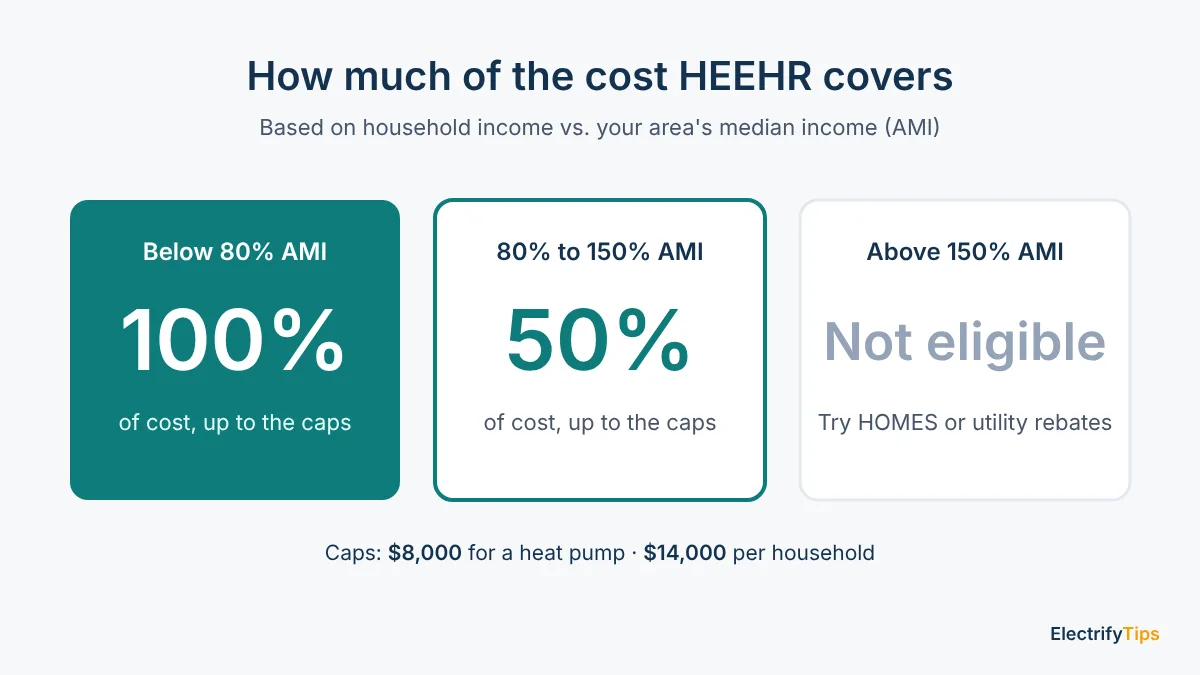
Your income decides how much of the cost HEEHR covers:
- Below 80% of area median income: up to 100% of the cost, up to the limits above.
- 80% to 150%: up to 50% of the cost, up to the same limits.
- Above 150%: not eligible for HEEHR. HOMES and utility rebates may still apply.
Two quick examples with a heat pump replacing electric baseboard heat, installed for $12,000:
- A household at 120% of median gets 50%, which is $6,000.
- A household at 70% of median could have the full cost covered. But the heat pump limit is $8,000, so the rebate is $8,000.
Area median income is set for each area. That means the same salary can qualify in one county and miss in the next. Your state program does the income check, so don’t rule yourself out based on a national average.
HOMES: the whole-home efficiency rebate
HOMES (Home Efficiency Rebates) doesn’t pay per appliance. It pays for the energy the whole project is modeled to save. The law sets these limits for a single-family home:
| Modeled energy savings | Most households | Below 80% of area median income |
|---|---|---|
| 20% to 35% | $2,000 or 50% of cost, whichever is less | $4,000 or 80% of cost |
| 35% or more | $4,000 or 50% of cost | $8,000 or 80% of cost |
There is no income cap at the federal level. Wisconsin, for example, opens HOMES to all homeowners. States can set up their programs differently, and some state pages show higher maximums (North Carolina’s lists up to $16,000). Treat your state’s page as the final word.
HOMES pays on the savings of the whole project, not on one appliance. That makes it a better fit when the heat pump is part of a bigger plan: insulation and air sealing done at the same time as the new system.
Do you qualify? A six-point check
- Your state’s program is open. No open program, no rebate yet. See the state status table below.
- Your home heats with electricity today, or it’s new construction. Since May 2026, HEEHR doesn’t pay to replace gas, oil or propane equipment.
- Your income is at or below 150% of area median (for HEEHR). HOMES has no federal income limit.
- You own the home, or the owner agrees. DOE says renters can take part with the property owner’s approval.
- Nothing has been installed yet. Federal rules don’t allow retroactive rebates.
- You use a contractor approved by the program. Wisconsin and Minnesota both route the rebate through registered or approved contractors.
If you pass all six, apply. If only #1 fails, the next section helps you decide whether to wait.
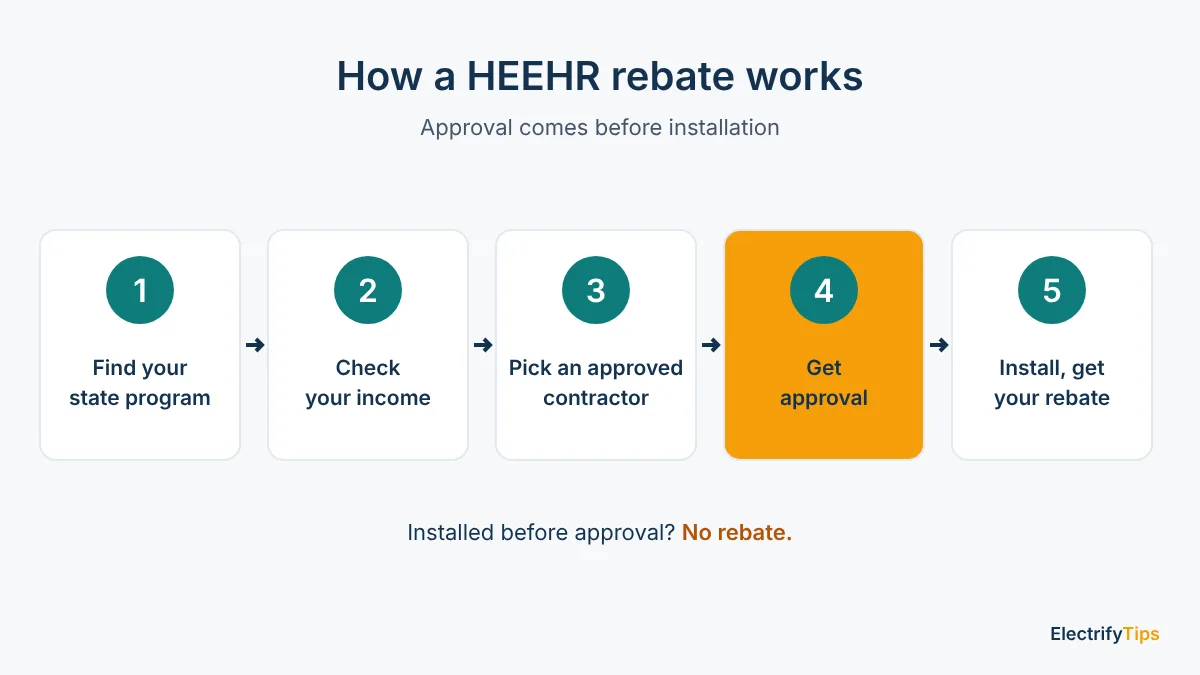
How to apply, step by step
- Find your state’s program. DOE keeps a state-by-state map at energy.gov/save/rebates.
- Check your income. Use the state’s own form or tool. It will ask about household size and income.
- Pick a contractor from the program’s list. Get a written quote that names the equipment model.
- Wait for approval. In DOE’s example of how the process works, the state approves the project before installation.
- Install, and see the rebate on the bill. In DOE’s example, the contractor takes the rebate off your invoice. Some states pay it after purchase instead (Wisconsin allows both).
- Then claim utility rebates. Keep the invoice, model numbers and approval letter. Utility programs often ask for them.
State status, October 2026
These are only the states whose official pages we checked on October 4, 2026. Programs change month to month, so open your state’s page before you plan around it.
| State | Status | What the official page says |
|---|---|---|
| California | Waitlist | Single-family HEEHRA funds were fully reserved on Feb 24, 2026. Multifamily is still open. |
| Michigan | Partly paused | New income-qualified applications are on hold in the Detroit, Warren, Grand Rapids, Lansing and Kalamazoo districts. |
| Minnesota | Not launched | Waiting for DOE approval. No launch date. The state says DOE’s new rules “change how the HEAR & HOMES rebates will work in Minnesota.” |
| New Hampshire | Not open yet | The state says the program is expected to launch in fall 2026, and only projects started after launch will qualify. |
| North Carolina | Open | Since Sept 1, 2026, no rebates for replacing gas or other fossil fuel appliances. |
| South Carolina | Not launched | Expected to launch in 2026. |
| Wisconsin | Open | Since Sept 1, 2026, retail rebates no longer accepted for equipment replacing fossil fuel appliances. |
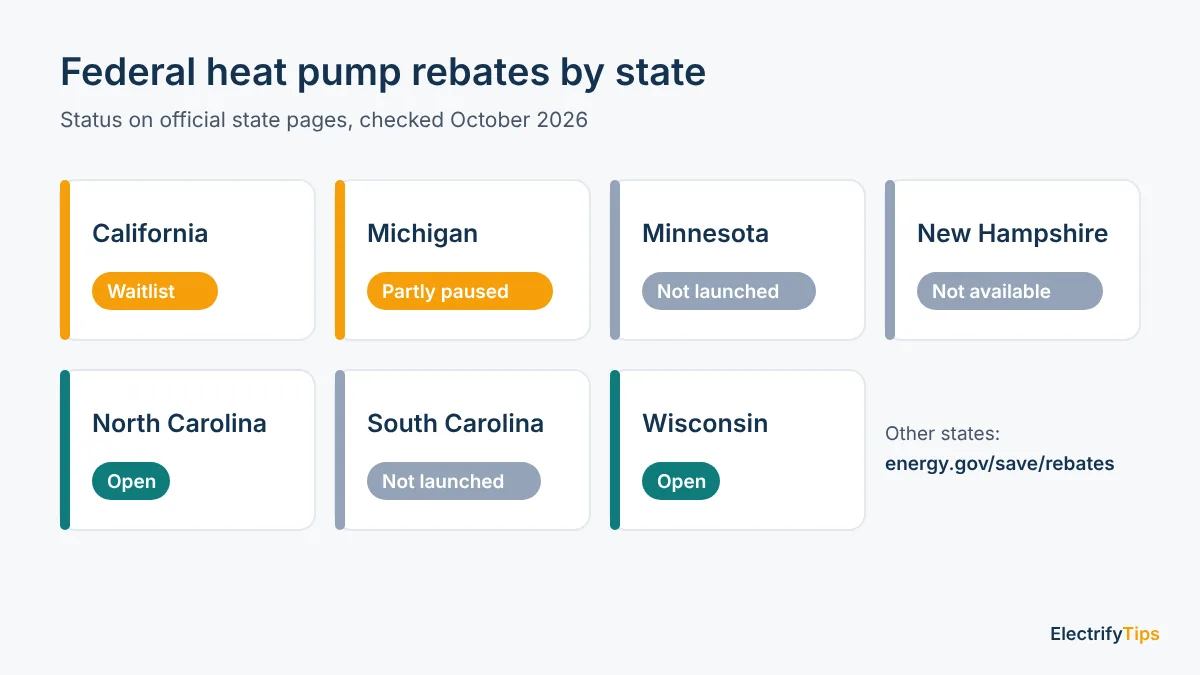
Massachusetts is a different case. Its main heat pump money comes from Mass Save, a utility program. Mass Save pays $2,650 per ton for whole-home heat pumps, up to $8,500, and forms are due by Feb 28, 2027.
Should you wait? If your current system works and your state is close to launching, waiting could mean thousands of dollars. Minnesota’s page says plainly to wait until the program launches. If your furnace or AC has died, look at utility rebates. They don’t depend on the federal programs. If you heat with gas, oil or propane, waiting for HEEHR won’t help, because the switch no longer qualifies.
Mistakes that cost people their rebate
- Installing before approval. Federal rules don’t allow retroactive rebates, so a heat pump that’s already in can’t be added later.
- Counting on the 2025 tax credit. A 2026 install gets nothing from 25C.
- Hiring a contractor who isn’t on the program’s list. The rebate runs through approved contractors.
- Planning HEEHR and HOMES for the same upgrade. The law forbids it (see below).
- Forgetting the caps. $8,000 is the most HEEHR pays for the heat pump, and $14,000 is the most per household. If you plan a new panel and wiring too, add them up first.
- Counting on HEEHR to replace a gas furnace. New reservations for that no longer qualify.
Stacking: what you can combine
Both laws say the same thing in slightly different words. A HOMES rebate “may not be combined with any other Federal grant or rebate” for the same single upgrade. HEEHR has the same rule for the same electrification project. So one federal rebate per upgrade.
Utility and state-funded rebates are not federal, so the law doesn’t stop you adding them. Some programs set their own rules, though, such as not paying more than the job costs. Ask both programs before you count on the total.
Can you use HEEHR for the heat pump and HOMES for insulation in the same house? The law blocks doubling up on one upgrade. How each state splits up a mixed project is the state’s call. Ask your program before you plan around it.
Frequently asked questions
Is there a federal tax credit for heat pumps in 2026?
No. The 25C credit covers only heat pumps placed in service by the end of 2025. If yours was installed in 2025, you can still claim it on your 2025 tax return using Form 5695.
Can I still use HEEHR to replace a gas furnace with a heat pump?
Not with a new reservation. Since DOE’s May 29, 2026 notice, HEEHR pays only for upgrades from existing electric equipment or in new construction. Reservations approved under the old rules can still be paid.
Does HEEHR also pay for a new electrical panel?
Yes. HEEHR allows up to $4,000 for an electrical panel and up to $2,500 for wiring, on top of the heat pump. All of it counts toward the $14,000 household limit.
Do I pay the full price and wait for a check?
It depends on your state. In DOE’s example, the contractor takes the rebate off the invoice, so you pay less up front. Some states, like Wisconsin, also pay rebates after purchase.
Can I use HEEHR and a utility rebate together?
Usually yes. The law blocks combining two federal rebates for the same upgrade, and utility rebates aren’t federal. Check both programs’ terms, since some won’t pay more than the job costs.
My state’s program isn’t open. Where else can I look?
Try your electric utility first. Two free search tools help too. ENERGY STAR’s Rebate Finder lists offers by ZIP code. DSIRE, run by the N.C. Clean Energy Technology Center at N.C. State University, tracks state and utility incentives.
Is HOMES only for low-income households?
No. HOMES has no income cap at the federal level. Households below 80% of area median income get larger maximums: $4,000 or $8,000 instead of $2,000 or $4,000.
Keep reading
- Heat pumps: the complete homeowner’s guide
- Rebate Finder: check programs for your state
- How much does a heat pump cost to install?
- Heat Pump Cost Calculator
- Rebates hub
- Heat pump water heater cost and savings
Sources & references
- https://www.govinfo.gov/link/uscode/42/18795a
- https://www.govinfo.gov/link/uscode/42/18795
- https://www.energy.gov/scep/home-energy-rebates-programs
- https://www.energy.gov/documents/program-notice-26-2
- https://www.energy.gov/sites/default/files/2024-12/home-energy-rebates-faq-fact-sheet_925224.pdf
- https://www.energy.gov/sites/default/files/2024-09/doe-hear-customer-journey_092424.pdf
- https://www.energy.gov/scep/slsc/home-energy-rebates-program/articles/doe-provides-states-and-territories-retroactive
- https://www.energy.gov/save/rebates
- https://www.irs.gov/credits-deductions/energy-efficient-home-improvement-credit
- https://www.irs.gov/credits-deductions/residential-clean-energy-credit
- https://www.irs.gov/credits-deductions/alternative-fuel-vehicle-refueling-property-credit
- https://focusonenergy.com/home-energy-rebates
- https://www.focusonenergy.com/ira-hear
- https://www.deq.nc.gov/energy-climate/state-energy-office/energy-saver-north-carolina
- https://www.deq.nc.gov/energy-climate/state-energy-office/energy-saver-north-carolina/program-changes
- https://www.michigan.gov/egle/about/organization/materials-management/energy/rfps-loans/home-energy-rebate-programs
- https://mn.gov/commerce/energy/consumer/energy-programs/hear.jsp
- https://energy.sc.gov/rebates
- https://www.energy.ca.gov/programs-and-topics/programs/inflation-reduction-act-residential-energy-rebate-programs
- https://www.energy.nh.gov/funding-opportunities/funding-opportunities-homeowners/home-electrification-and-appliance-rebates
- https://www.masssave.com/residential/rebates-and-incentives/heating-and-cooling/heat-pumps/air-source-heat-pumps
- https://www.energystar.gov/rebate-finder
- https://www.dsireusa.org/