Quick answer
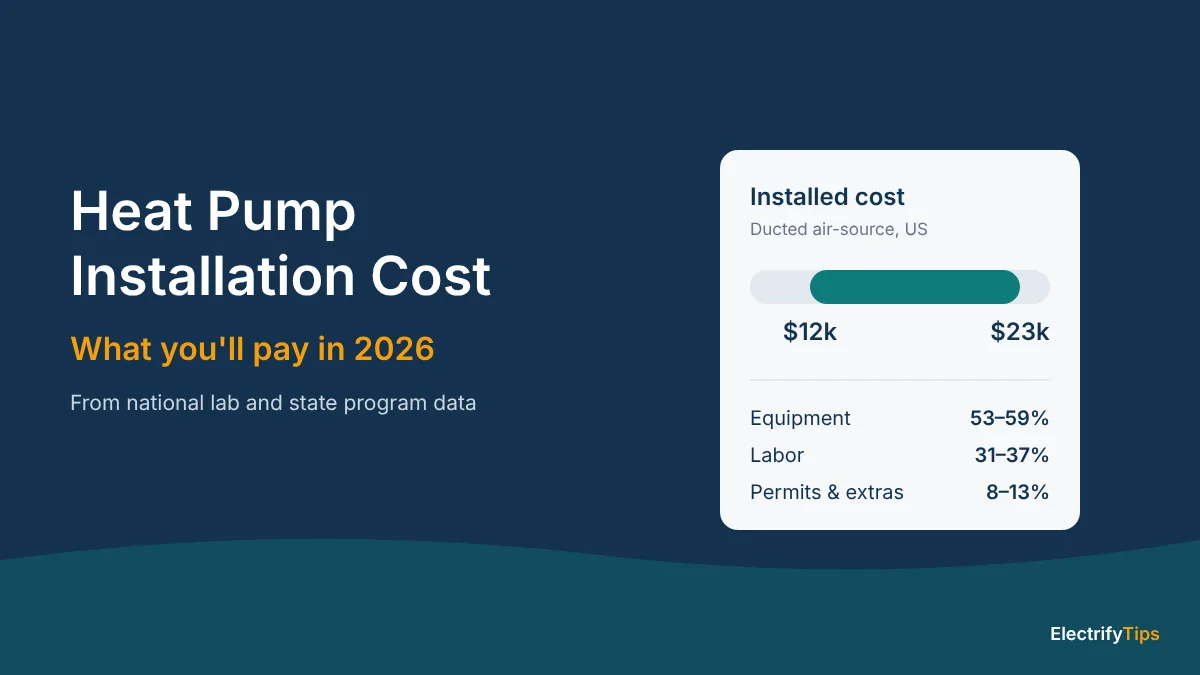
A typical ducted air-source heat pump costs about $12,000 to $23,000 installed in the US (NESCAUM, 2024). Efficiency moves the price most: NREL estimates about $9,000 for a minimum-efficiency unit and $24,000 for a high-efficiency cold-climate model. Equipment is roughly half to 60% of a quote, labor about a third.
Ask three installers to price a heat pump for the same house and you can get three quotes thousands of dollars apart. That isn’t always someone overcharging. Heat pump installation cost depends on the size and efficiency of the system, whether your ducts can be reused, and how much electrical work the job needs. This guide uses published data from a national lab and two state-level sources to show what installs cost, where the money goes, and which extras to watch for.
The short answer
- A typical ducted air-source heat pump costs about $12,000 to $23,000 installed in the US, according to an October 2024 cost study for the Northeast states’ air agencies (NESCAUM).
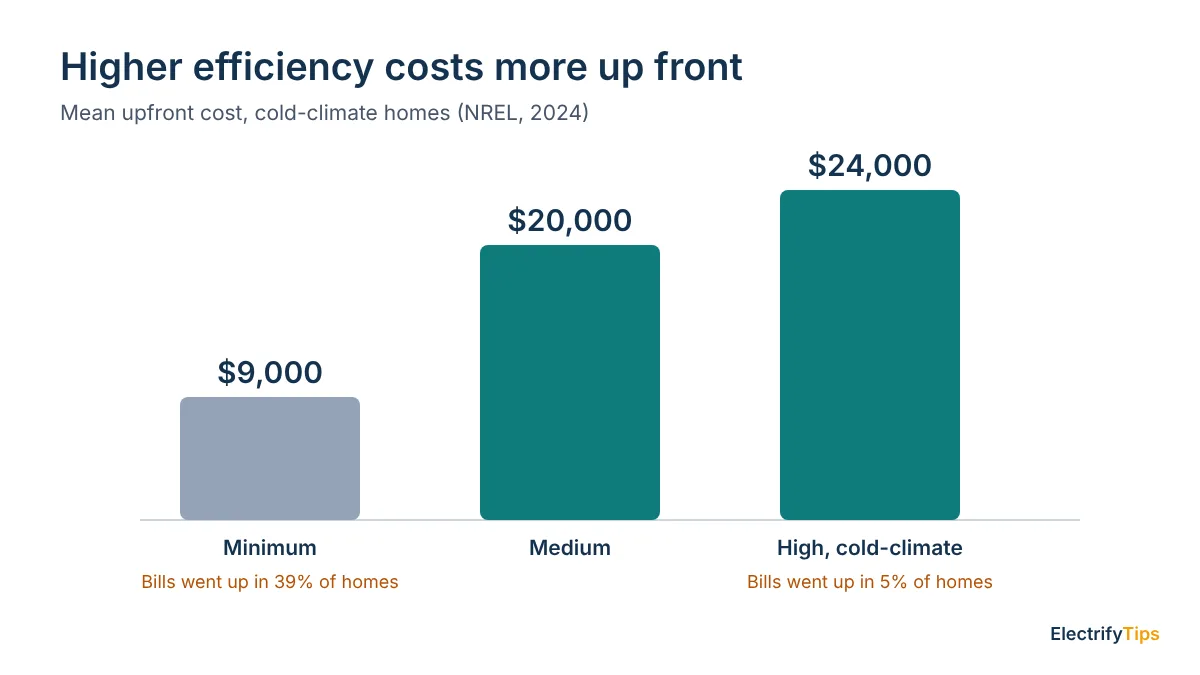
- Efficiency moves the price the most. In NREL’s 2024 national study, the mean upfront cost in cold-climate homes ran from about $9,000 for a minimum-efficiency unit to $24,000 for a high-efficiency cold-climate model.
- Equipment is about half to 60% of the bill. Labor is roughly a third. Permits, testing and parts make up the rest (California contractor survey, 2024).
- Extras aren’t always in the quote. Watch for panel upgrades, new ductwork and wiring.
- Rebates can cut the price a lot, but only if you’re approved before installation. The 25C tax credit doesn’t cover 2026 installs.
What real installs cost: three sources compared
No government agency publishes one official national price for a heat pump install. These three sources are the most solid public numbers. Each measured something different:
| Source | What it measured | Cost |
|---|---|---|
| NESCAUM cost study (Oct 2024) | US average total installed cost, ducted air-source heat pump | $12,000 – $23,000 |
| Same study, for comparison | Gas or oil system plus central AC | $10,000 – $13,000 |
| NREL, Joule (Apr 2024) | Modeled mean upfront cost, homes in cold and very cold climates | $9,000 (minimum efficiency), $20,000 (medium), $24,000 (high-efficiency cold-climate) |
| TECH Clean California contractor survey (Feb 2024) | Average 3-ton install in California, 64 contractors surveyed | $11,201 (replacing central AC), $13,281 (replacing AC + furnace), $14,909 (replacing a gas furnace) |
A few things stand out:
- California sits at the low end of the national range. Its averages ($11,201–$14,909) fall near the bottom of NESCAUM’s $12,000–$23,000.
- High-efficiency cold-climate units cost the most. In colder states, that’s often the model you want.
- Replacing a furnace costs more than replacing an AC. In the California survey, swapping out a gas furnace averaged about $3,700 more than swapping out a central AC ($14,909 vs $11,201).
- The California figures leave out two big extras. The survey assumed no panel upgrade and no duct replacement. If your job needs either, expect to pay more.
Where the money goes
The California contractor survey split each job into three parts:
| Part of the bill | Share of total cost |
|---|---|
| Equipment (outdoor unit, indoor unit, thermostat) | 53% – 59% |
| Labor | 31% – 37% |
| Miscellaneous (permits, required testing, duct sealing, parts) | 8% – 13% |
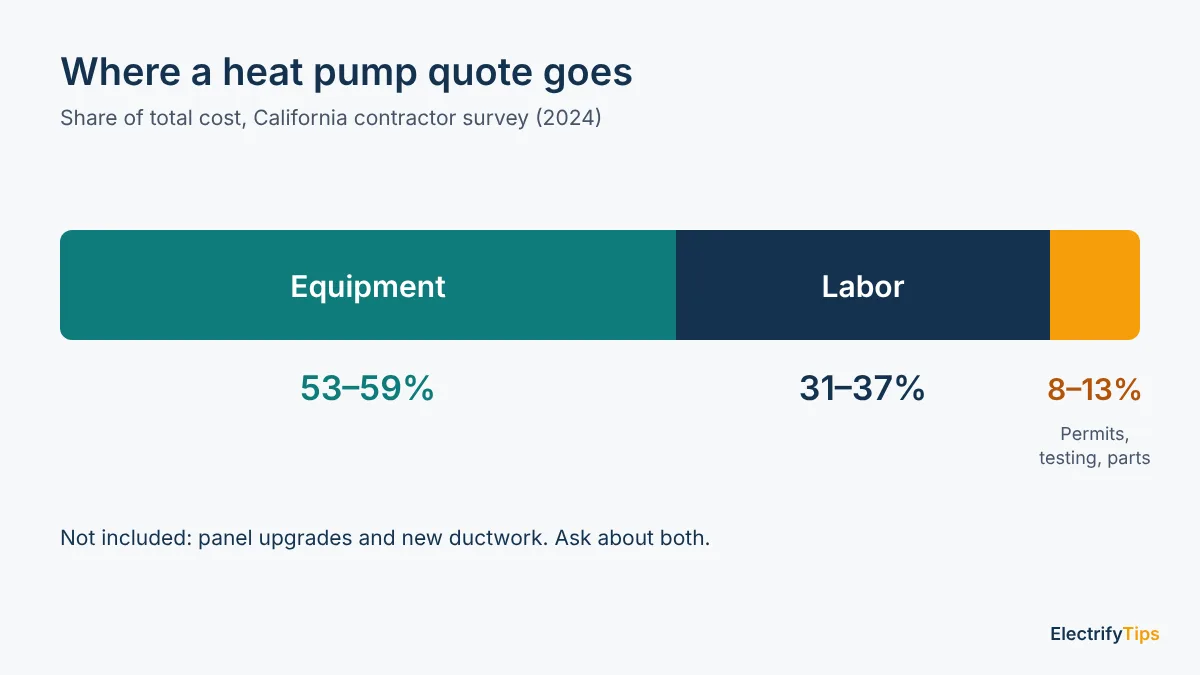
The survey found that code requirements drove most of the miscellaneous costs, such as permits, required testing and duct sealing. Those costs aren’t optional, so a quote that leaves them out isn’t really cheaper.
Six things that push the price up or down
1. Efficiency. This is the biggest swing in NREL’s data. A minimum-efficiency unit averaged about $9,000 in cold-climate homes. A high-efficiency cold-climate model averaged $24,000. The more expensive unit also cut bills more: NREL estimated bills went up in 39% of homes with minimum-efficiency units, against 5% with high-efficiency cold-climate units.
2. Size. Larger homes need more capacity, measured in tons. In the California survey, 3-ton installs averaged about $3,700 to $5,000 per ton. An oversized unit costs more and doesn’t help. Have the installer do a proper load calculation rather than matching your old unit’s size. Our Heat Pump Sizing Calculator gives you a starting estimate to check their number against.
3. Your ducts. Reusing sound ducts keeps the price down. Leaky ducts cost you twice: DOE says ducts that leak heated air into unheated spaces “can add hundreds of dollars a year” to heating and cooling bills. Ask whether sealing is included. DOE calls insulating ducts in unconditioned spaces “usually very cost-effective.”
4. Electrical work. Some homes need a new circuit, new wiring or a bigger electrical panel. These are easy to miss when comparing quotes. Ask each installer whether your panel has room, and get the answer in writing.
5. Permits and testing. Local code may require a permit and inspection. In California, contractors named these as the main source of extra costs.
6. Insulation and air sealing. These add cost up front, but they can shrink the heat pump you need. NREL estimated envelope upgrades at a mean of $9,000 per home, while cutting $2,500 to $4,000 off the cost of a medium- or high-efficiency heat pump.
Cost by system type
| System | What we know about cost | Source |
|---|---|---|
| Ducted air-source | $12,000 – $23,000 typical installed cost | NESCAUM 2024 |
| Ductless mini-split | No reliable national figure. Price rises with each indoor unit you add. See our mini-split cost guide for real program data | — |
| Geothermal (ground-source) | Can cost “several times” an air-source system of the same capacity. The extra cost may pay back in 5 to 10 years | DOE |
| Air-to-water | About $50,000 | NESCAUM 2024 |
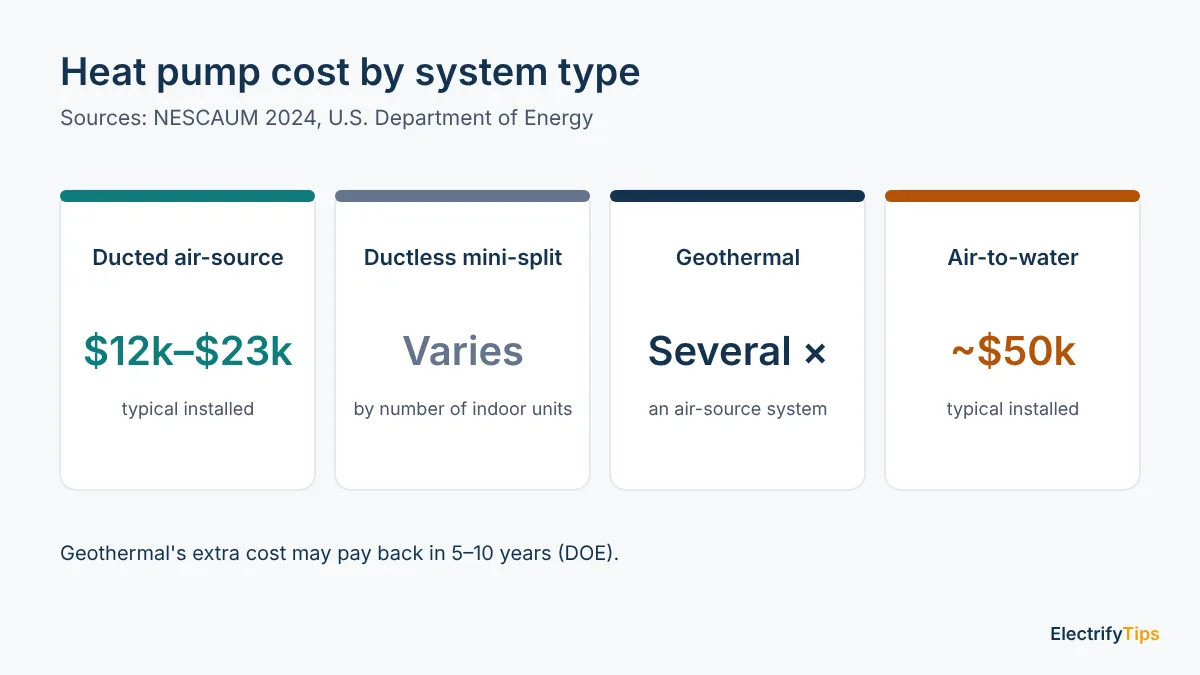
Geothermal’s higher price buys longevity. DOE estimates the indoor parts last up to 24 years and the ground loop 50+ years.
What rebates take off the price
The federal tax credit (25C) covers only heat pumps placed in service by the end of 2025. For a 2026 install, the help comes from rebates:
- HEEHR (formerly HEAR), a state-run federal rebate. It pays up to $8,000 toward a heat pump, plus up to $4,000 for a panel and $2,500 for wiring, with a $14,000 household cap (42 U.S.C. 18795a). You need a household income at or below 150% of area median, and your state’s program has to be open. Since May 29, 2026, it pays only for upgrades from existing electric equipment or in new construction, not for replacing gas, oil or propane.
- Utility rebates. Mass Save in Massachusetts, for example, pays $2,650 per ton for whole-home heat pumps, up to $8,500.
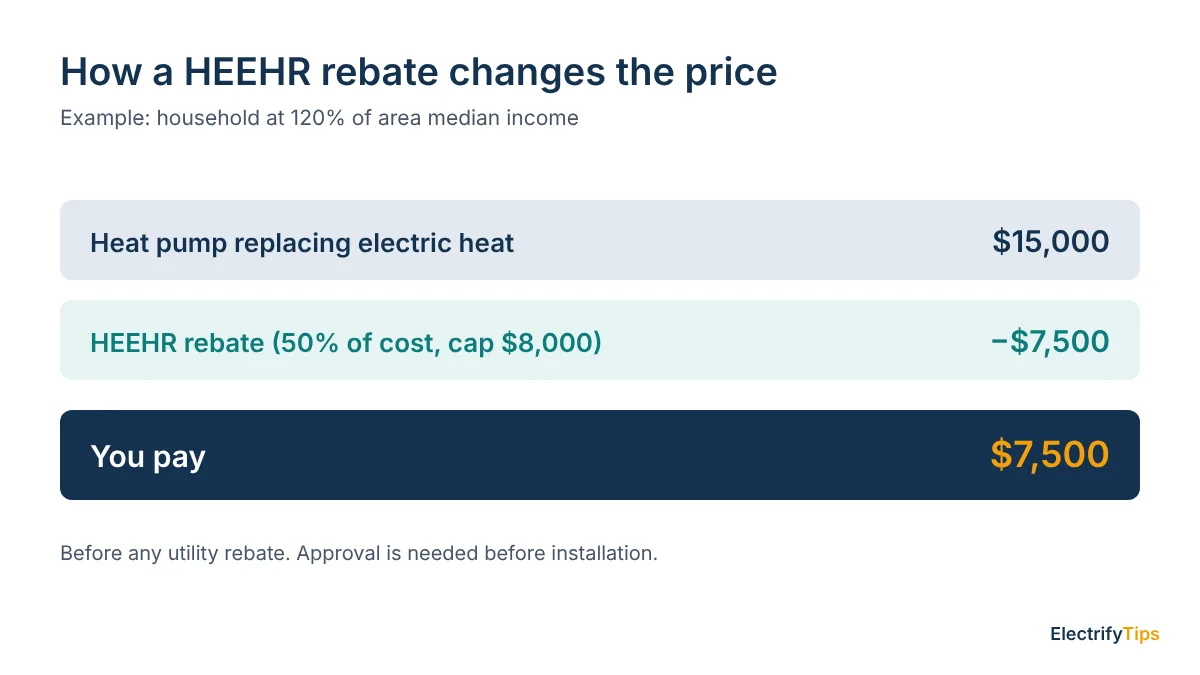
A worked example: a $15,000 ducted install replacing electric resistance heat, for a household at 120% of area median income. HEEHR covers 50% of the cost, which is $7,500. That’s under the $8,000 heat pump cap, so the household pays $7,500 before any utility rebate.
The catch: HEEHR needs approval before installation, it isn’t open in every state, and it no longer covers switching from gas, oil or propane. Our heat pump rebates guide covers who qualifies, state by state.
The cost after installation
The price tag is only half the math. A heat pump’s running cost depends on your electricity rate and the unit’s efficiency:
- Electricity prices vary a lot by state. The US average residential price was 18.31¢ per kWh in July 2026 (EIA).
- Heat pumps move heat instead of making it. Natural Resources Canada says air-source units typically deliver 2.0 to 5.4 times as much heat as the electricity they use at 46°F (8°C).
- Efficiency affects running costs as well as price. In NREL’s data, minimum-efficiency units raised bills in 39% of homes. High-efficiency cold-climate units raised them in only 5%.
Our Operating Cost Comparison tool compares heat pump and gas heating costs using your own rates.
How to keep the quote down without cutting corners
- Get three written quotes for the same job. Same capacity, same efficiency rating and the same scope. Otherwise you’re comparing different jobs.
- Ask for a load calculation. It sizes the unit to your house, so you don’t pay for capacity you don’t need.
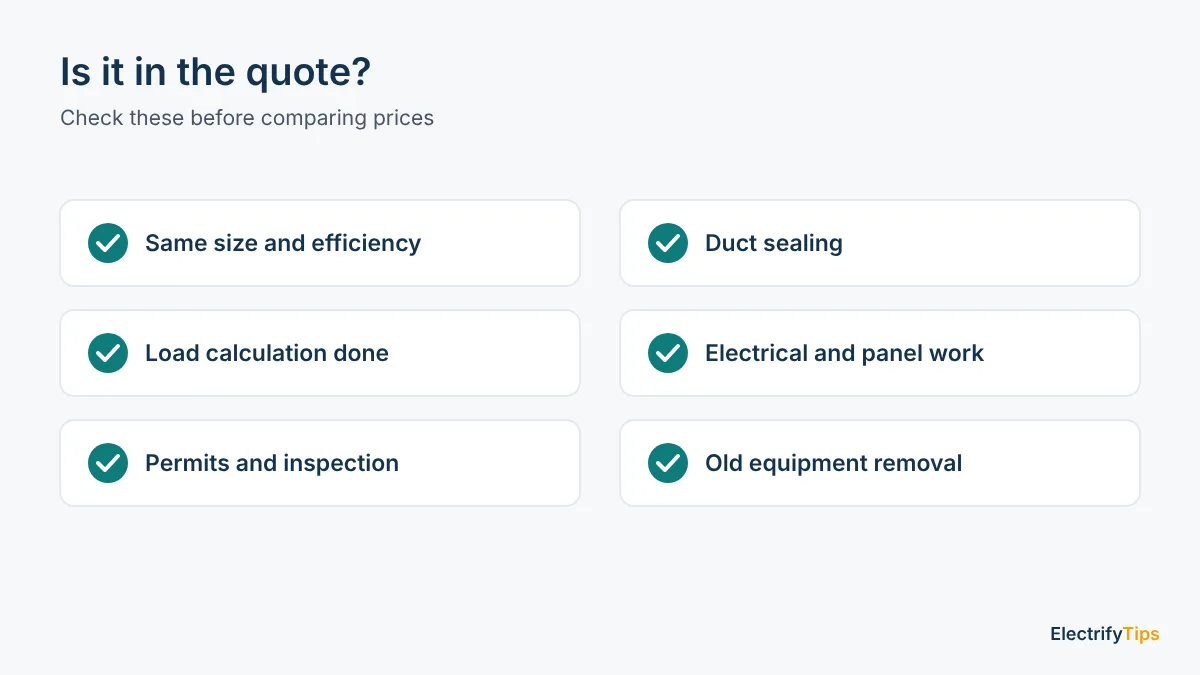
- Ask what’s included. Permits, testing, duct sealing, electrical work, thermostat and taking away the old equipment. Get it itemized.
- Check rebates before you sign. Ask whether the contractor is on your state’s approved list, and whether approval comes first.
- Fix the house first, if you can. Air sealing and insulation can let you buy a smaller heat pump (NREL).
- Run your quotes through our Heat Pump Cost Calculator to add up equipment, labor and extras for each one, with a contingency.
Frequently asked questions
Is a heat pump more expensive to install than a furnace and AC?
Usually, before rebates. NESCAUM’s 2024 study puts a ducted heat pump at $12,000–$23,000, against $10,000–$13,000 for a gas or oil system plus central AC. Utility rebates may narrow that gap. The federal HEEHR rebate no longer pays to replace a gas or oil system.
How much of a heat pump quote is labor?
In a 2024 survey of California contractors, labor made up about 31% to 37% of the total. Equipment was 53% to 59%, and permits, testing and parts made up the rest.
Will I need a new electrical panel?
Not always. It depends on how much spare capacity your panel has. Ask each installer to check and to say so in the quote. If you do need one, HEEHR can pay up to $4,000 toward it for eligible households and projects.
Why does geothermal cost so much more?
The ground loop has to be drilled or dug. DOE says a geothermal system can cost several times as much as an air-source system of the same capacity. The extra cost may pay back in 5 to 10 years, and the ground loop can last 50+ years.
Is a cheaper minimum-efficiency heat pump a mistake?
It depends on your climate and rates. In NREL’s national study, minimum-efficiency units raised energy bills in 39% of homes, compared with 5% for high-efficiency cold-climate units. In a cold area, the cheaper unit can cost more to run.
Keep reading
- What size heat pump do I need?
- Ducted vs ductless mini-split heat pumps
- Heat pump vs air conditioner: what’s the difference?
- Heat pumps: the complete homeowner’s guide
- Heat pump rebates and incentives: complete guide (2026)
- Heat pump vs furnace: which is cheaper to run?
- Heat Pump Cost Calculator
- Heat Pump Sizing Calculator
- Operating Cost Comparison
- How much does a mini-split cost to install?
- Heat pump water heater cost and savings
- How long do heat pumps last?
Sources & references
- https://nrel.gov/docs/fy24osti/84775.pdf
- https://www.nescaum.org/documents/Heat-Pumps-in-the-Northeast-and-Mid-Atlantic---Costs-and-Market-Trends.pdf
- https://techcleanca.com/documents/4258/TECH_Cost_Study_-_FINAL_Phase_I_Findings_2.12.24_2.pdf
- https://web.archive.org/web/20260529112817/https://www.energy.gov/energysaver/geothermal-heat-pumps
- https://web.archive.org/web/20260602160945/https://www.energy.gov/energysaver/air-source-heat-pumps
- https://web.archive.org/web/20260613031412/https://www.energy.gov/energysaver/minimizing-energy-losses-ducts
- https://www.irs.gov/credits-deductions/energy-efficient-home-improvement-credit
- https://www.govinfo.gov/link/uscode/42/18795a
- https://www.masssave.com/residential/rebates-and-incentives/heating-and-cooling/heat-pumps/air-source-heat-pumps
- https://www.eia.gov/electricity/monthly/epm_table_grapher.php?t=table_5_06_a
- https://natural-resources.canada.ca/energy-efficiency/energy-star/heating-cooling-heat-pump