Quick answer
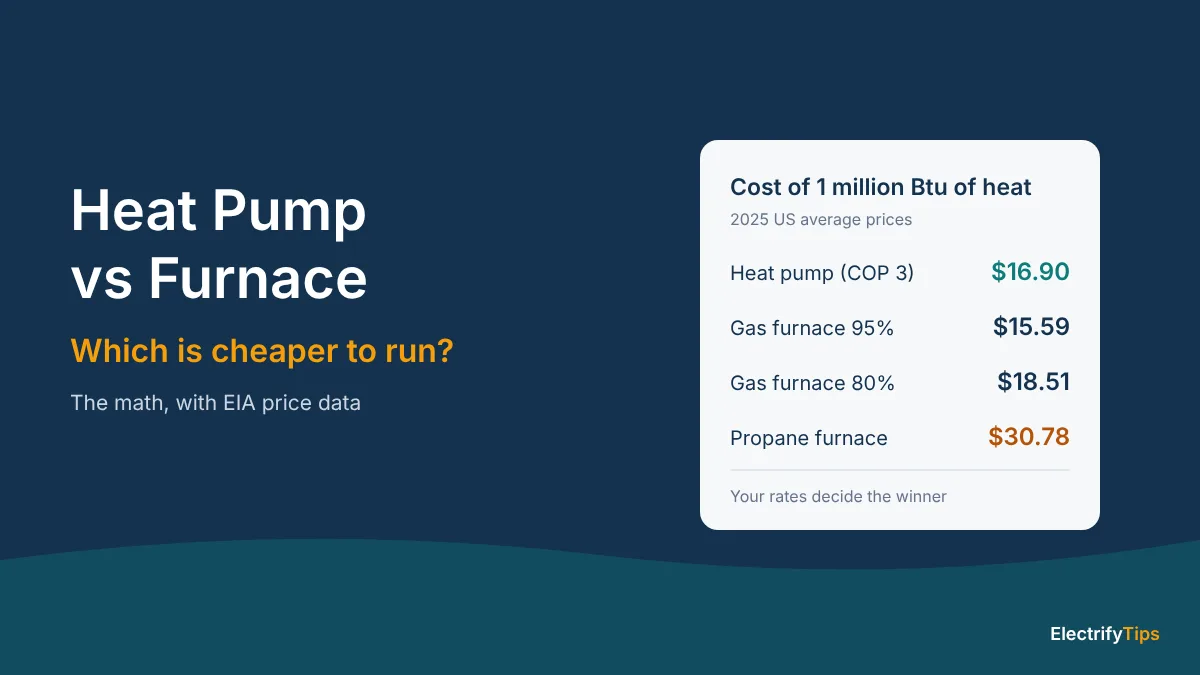
At 2025 US average prices, a heat pump at COP 3 costs about $16.90 per million Btu of heat, versus $15.59 for a 95% gas furnace and $18.51 for an 80% furnace. Propane and oil cost far more. Multiply your gas price per therm by 10.8: if your electricity costs less in cents per kWh, the heat pump is cheaper to run.
Whether a heat pump beats a gas furnace on running costs comes down to two numbers on your utility bills: what you pay for electricity and what you pay for gas. At 2025 US average prices, a good heat pump and a new high-efficiency gas furnace cost about the same to run. A heat pump wins clearly against an older furnace, or against propane and oil. This guide shows the math, gives you a quick rule to test your own rates, and covers what happens on the coldest days.
The short answer
- Against a new 95% gas furnace, it’s close. At 2025 US average prices, gas heat costs about $15.59 per million Btu. A heat pump working at a COP of 3 costs about $16.90.
- Against an older 80% furnace, the heat pump wins ($18.51 for the gas furnace vs $16.90).
- Against propane or oil, the heat pump wins by a lot. Propane costs about $31 and oil about $50 per million Btu.
- Cold days change the math. At 5°F, a cold-climate heat pump may work at a COP of 1.75, which costs about $29 per million Btu. That’s why some homes keep a gas furnace as backup.
- Your own rates decide it. Multiply your gas price per therm by 10.8. If your electricity costs less than that number in cents per kWh, a heat pump running at a COP of 3 is cheaper than a 95% furnace.
How each one makes heat
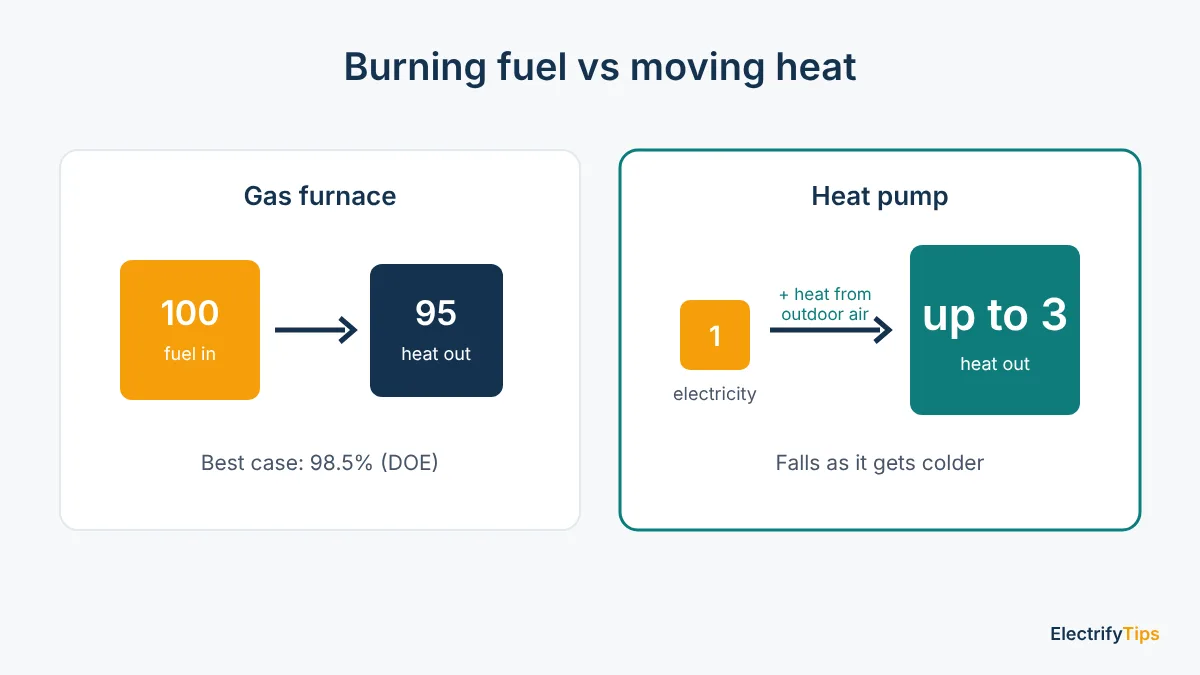
A gas furnace burns fuel. Its efficiency is called AFUE: the share of the fuel’s energy that ends up as heat in your home. DOE puts old furnaces at 56–70% AFUE, mid-efficiency models at 80–83%, and high-efficiency condensing furnaces at 90–98.5%. Even the best furnace can’t deliver more heat than the fuel contains.
A heat pump moves heat instead of making it. It pulls heat from outdoor air and brings it inside. Its efficiency is called COP: units of heat delivered for each unit of electricity used. Natural Resources Canada says air-source heat pumps typically reach a COP of 2.0 to 5.4 at 46°F (8°C). A COP above 1 is something no furnace or electric baseboard can do.
The catch: as it gets colder outside, there’s less heat to pull in, so COP falls. ENERGY STAR’s cold-climate label requires a COP of at least 1.75 at 5°F.
The running cost math
To compare fairly, work out what each system costs to deliver the same amount of heat: 1 million Btu. The prices below are EIA’s 2025 US residential averages for electricity and gas. Propane and oil are EIA’s March 30, 2026 prices.
| System | Efficiency used | Cost per million Btu of heat |
|---|---|---|
| Heat pump, mild weather | COP 3 | $16.90 |
| Heat pump, colder weather | COP 2 | $25.35 |
| Heat pump at 5°F (ENERGY STAR cold-climate minimum) | COP 1.75 | $28.97 |
| High-efficiency gas furnace | 95% AFUE | $15.59 |
| Standard gas furnace | 80% AFUE | $18.51 |
| Old gas furnace | 60% AFUE | $24.68 |
| Propane furnace | 95% AFUE | $30.78 |
| Oil furnace | 80% AFUE | $49.95 |
| Electric baseboard or electric furnace | COP 1 | $50.70 |
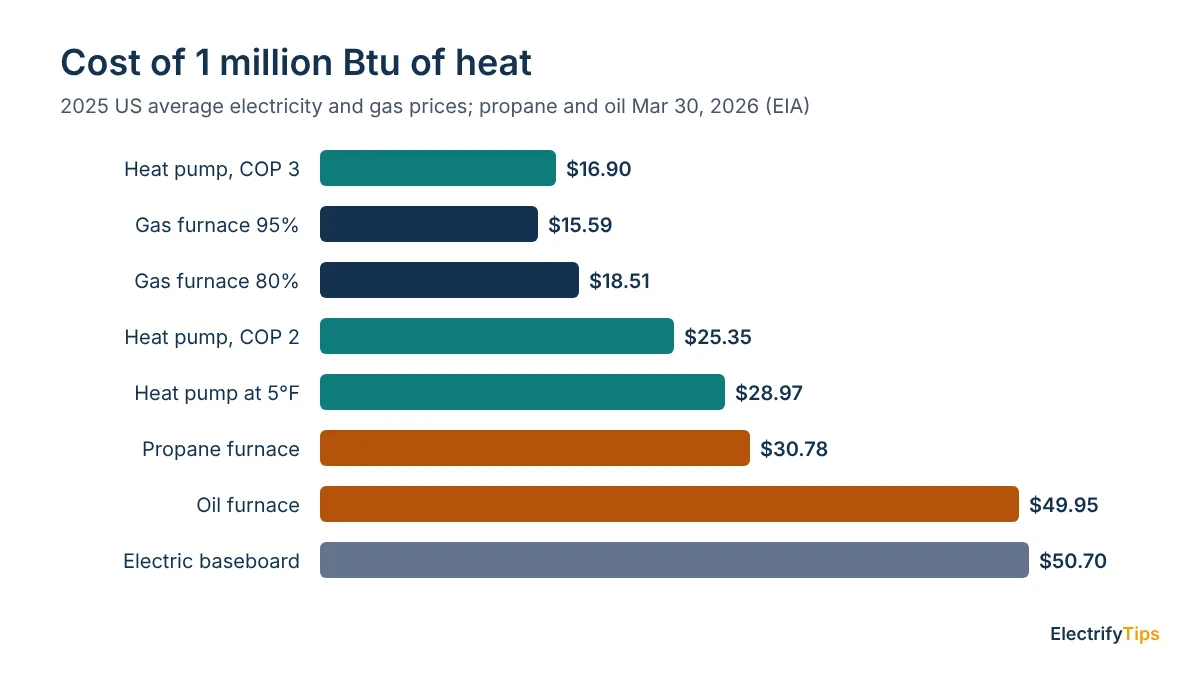
Prices used: electricity 17.30¢/kWh, natural gas $15.34 per thousand cubic feet (about $1.48 per therm), propane $2.674/gallon, heating oil $5.535/gallon. The COP and AFUE levels are illustrations, not test results for any particular model.
The table shows why this question has no one-word answer. In mild weather, a heat pump and a new gas furnace are neck and neck. On the coldest nights, gas is cheaper. Over a whole winter, the result depends on your climate and your rates.
Test your own rates: the break-even rule
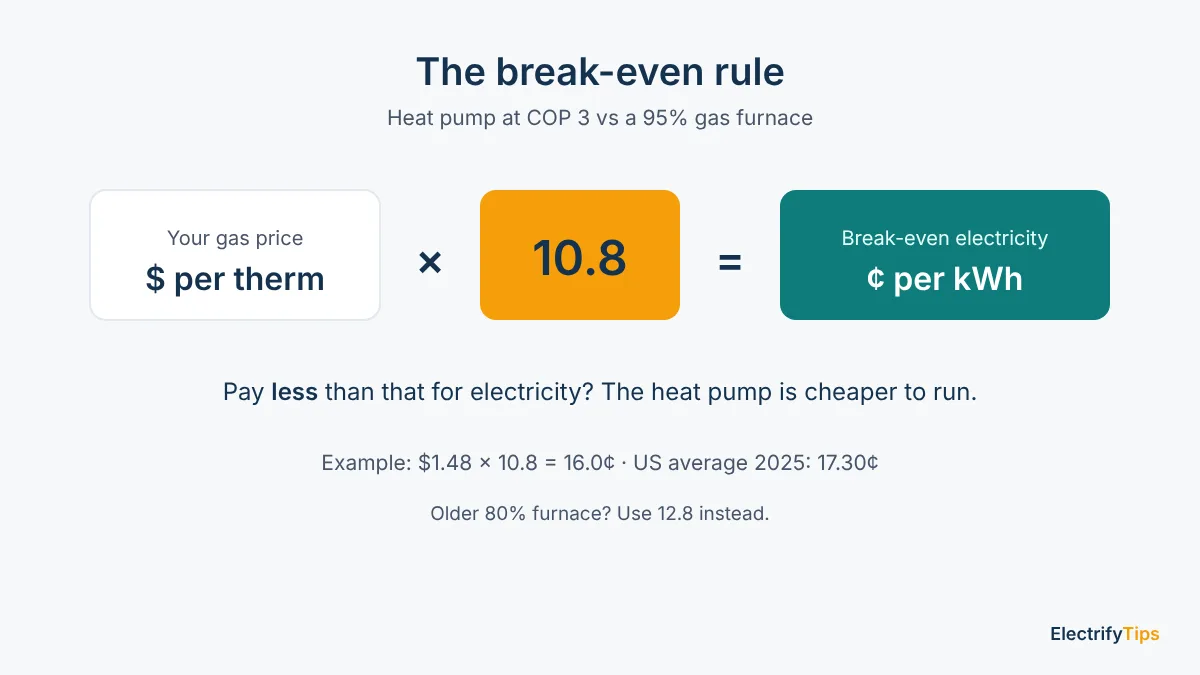
You don’t need a spreadsheet. Find two numbers on your bills: your gas price per therm (total bill ÷ therms used) and your electricity price per kWh (total bill ÷ kWh used). Then:
- Multiply your gas price per therm by 10.8. If your electricity price in cents per kWh is lower than the result, a heat pump at COP 3 heats more cheaply than a 95% gas furnace.
- Comparing against an older 80% furnace? Multiply by 12.8 instead.
- In a cold climate, where the season-long COP may be closer to 2, multiply by 7.2 (vs a 95% furnace) or 8.5 (vs an 80% furnace).
Example at 2025 US averages: $1.48 per therm × 10.8 = 16.0¢. The US average electricity price was 17.30¢, just above that. So at COP 3, a new high-efficiency gas furnace edges out the heat pump nationally. Against an 80% furnace, the break-even is $1.48 × 12.8 = 18.9¢, so the heat pump comes out ahead.
Where the multipliers come from: 1 kWh = 3,412 Btu and 1 therm = 100,000 Btu (EIA). So the multiplier is COP × 3.412 ÷ furnace efficiency. For COP 3 and 95%, that’s 3 × 3.412 ÷ 0.95 = 10.8.
The answer changes by state
Rates vary so much that the same heat pump can be the cheaper option in one state and the pricier one in the next. Here’s the rule applied to EIA’s latest state averages: electricity for January–July 2026, and natural gas for 2025.
| State | Gas per therm | Break-even electricity (vs 95% furnace, COP 3) | Actual electricity price | Cheaper to run |
|---|---|---|---|---|
| Georgia | $1.97 | 21.2¢ | 15.40¢ | Heat pump |
| Texas | $1.87 | 20.2¢ | 16.06¢ | Heat pump |
| Washington | $1.70 | 18.3¢ | 14.40¢ | Heat pump |
| Ohio | $1.34 | 14.4¢ | 18.70¢ | Gas furnace |
| Minnesota | $1.06 | 11.4¢ | 16.25¢ | Gas furnace |
| New York | $1.70 | 18.3¢ | 29.38¢ | Gas furnace |
| Massachusetts | $2.42 | 26.1¢ | 30.14¢ | Gas furnace (heat pump wins vs an 80% furnace) |
Two cautions. These are statewide averages, and your utility’s rates may be quite different. Also, COP 3 is generous for a Minnesota winter, so the real gap there is likely wider. Our Electricity Rate Checker shows recent rates for your state.
What else changes the answer
- Your climate. Milder winters keep the heat pump working at higher efficiency more of the time.
- The heat pump’s efficiency. A cold-climate model keeps more of its efficiency in deep cold. ENERGY STAR’s cold-climate label requires at least 70% of rated capacity at 5°F.
- The furnace you’re replacing. Replacing a 60% furnace is a very different decision from replacing a 95% one.
- Your rate plan. Check which rate plan you’re on, and ask your utility whether it offers others for electric heating.
- Cooling. A heat pump is also your air conditioner. If you’d be replacing the AC anyway, the comparison is heat pump vs furnace plus AC.
Upfront cost: heat pump vs furnace and AC
Running cost is only half the decision. A heat pump replaces two systems, the furnace and the central AC. So compare it against both:
| Option | Typical installed cost (US average) |
|---|---|
| Ducted air-source heat pump | $12,000 – $23,000 |
| Gas or oil system plus central AC | $10,000 – $13,000 |
Source: NESCAUM cost study, October 2024.
Before incentives, the heat pump usually costs more to install. Federal help for switching from gas has shrunk. Since DOE’s May 2026 changes, the HEEHR rebate (formerly HEAR) no longer pays to replace gas, oil or propane equipment, and the federal 25C tax credit doesn’t cover heat pumps installed in 2026. Check your electric utility, since some offer their own heat pump rebate. Our installation cost article breaks the price down in detail.
Cold weather: will a heat pump keep up?
Modern cold-climate models are built for it. DOE says cold-climate heat pumps are designed to work in temperatures as low as 5°F. To carry the ENERGY STAR cold-climate label, a heat pump must keep at least 70% of its rated heating capacity at 5°F, at a COP of at least 1.75.
What matters for your bill is that the heat pump is less efficient on the coldest days. At COP 1.75 it’s still about 1.75 times as efficient as electric baseboard heat, but at 2025 average prices it costs more per Btu than gas.
Dual fuel: keeping the furnace as backup
You don’t have to choose one or the other. DOE describes dual-fuel (hybrid) systems that “combine the efficiency of a heat pump with the reliability of a gas furnace.” The heat pump handles most of the heating in milder weather, and the furnace takes over in colder temperatures.
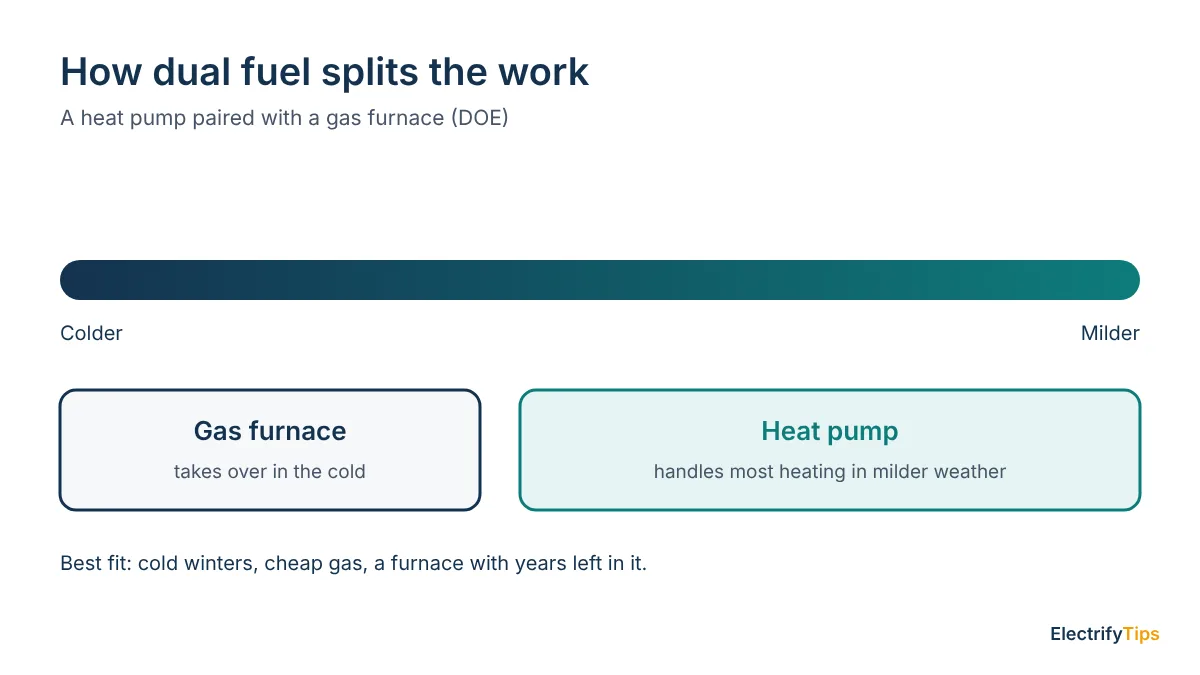
Dual fuel makes most sense when:
- you already have a working gas furnace with years left in it,
- your winters are cold, and
- your gas is cheap compared with your electricity (the break-even rule above tells you).
The trade-off: you keep paying the fixed monthly charge for gas service, and you have two systems to maintain.
How to decide: a quick checklist
- Run the break-even rule with your own gas and electric rates.
- Check your furnace’s age and AFUE. An old, low-efficiency furnace tips the math toward the heat pump.
- Check whether your AC also needs replacing. If it does, the heat pump replaces both.
- Check rebates before you sign. Utility rebates can change the upfront math, and most need approval first. See our rebates guide.
- In a cold climate, ask installers about cold-climate models or a dual-fuel setup.
- Put your numbers into our Operating Cost Comparison tool. It uses the same formula as this article.
Frequently asked questions
Is a heat pump cheaper to run than a gas furnace?
It depends on your rates. At 2025 US average prices, a heat pump working at COP 3 costs about $16.90 per million Btu of heat. A 95% gas furnace costs $15.59, and an 80% furnace $18.51. Multiply your gas price per therm by 10.8. If your electricity price in cents per kWh is lower, the heat pump is cheaper than a 95% furnace.
Is a heat pump cheaper than propane or oil heat?
In most cases, yes. At EIA’s March 30, 2026 prices, propane heat costs about $31 per million Btu and oil about $50. A heat pump costs about $17 at COP 3, or $25 even at COP 2.
What is COP?
Coefficient of performance: how many units of heat a heat pump delivers for each unit of electricity it uses. DOE says air-source heat pumps can reach up to 3. The number falls as outdoor temperatures drop.
What is a dual-fuel heat pump?
A heat pump paired with a gas furnace. The heat pump heats the home in milder weather, and the furnace takes over when it gets colder. DOE describes it as combining the efficiency of a heat pump with the reliability of a gas furnace.
Should I replace a working gas furnace with a heat pump?
Often the easier time to switch is when your AC needs replacing, because a heat pump does both jobs. If the furnace is old and inefficient (DOE puts older units at 56–70% AFUE), the running-cost math leans further toward the heat pump.
Keep reading
- Do heat pumps work in cold climates?
- Heat pump vs air conditioner: what’s the difference?
- Heat pumps: the complete homeowner’s guide
- How much does a heat pump cost to install?
- Heat pump rebates and incentives: complete guide (2026)
- Operating Cost Comparison
- Electricity Rate Checker
- Heat pump vs electric baseboard heat
- Heat pump vs propane furnace
- Dual fuel heat pump systems
Sources & references
- https://www.eia.gov/electricity/monthly/epm_table_grapher.php?t=table_5_03
- https://www.eia.gov/electricity/monthly/epm_table_grapher.php?t=table_5_06_b
- https://www.eia.gov/dnav/ng/ng_pri_sum_a_EPG0_PRS_DMcf_a.htm
- https://www.eia.gov/petroleum/heatingoilpropane/
- https://www.eia.gov/energyexplained/units-and-calculators/british-thermal-units.php
- https://web.archive.org/web/20260531015158/https://www.energy.gov/energysaver/furnaces-and-boilers
- https://web.archive.org/web/20260531150702/https://www.energy.gov/energysaver/heat-pump-systems
- https://web.archive.org/web/20260602160945/https://www.energy.gov/energysaver/air-source-heat-pumps
- https://www.energystar.gov/sites/default/files/2025-04/ENERGY STAR Version 6.2 Heat Pump Specification Rev. March 2025.pdf
- https://www.nescaum.org/documents/Heat-Pumps-in-the-Northeast-and-Mid-Atlantic---Costs-and-Market-Trends.pdf
- https://www.irs.gov/credits-deductions/energy-efficient-home-improvement-credit
- https://www.govinfo.gov/link/uscode/42/18795a
- https://natural-resources.canada.ca/energy-efficiency/energy-star/heating-cooling-heat-pump