Quick answer
A heat pump uses electricity to move heat instead of making it: from outdoors into your home in winter, and from your home to outdoors in summer. The U.S. Department of Energy says a properly installed air-source heat pump can deliver up to three times more heat energy than the electricity it uses.
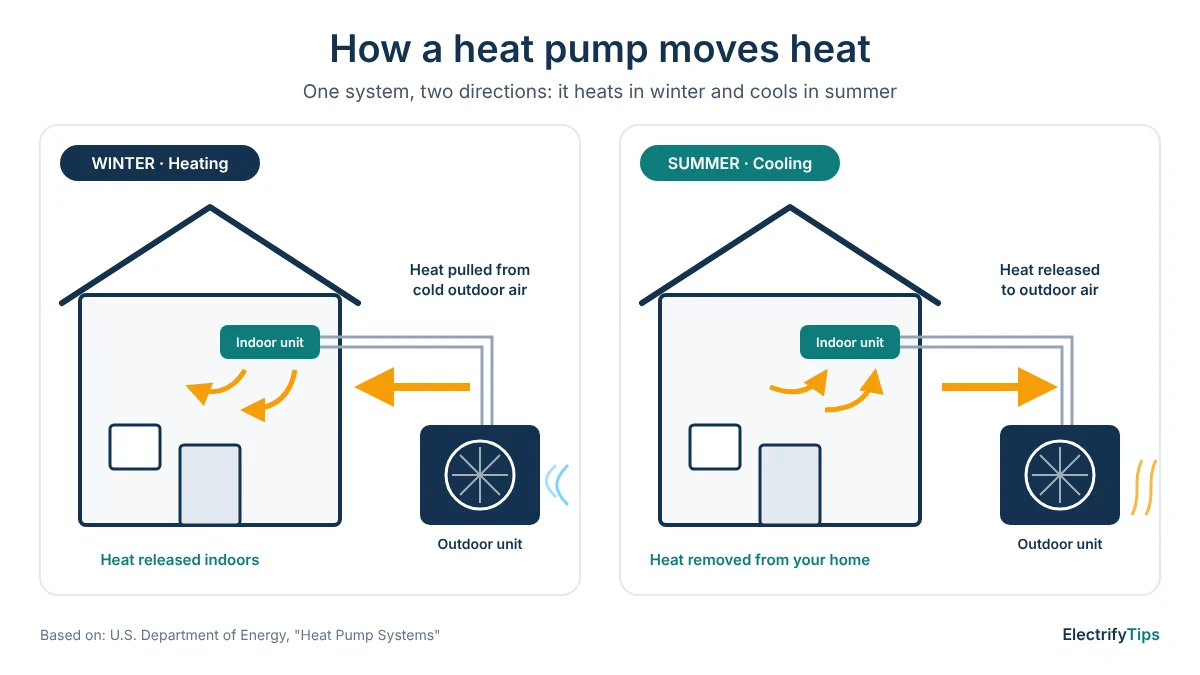
A heat pump heats your home by moving heat, not by burning fuel. In winter it pulls heat from outdoor air (or the ground) and brings it inside. In summer it runs the other way and works as an air conditioner (see heat pump vs air conditioner). One system, two jobs.
This guide covers how they work, which type suits which home, how to read efficiency ratings, what happens in cold weather, what drives cost, and where incentives stand in 2026. Every fact links to the agency or program it came from.
How a heat pump works
The U.S. Department of Energy (DOE) puts it simply: heat pumps use electricity to transfer heat from a cool space to a warm space. During the cooling season they move heat from your house to the outdoors; during the heating season they move heat from the cool outdoors into your house.
Even cold air holds heat. A refrigerant loop absorbs it outside, a compressor concentrates it, and an indoor coil releases it into your home. A reversing valve flips the direction for cooling.
Because it moves heat rather than creating it, a heat pump can put out more heat than the electricity it uses. Natural Resources Canada says air-source heat pumps typically reach a COP of 2.0 to 5.4 at 46°F (8°C), meaning 2 to 5 units of heat for each unit of electricity. Compared with electric resistance heating such as baseboard heaters, DOE says today’s heat pumps can cut electricity use for heating by up to 75%.
The main types of heat pumps
| Type | How it works | Best fit |
|---|---|---|
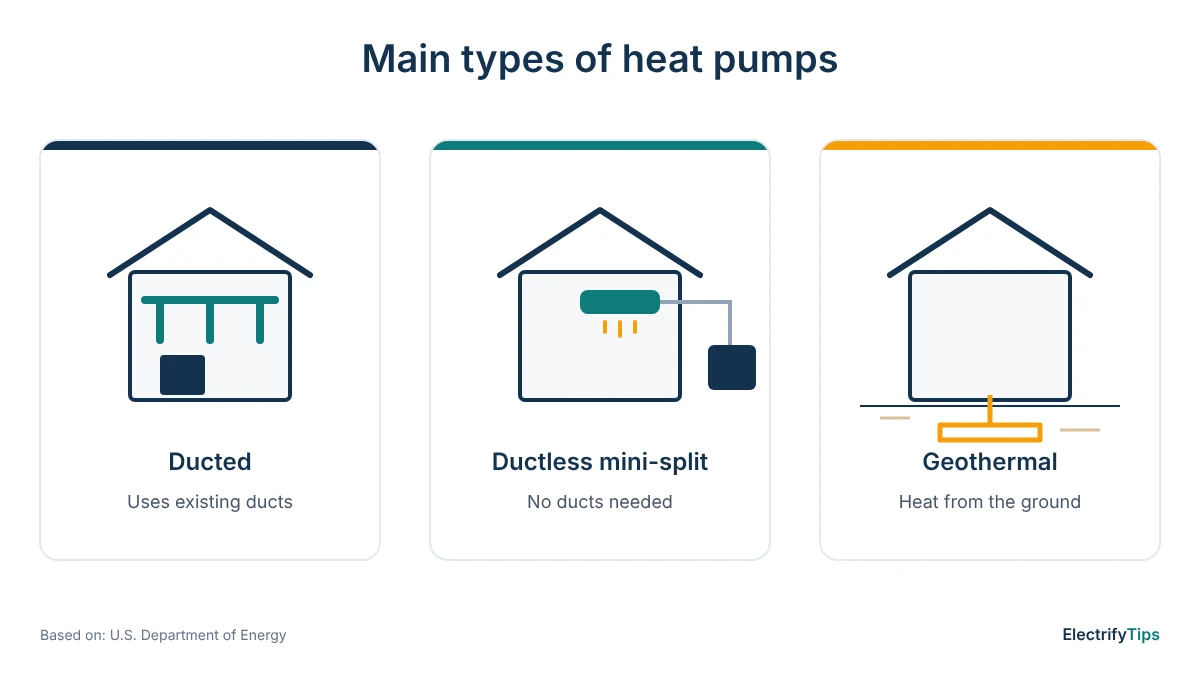
| Ducted air-source | Outdoor unit plus an indoor air handler that uses your existing ducts | Homes with ducts in good condition, often replacing a furnace and central AC |
| Ductless mini-split | Outdoor unit connected by refrigerant lines to one or more wall or ceiling units | Homes without ducts, additions, or rooms that are always too hot or cold |
| Ground-source (geothermal) | Buried pipe loop uses the ground’s steady temperature | New builds or big renovations with land for the loop, where higher upfront cost is acceptable |
| Heat pump water heater | Same principle, used to heat a hot water tank | Replacing an electric or gas tank water heater |
Ductless mini-splits. DOE describes them as good retrofit add-ons, with flexibility to heat and cool individual rooms. DOE says installing one generally needs only a three-inch hole through the wall for the lines between the outdoor unit and the indoor heads.
Geothermal. The shallow ground stays between about 40°F and 70°F year-round, which is why these systems run so steadily. DOE estimates the indoor components last up to 24 years and the ground loop 50+ years, and says the extra installation cost may be returned in energy savings in 5 to 10 years, depending on energy prices and incentives.
Heat pump water heaters. DOE says they can be two to three times more energy efficient than conventional electric resistance water heaters. They need a spot that stays between 40°F and 90°F year-round with at least 1,000 cubic feet of air around them, and they cool the space they sit in, so a garage in a cold climate is often a poor choice.
Not sure which type suits your house? Compare them in ducted vs ductless heat pumps.
Efficiency ratings: SEER2 and HSPF2
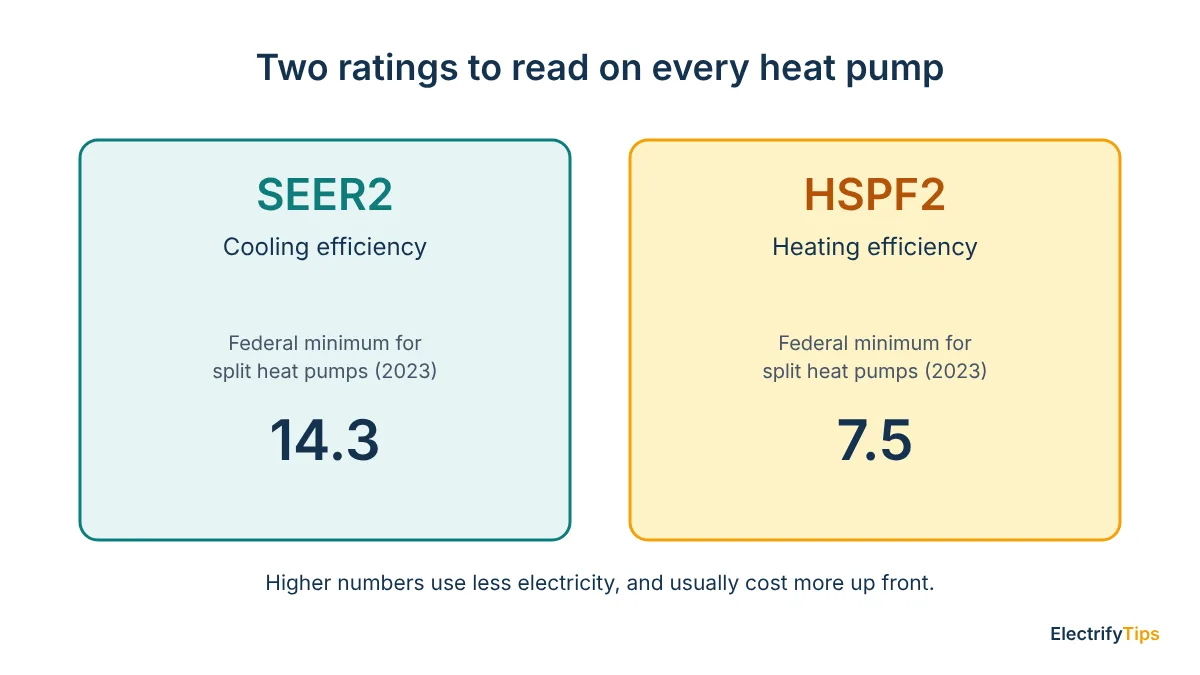
Every quote should list two ratings. Higher is better for both.
- HSPF2 (heating seasonal performance factor) measures heating efficiency over a typical heating season.
- SEER2 (seasonal energy efficiency ratio) measures cooling efficiency over a typical cooling season.
The “2” matters. On January 1, 2023, DOE switched to new test procedures and new metrics (SEER2, EER2 and HSPF2) that better reflect real-world conditions. The numbers are not directly comparable with the older SEER and HSPF ratings, so if one quote shows SEER and another shows SEER2, ask the installer for both systems’ ratings on the same scale.
For split-system heat pumps made on or after January 1, 2023, the federal minimums are SEER2 14.3 and HSPF2 7.5. Equipment made since then must meet those minimums; for the same home, a higher rating means less electricity for the same heating or cooling. DOE also recommends looking for the ENERGY STAR label.
Full explanation: what each rating measures, the ENERGY STAR levels and how to read the ratings on a quote, in SEER2, HSPF2 and COP explained.
Heat pumps in winter
Modern models handle cold well. DOE says cold-climate heat pumps are designed to work in temperatures as low as 5°F, and that air-source technology is now a legitimate heating option in colder regions. Three things to know before your first winter:
- Defrost cycles are normal. In cold, damp weather, frost builds up on the outdoor coil, and the system briefly reverses to clear it. DOE recommends demand-defrost control, which defrosts only when needed.
- Plan for some backup heat. Many systems have electric backup or keep a furnace for the coldest days (dual fuel). DOE says a heat pump can use up to 75% less electricity than electric resistance heat, so the less the electric backup runs, the better.
- Buy a cold-climate model if your winters regularly drop below freezing.
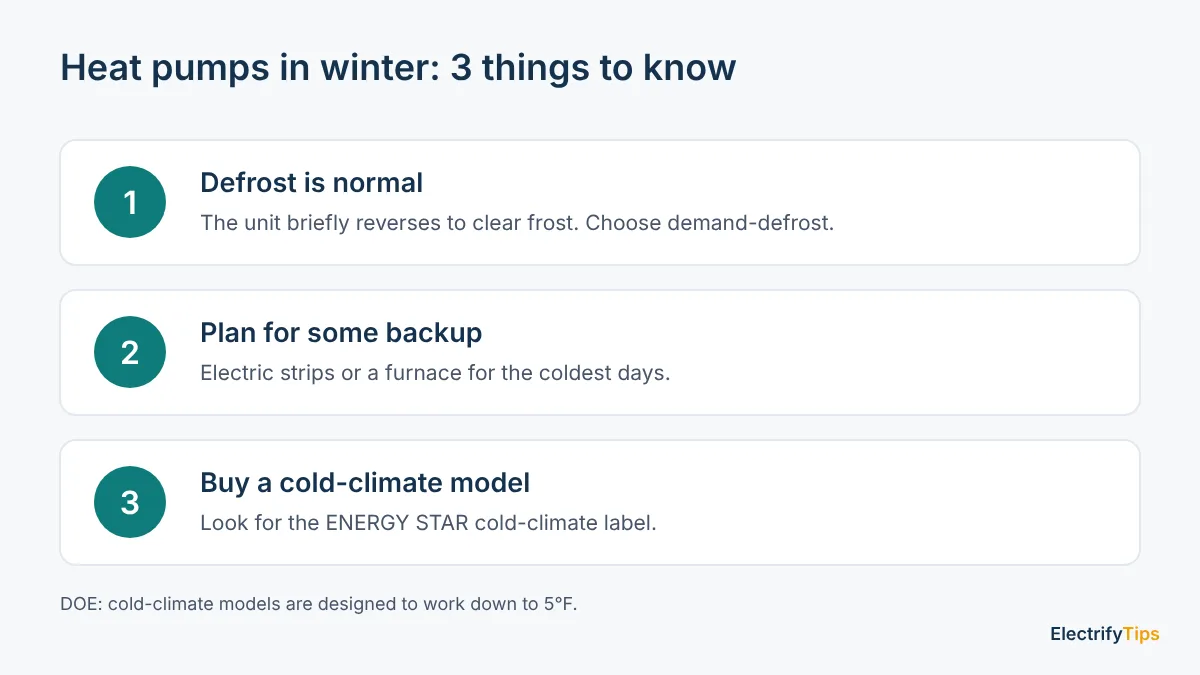
Full answer, with DOE’s 2022–2024 field-test results: Do heat pumps work in cold climates?
Running nonstop in cold weather? That’s often normal. See why a heat pump runs constantly in winter and the checks to do before calling a technician.
What will it cost to run?
There’s no national answer, because it depends on your electricity and gas prices, your climate and the efficiency of the system. Residential electricity averaged 18.31¢ per kWh across the U.S. in July 2026, but it ranged from 12.72¢ in Louisiana to 48.00¢ in Hawaii (EIA). Look up your state in our Electricity Rate Checker.
A worked example using our Operating Cost Comparison, with example inputs rather than averages:
| Input | Example A | Example B |
|---|---|---|
| Heat needed per year | 50 million BTU | 50 million BTU |
| Electricity | $0.18 per kWh | $0.15 per kWh |
| Gas | $1.50 per therm | $1.80 per therm |
| Heat pump (seasonal COP 3) | about $879 per year | about $733 per year |
| Gas furnace (90% efficient) | about $833 per year | about $1,000 per year |
| Cheaper option | Gas, by about $46 | Heat pump, by about $267 |
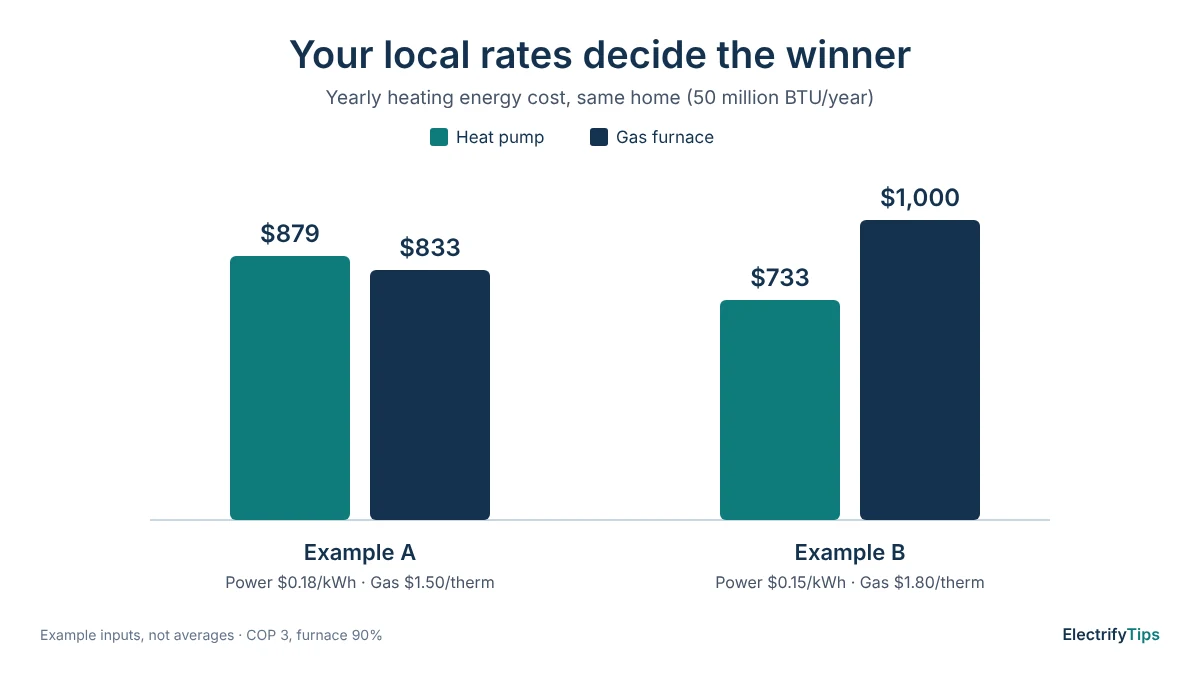
Same house, same heat demand, different winner. That’s why you should run your own utility rates rather than trust a headline saving. The comparison leaves out cooling (a heat pump also replaces your AC), fixed monthly charges, backup heat and equipment costs.
Against electric baseboard, oil or propane, the case is usually much stronger. DOE’s up-to-75% figure applies to electric resistance heat, and its cold-climate handout describes heat pumps heating and cooling at a fraction of the cost of oil or propane.
Want to test your own rates? Our heat pump vs furnace guide has a one-line break-even rule and state-by-state results.
What drives installation cost
We don’t quote a single national price, because installed cost depends on the home far more than the box. These are the line items that move the total:
- System type and size: ducted, ductless (and how many indoor units), or geothermal with a ground loop.
- Ducts: reusing good ducts is cheapest; repairs, sealing or new ductwork add cost. DOE notes ducted systems need roughly 400 to 500 cubic feet per minute of airflow per ton of cooling capacity, so undersized ducts may need work.
- Electrical work: a new circuit, or more if your panel is full.
- Removal of old equipment, permits and labor rates where you live.
Put your actual quotes into the Heat Pump Cost Calculator to compare them side by side with a contingency for surprises.
For price ranges from a national lab and state program data, see how much a heat pump costs to install.
Getting the size right
Sizing by square footage alone is a guess. The ANSI-recognized standard for sizing residential heating and cooling equipment is ACCA Manual J, a room-by-room load calculation that accounts for insulation, windows, air leaks and climate.
Use our Heat Pump Sizing Calculator for a rough starting number (1 ton = 12,000 BTU per hour), then ask each installer to show their load calculation. If two quotes differ by a full ton or more, ask why.
Full guide: what size heat pump do I need? covers tons, Manual J and how to check an installer’s number.
Incentives in 2026: what changed
The federal tax credits are gone. The IRS lists the Energy Efficient Home Improvement Credit (25C), which offered up to $2,000 a year for qualifying heat pumps, as unavailable for property placed in service after December 31, 2025. The Residential Clean Energy Credit (25D), which covered geothermal heat pumps, ended on the same date.
State and utility programs are where the money is now. DOE’s Home Energy Rebates are run by states: HOMES offers up to $8,000 for whole-home upgrades, and the High-Efficiency Electric Home Rebate up to $14,000 for efficient appliances. They are available in select states only. Some utilities and state agencies run their own heat pump rebates too, such as Mass Save in Massachusetts and Efficiency Maine.
Check your state in our Rebate Finder, and read the rules before you sign anything. Some programs only pay for projects approved before work starts; California’s HEEHRA program, for example, requires an approved reservation first.
Full breakdown of HEEHR (formerly HEAR), HOMES and state status: heat pump rebates and incentives guide.
Is a heat pump right for your home?
Strong fit if you:
- heat with electric baseboard, oil or propane
- need to replace your central AC anyway
- have rooms that are never comfortable (a ductless head can fix one room)
- live where electricity is cheap relative to gas, or qualify for a local rebate
Think harder if you:
- have cheap natural gas and expensive electricity (run the numbers first)
- live somewhere very cold and the quote isn’t for a cold-climate model
- have leaky ducts or poor insulation (a load calculation counts air leaks and insulation, so sealing and insulating first can reduce the size you need)
Questions to ask every installer
- Did you do a room-by-room load calculation (Manual J)? Can I see it?
- What are the SEER2 and HSPF2 ratings, and is the model ENERGY STAR certified?
- Is this a cold-climate model, and how does it perform at our winter design temperature?
- What backup heat is included, and when will it turn on?
- Does the model have demand-defrost control?
- Where will the outdoor unit go? (DOE advises keeping it away from windows and neighboring buildings and choosing a lower outdoor sound rating.)
- Will you leak-check the refrigerant at installation?
- What do the equipment and labor warranties cover, and for how long?
- Which rebates is this system eligible for, and who files the paperwork?
Frequently asked questions
Do heat pumps work below freezing?
Yes. Cold-climate models are designed to perform in temperatures as low as 5°F, according to DOE. In very cold areas, many homes keep a backup heat source for the coldest days.
Why is my heat pump blowing cool air in winter?
Short periods of cooler air can happen while the unit defrosts its outdoor coil. If it lasts, check the thermostat mode and call a technician.
Can a heat pump replace my air conditioner?
Yes. A heat pump cools exactly like an AC in summer, so one system covers both.
Is there still a federal tax credit for heat pumps?
No. The 25C credit is not available for heat pumps placed in service after December 31, 2025. State and utility rebates may still apply; see our rebates guide.
How long do heat pumps last?
For geothermal systems, DOE estimates up to 24 years for the indoor components and 50+ years for the ground loop. Natural Resources Canada gives air-source heat pumps a service life of 15 to 20 years. Full breakdown: how long heat pumps last.
Do I need ducts?
No. Ductless mini-splits need only small wall openings for refrigerant lines and can heat and cool individual rooms.
Should I keep my heat pump at one temperature?
Follow the setting your installer and the manufacturer recommend for your model and climate. If you lower the temperature at night or while away, ask your installer whether recovering from that setback will switch on electric resistance backup heat, the type of heating the Department of Energy says heat pumps can use up to 75% less electricity than.
Are heat pumps noisy?
The outdoor unit has a fan and compressor, so it makes some noise. The U.S. Department of Energy recommends placing the outdoor unit away from windows and neighboring buildings and choosing a model with a lower outdoor sound rating in decibels. Ask installers to show you that rating on the spec sheet.
Single-stage, two-stage or variable-speed: which do I need?
A single-stage compressor runs at one speed; two-stage and variable-speed models can run slower when full power isn’t needed. The Department of Energy lists variable-speed blowers and inverter-driven compressors among the advances that make today’s heat pumps more efficient. Compare the SEER2 and HSPF2 ratings of each option in your quotes rather than the label alone.
Will I need a bigger electrical panel?
Not always. It depends on how much spare capacity your current panel has, so ask a licensed electrician to check before you buy. If an upgrade is needed, the federal HEEHR rebate (formerly HEAR), run by states, allows up to $4,000 for an electrical panel where your state’s program is open. Since May 2026 it no longer covers switching from gas, oil or propane, so check what your state allows.
Can I keep my gas furnace as backup?
Yes. This is called a dual-fuel system: the Department of Energy describes systems where the heat pump handles most heating and the gas furnace takes over when temperatures drop. Ask your installer how the switch-over point is set.
Is a heat pump worth it if I have cheap natural gas?
It can go either way. In our worked example, the same home costs about $879 a year to heat with a heat pump and $833 with gas at $0.18/kWh and $1.50/therm, but the heat pump wins at $0.15/kWh and $1.80/therm. Run your own rates in our Operating Cost Comparison, and remember a heat pump also replaces your air conditioner.
Keep reading
- Do heat pumps work in cold climates?
- Heat pump vs air conditioner: what’s the difference?
- Heat pump rebates and incentives: complete guide (2026)
- How much does a heat pump cost to install?
- Heat Pump Cost Calculator
- Heat Pump Sizing Calculator
- Heat pump vs furnace: which is cheaper to run?
- Heat pump vs gas: Operating Cost Comparison
- SEER2, HSPF2 and COP explained
- Why is my heat pump running constantly in winter?
- How much does a mini-split cost to install?
- Heat pump water heater cost and savings
- How long do heat pumps last?
- Heat pump vs electric baseboard heat
- Heat pump vs propane furnace
- Dual fuel heat pump systems
- Heat pump maintenance checklist
Sources & references
- https://web.archive.org/web/20260531150702/https://www.energy.gov/energysaver/heat-pump-systems
- https://web.archive.org/web/20260602160945/https://www.energy.gov/energysaver/air-source-heat-pumps
- https://web.archive.org/web/20260529112817/https://www.energy.gov/energysaver/geothermal-heat-pumps
- https://web.archive.org/web/20260605231828/https://www.energy.gov/energysaver/heat-pump-water-heaters
- https://www1.eere.energy.gov/buildings/appliance_standards/pdfs/2023_CAC_Standards_FAQ_10-5-2022_Final.pdf
- https://www.energy.gov/scep/home-energy-rebates-programs
- https://www.irs.gov/credits-deductions/energy-efficient-home-improvement-credit
- https://www.irs.gov/credits-deductions/residential-clean-energy-credit
- https://www.eia.gov/electricity/monthly/epm_table_grapher.php?t=table_5_06_a
- https://www.acca.org/standards/technical-manuals/manual-j
- https://www.energy.ca.gov/programs-and-topics/programs/inflation-reduction-act-residential-energy-rebate-programs
- https://www.masssave.com/residential/rebates-and-incentives/heating-and-cooling/heat-pumps/air-source-heat-pumps
- https://www.efficiencymaine.com/at-home/heat-pumps/
- https://natural-resources.canada.ca/energy-efficiency/energy-star/heating-cooling-heat-pump