Quick answer
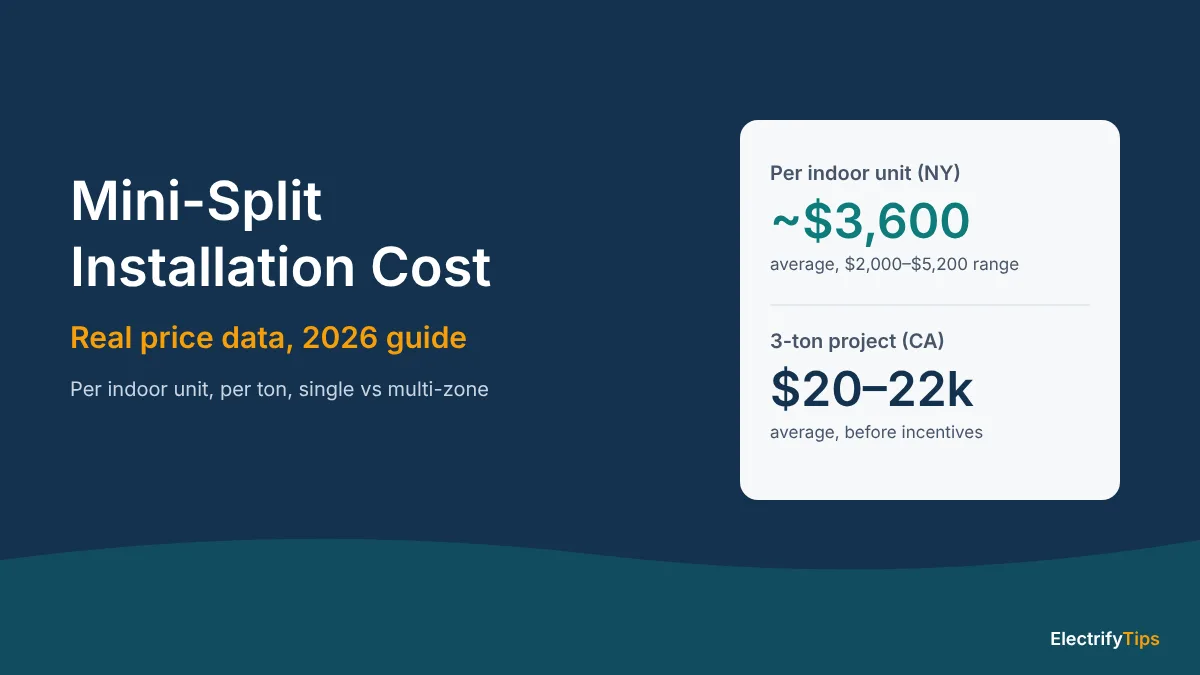
There's no single national price. In real program data, each indoor unit averaged about $3,600 installed (New York), and 3-ton mini-split and multi-split projects in California averaged about $20,000–$22,000 before incentives. Whole-home multi-head systems cost more. Rebates such as HEEHR now cover only upgrades from electric heat, like baseboard, or new construction.
A ductless mini-split is the go-to option for homes without ducts: an outdoor unit, one or more indoor units on the walls, and a small hole through the wall to connect them. The price is harder to pin down than for a ducted system, because it depends mostly on how many indoor units you need. No agency publishes one national price, so this guide puts three real data sets side by side and explains what each one measured. If you’re still deciding between ducted and ductless, start with our ducted vs ductless guide, or our complete heat pump guide for the basics.
The short answer
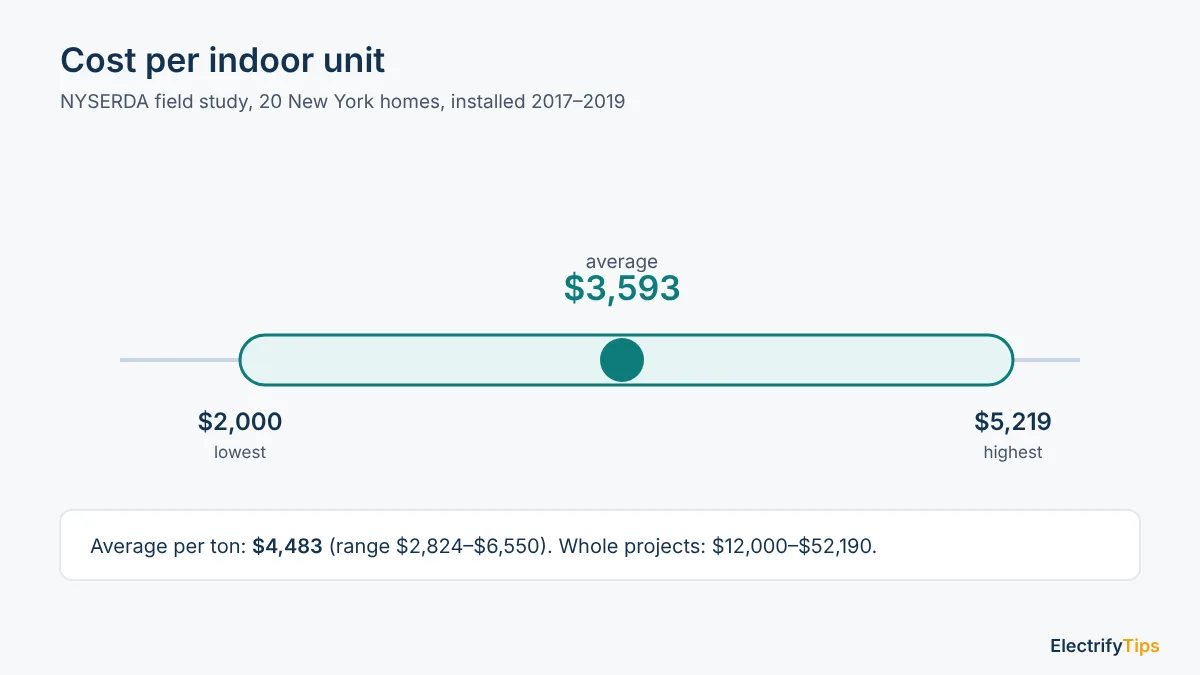
- Count the indoor units first. Each indoor unit adds equipment and labor, so the number of units is the best place to start an estimate. In New York program data, each indoor unit (“head”) averaged about $3,600 installed, with a range of $2,000 to $5,200.
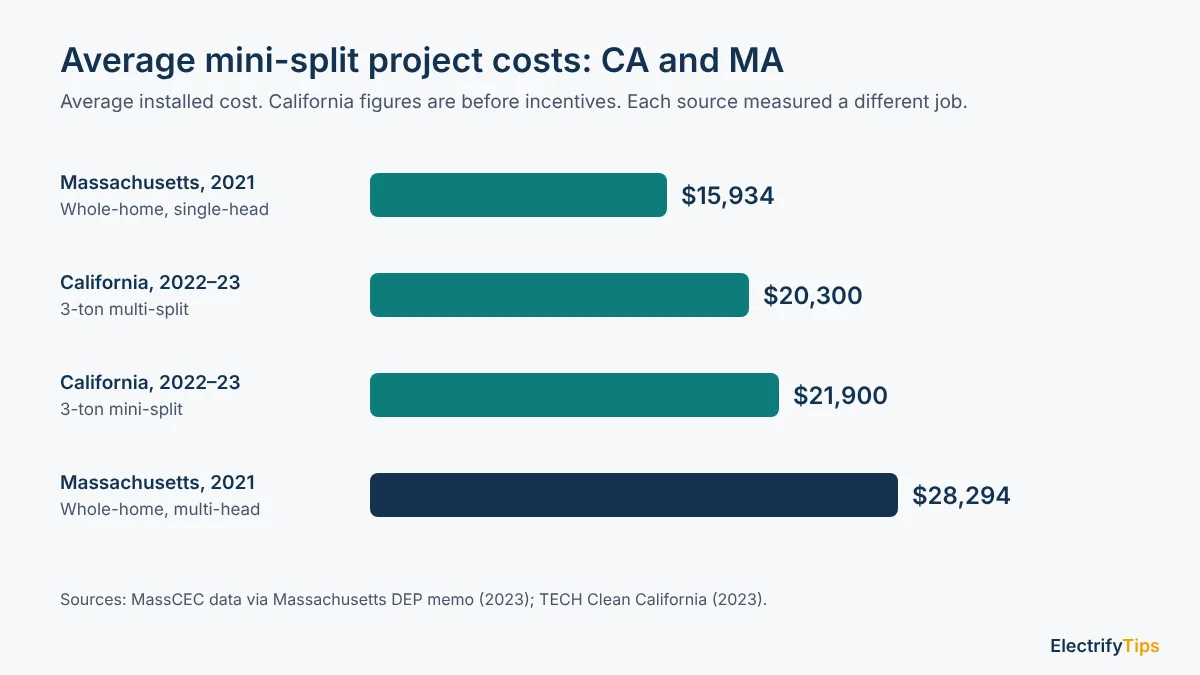
- Real 3-ton projects in California averaged about $20,000–$22,000 for mini-split and multi-split systems, before incentives (TECH Clean California, 2022–2023 data).
- Whole-home systems with several heads cost more. In Massachusetts data, multi-head whole-home systems averaged about $28,300, against about $15,900 for single-head systems.
- Extras add thousands. In the California data, project features such as panel upgrades and longer jobs added about $5,400–$5,900 to the average mini-split or multi-split project.
- Rebates can help, mostly if you heat with electricity now. Since May 29, 2026, the federal HEEHR rebate pays only for upgrades from existing electric equipment (such as baseboard heat) or in new construction.
What real installs cost: three data sets
Each of these measured something different, so read the “what it measured” column before comparing numbers.
| Source | What it measured | Cost |
|---|---|---|
| TECH Clean California (Oct 2023) | 5,783 single-family heat pump retrofits in California, Jan 2022–Jul 2023; average 3-ton project before incentives | Mini-split $21,900. Multi-split $20,300. For comparison, central ducted split $16,300 |
| NYSERDA Report 22-04 (Mar 2022) | 20 whole-home cold-climate mini-split installs in New York City, Yonkers and Long Island, 2017–2019 | $4,483 per ton on average; $3,593 per indoor head; whole projects $12,000–$52,190 |
| Massachusetts DEP memo (May 2023), MassCEC data (2021) | Whole-home heat pump installs in Massachusetts | Single-head mini-splits: about $15,900 per system ($6,415/ton). Multi-head: about $28,300 ($8,398/ton) |
What stands out:
- Whole-home systems are a different job from one room. The New York and Massachusetts data are whole-home replacements of the main heating system. A single head for one room or an addition is a much smaller job, which is why the per-head number is the most useful one for small projects.
- Per ton, ductless isn’t automatically cheaper than ducted. In the Massachusetts data, multi-head mini-splits ($8,398/ton) cost about the same per ton as central ducted systems ($8,853/ton). NESCAUM notes ductless systems “may be a more economical choice” in homes without ducts, because they avoid the cost of new ductwork, which it puts at about $4,500.
What’s usually in a mini-split quote
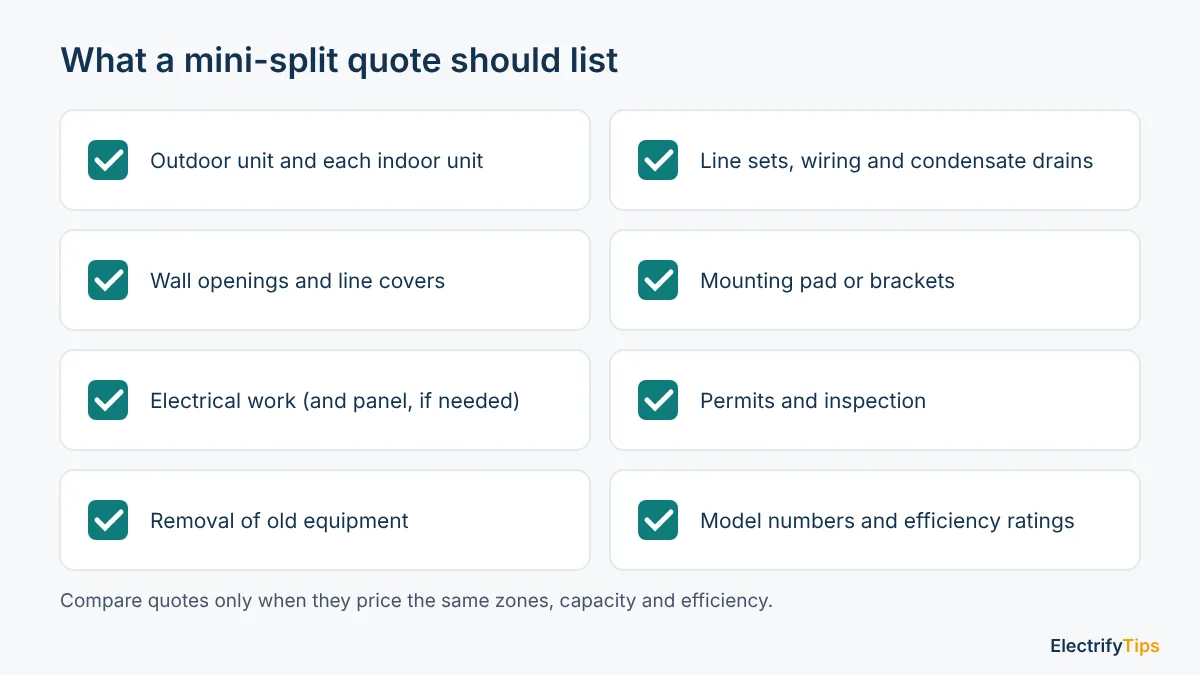
- The outdoor unit and each indoor unit (wall-mounted, ceiling cassette or floor console)
- The refrigerant line set, power and communication wiring, and the condensate drain for each indoor unit
- A three-inch hole through the wall for each connection. DOE notes the connection between the outdoor and indoor units “generally requires only a three-inch hole through a wall for the conduit.”
- Mounting pads or brackets for the outdoor unit, and line covers
- Electrical work: wiring to the outdoor unit, and sometimes a panel upgrade
- Permits and inspection, where required
Ask for each of these to be listed. A quote that leaves out electrical work or permits isn’t really cheaper.
Five things that move the price
1. How many indoor units. One outdoor unit can serve one indoor unit (single-zone) or several (multi-zone). DOE explains that multi-zone systems “can connect multiple indoor heads to one outdoor condenser, allowing for individual room temperature control.” More rooms that need their own unit means more equipment, more line sets and more labor. In the New York data, the 20 homes had up to 12 indoor heads each, and whole projects ranged from $12,000 to $52,190.
2. Capacity and climate. Bigger homes and colder climates need more capacity, measured in tons. In the New York data, cost per ton ranged from $2,824 to $6,550. If your winters are cold, look for an ENERGY STAR Cold Climate model: ductless units need at least 8.5 HSPF2 and must pass tests at 5°F. Our SEER2, HSPF2 and COP guide explains those ratings. Higher-efficiency units usually cost more up front, so get the size right first with a proper load calculation, not a guess. See what size heat pump you need.
3. Line set runs and where the units go. The installer has to run refrigerant lines, wiring and a condensate drain from each indoor unit to the outdoor unit. Short, straight runs on an outside wall are simplest. Units on interior walls or upper floors mean longer runs, more covers and more labor. Placement matters for performance too: NYSERDA’s field study found installation problems such as poor condensate drainage and inadequate refrigerant line insulation at some sites.
4. Electrical work. Most installs need some electrical work, and some homes need a bigger panel. In the California data, panel upgrades were one of the project features that pushed costs up. Ask each installer whether your panel has room and get the answer in writing.
5. What it’s replacing. Adding a single head to a room or an addition is a small job. Replacing the main heating system for the whole house is a much bigger one, and the New York and Massachusetts numbers are for that bigger job. Removing old equipment, patching walls and permits can also add cost. Our heat pump installation cost guide covers ducted systems.
Rebates: what can come off the price
The federal 25C tax credit covers only heat pumps placed in service by the end of 2025, so a 2026 install needs rebates instead:
- HEEHR (formerly HEAR), the state-run federal rebate. It pays up to $8,000 toward a heat pump, plus up to $4,000 for a panel and $2,500 for wiring, with a $14,000 household cap (42 U.S.C. 18795a). Your household income must be at or below 150% of area median, and your state’s program has to be open. Since May 29, 2026, it pays only for upgrades from existing electric equipment or in new construction, not for replacing gas, oil or propane.
- Utility and state programs. These vary a lot. Mass Save in Massachusetts, for example, pays $2,650 per ton for whole-home heat pumps and $1,125 per ton for partial-home systems, each up to $8,500, for 2026 installs. Check your electric utility’s site.
Replacing electric baseboard heat with a mini-split is the kind of electric-to-electric upgrade HEEHR still covers. A worked example: a $12,000 ductless system replacing baseboard heat, for a household at 120% of area median income. HEEHR covers 50% of the cost at that income, which is $6,000. Below 80% of area median, it can cover up to the full cost, capped at $8,000 for the heat pump.
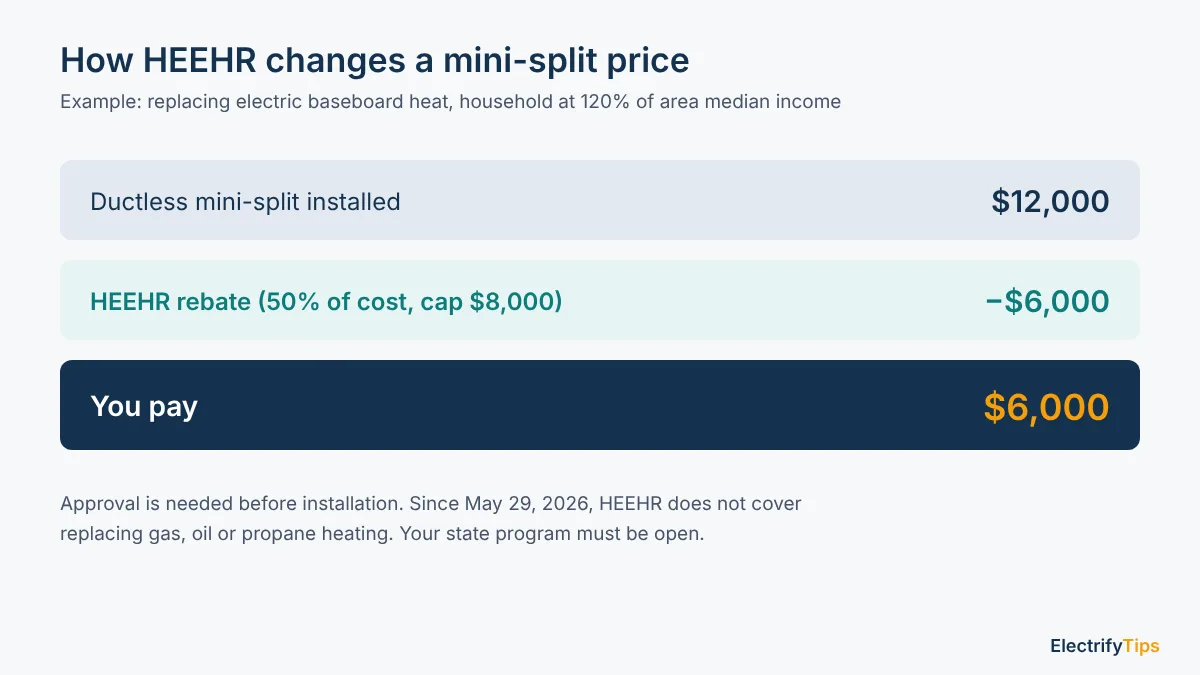
Approval comes first: federal rules don’t allow retroactive rebates. Our heat pump rebates guide covers who qualifies, state by state.
What it costs to run
The running cost depends on your electricity rate and the system’s efficiency. In NYSERDA’s field study of 20 New York homes, the cold-climate mini-splits ran at an average COP of 2.4, delivering about 2.4 units of heat for each unit of electricity, about 80% of what their HSPF ratings implied. The homes cut fossil fuel use for space heating by 86% on average.
To estimate your own running cost, try our Operating Cost Comparison tool with your electricity rate.
How to keep the quote down without cutting corners
- Plan the zones before you get quotes. Decide which rooms really need their own indoor unit. Every extra head adds cost.
- Get three written quotes for the same job: the same number of indoor units, capacity and efficiency, and the same scope.
- Ask for a load calculation for each zone, so you don’t pay for capacity you don’t need.
- Get it itemized: equipment, line sets and covers, electrical work, permits and removal of old equipment.
- Check rebates before you sign. Ask whether the contractor is on your state’s approved list and whether approval comes first.
- Use our Heat Pump Cost Calculator to add up each quote with extras and a contingency.
Frequently asked questions
How much does it cost to add one more indoor unit?
In NYSERDA’s New York study, installed cost per indoor head averaged $3,593, with a range of $2,000 to $5,219 (2017–2019 installs). Prices have changed since then, so use it as a rough guide and ask for per-head pricing in your quote.
Is a mini-split cheaper than a ducted heat pump?
Not per ton. In Massachusetts data, multi-head mini-splits cost about $8,400 per ton and central ducted systems about $8,900. A mini-split can be the more economical choice when your home has no ducts, because it avoids the cost of new ductwork.
Why are mini-split quotes so different?
They often aren’t pricing the same job. The number of indoor units, line set runs, electrical work and permits all vary. Compare itemized quotes for the same number of zones and the same efficiency.
Do mini-splits qualify for rebates in 2026?
They can. The federal HEEHR rebate covers heat pumps that replace existing electric equipment, such as baseboard heat, where your state’s program is open and you’re approved first. Utility rebates vary by area.
Will I need a new electrical panel for a mini-split?
Not always. It depends on your panel’s spare capacity. Ask each installer to check and put the answer in writing. HEEHR can pay up to $4,000 toward a panel for eligible households and projects.
Per-ton and per-system figures are quoted as each source published them. They aren’t adjusted for inflation.
Keep reading
- Ducted vs ductless heat pumps
- How much does a heat pump cost to install?
- What size heat pump do I need?
- SEER2, HSPF2 and COP explained
- Heat pump rebates and incentives (2026)
- Heat pumps: the complete homeowner’s guide
- Heat Pump Cost Calculator
- Heat pump vs electric baseboard heat
Sources & references
- https://techcleanca.com/documents/2707/TECH_Data_Webinar_October_2023.pdf
- https://www.nyserda.ny.gov/-/media/Project/Nyserda/Files/Publications/PPSER/Program-Evaluation/22-04-Replacing-Fossil-Fuel-Heat-with-Mini-Split-Heat-Pumps-in-Urban-House-Stock.pdf
- https://www.mass.gov/doc/memo-on-heating-technology-costs-and-emissions/download
- https://www.nescaum.org/documents/Heat-Pumps-in-the-Northeast-and-Mid-Atlantic---Costs-and-Market-Trends.pdf
- https://web.archive.org/web/20260602160945/https://www.energy.gov/energysaver/air-source-heat-pumps
- https://www.energystar.gov/sites/default/files/2025-04/ENERGY STAR Version 6.2 Heat Pump Specification Rev. March 2025.pdf
- https://www.govinfo.gov/link/uscode/42/18795a
- https://www.energy.gov/documents/program-notice-26-2
- https://www.irs.gov/credits-deductions/energy-efficient-home-improvement-credit
- https://www.masssave.com/residential/rebates-and-incentives/heating-and-cooling/heat-pumps/air-source-heat-pumps