Quick answer
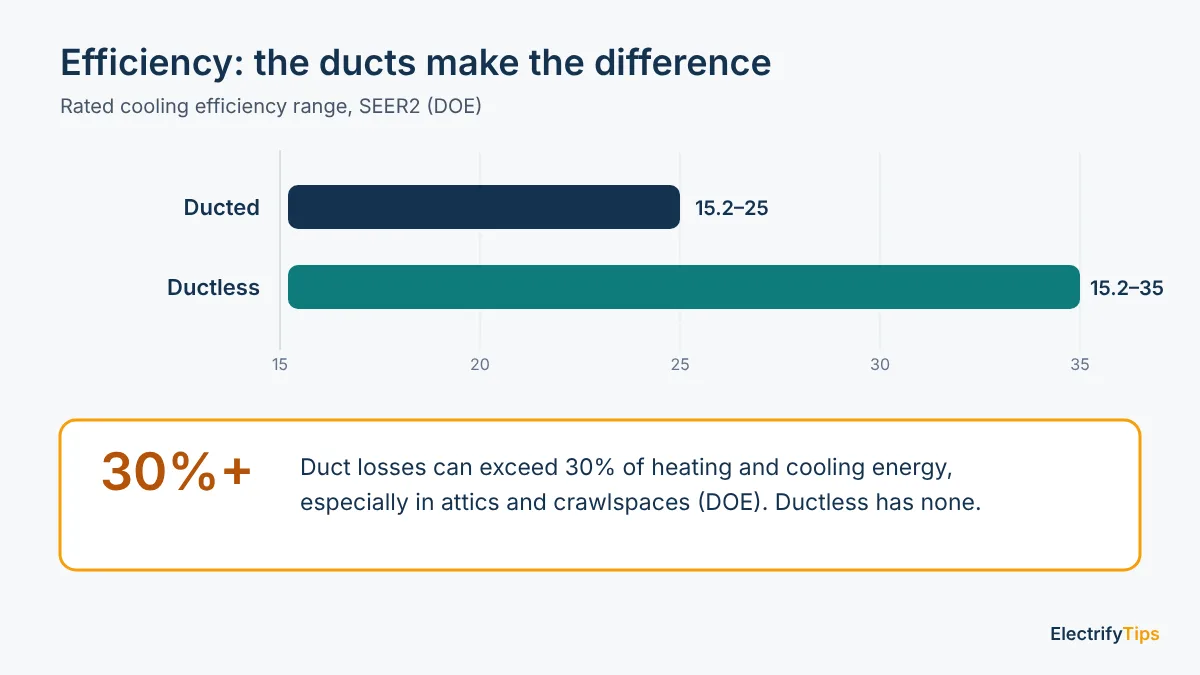
A ducted heat pump is usually the simplest choice if your home already has sound ducts. A ductless mini-split suits homes without ducts, additions and problem rooms, and avoids duct losses that DOE says can exceed 30% of heating and cooling energy. DOE rates ducted systems at 15.2–25 SEER2 and ductless at 15.2–35 SEER2.
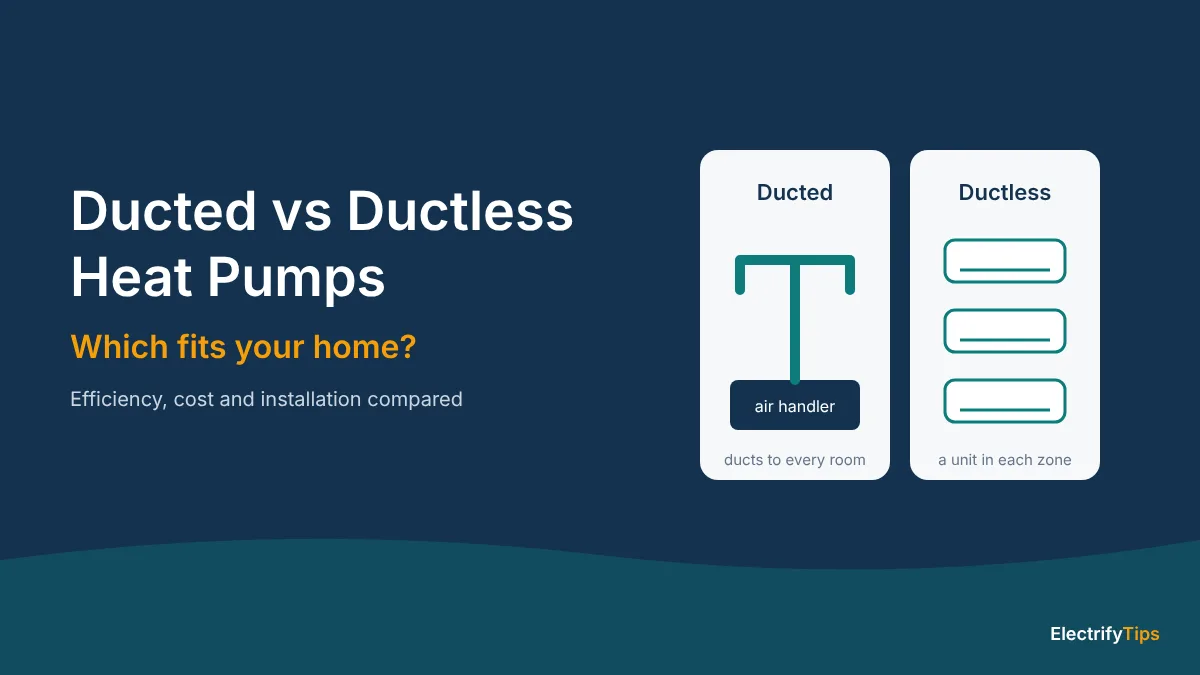
Both kinds of heat pump do the same job: move heat into your home in winter and out of it in summer. The difference is how the heated or cooled air reaches your rooms. A ducted heat pump pushes air through ductwork from one central indoor unit. A ductless mini-split puts a small indoor unit in each room or zone and skips the ducts entirely. Which one fits your home depends mostly on one question: do you already have good ducts?
The short answer
- You have ducts in good shape: a ducted heat pump is usually the simplest swap. It can often use the same ductwork as your furnace or central AC.
- You have no ducts (baseboard, boiler, wall heaters or an addition): a ductless mini-split avoids the cost and disruption of adding ductwork. DOE says the connection between the units generally needs only a three-inch hole through a wall.
- Efficiency: ductless avoids duct losses, which DOE says “can account for more than 30% of energy consumption for space conditioning.” The best ductless models also reach higher ratings: up to 35 SEER2, against up to 25 SEER2 for ducted systems.
- Cost: DOE says installing mini-splits “can be more expensive than some other systems”, and the price rises with each indoor unit you add.
- You can mix both: a ducted system for most of the house, plus a mini-split for an addition, attic room or hard-to-heat space.
How each one works
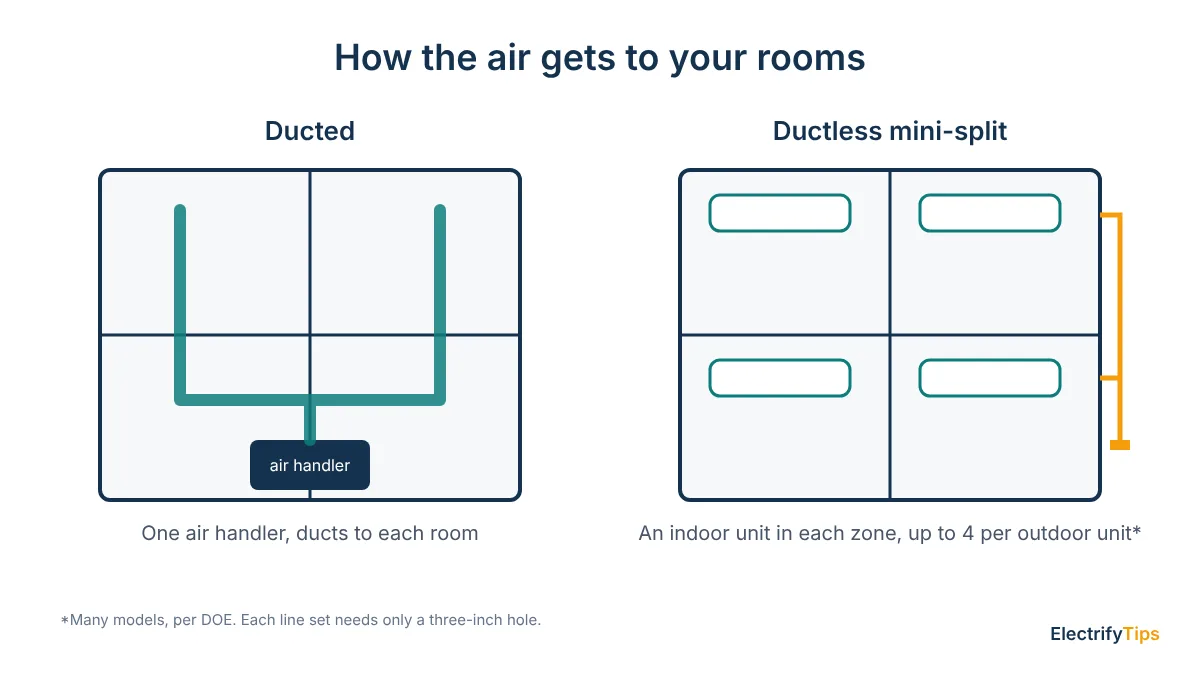
Ducted (central) heat pump. An outdoor unit connects to one indoor air handler, often where your furnace sits. The air handler blows heated or cooled air through supply ducts to every room, and return ducts bring it back. One thermostat often runs the whole system.
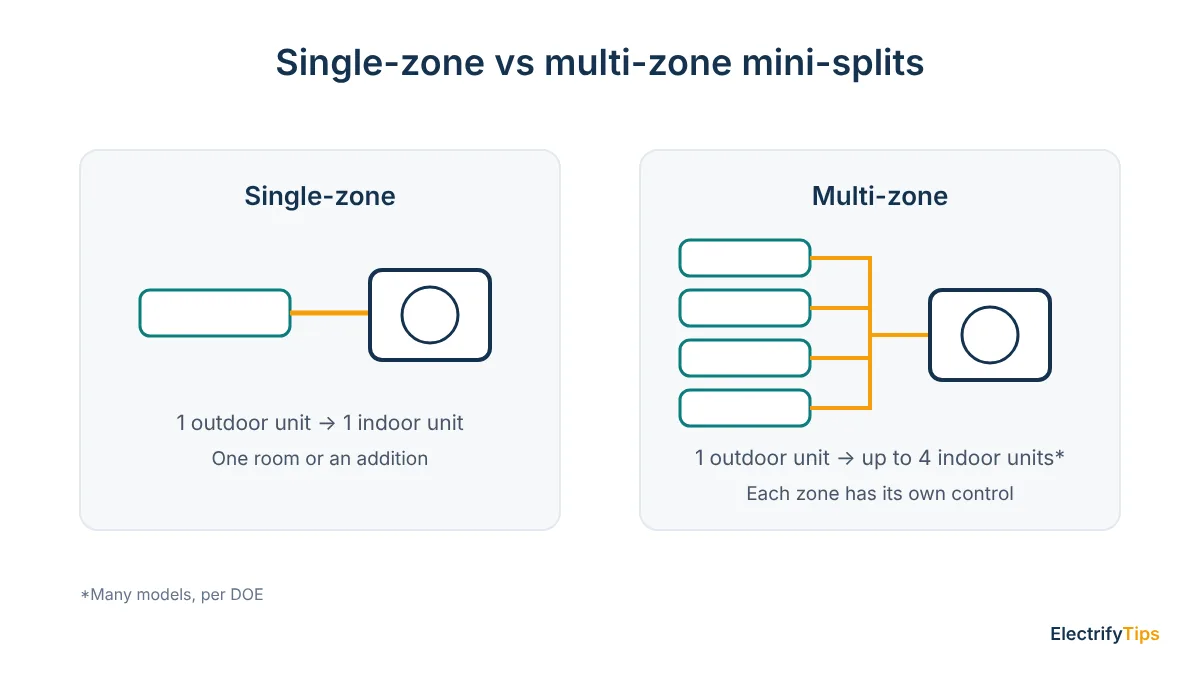
Ductless mini-split. An outdoor unit connects by a small conduit (refrigerant lines, power and a condensate drain) to one or more indoor units mounted on a wall, ceiling or floor. Each indoor unit heats or cools its own room or zone. According to DOE:
- a single-zone system has one outdoor unit and one indoor head,
- a multi-zone system connects two or more indoor units to one outdoor unit, and many models support up to four,
- the outdoor unit can sit up to 50 feet from the indoor unit.
Side by side
| Ducted heat pump | Ductless mini-split | |
|---|---|---|
| Needs ductwork | Yes | No |
| How air is delivered | One air handler, ducts to every room | An indoor unit in each room or zone |
| Efficiency range (DOE) | 15.2–25 SEER2 | 15.2–35 SEER2 |
| Duct losses | Yes, can exceed 30% of heating and cooling energy (DOE) | None |
| Room-by-room control | Limited, usually one thermostat | Yes, each indoor unit has its own control |
| Installation work | Uses existing ducts, or major work if new ducts are needed | A three-inch hole per line set, no ductwork |
| What you see indoors | Vents only | A wall, ceiling or floor unit in each zone |
| Best fit | Homes with sound ducts | Homes without ducts, additions, single rooms |
Efficiency: where ducts cost you
On paper, both types can be efficient. DOE puts ducted heat pumps at 15.2–25 SEER2 and ductless mini-splits at 15.2–35 SEER2. The rating only tells part of the story, though, because it doesn’t count what happens in your ducts.
Duct losses are the real difference. DOE says losses from ductwork “can account for more than 30% of energy consumption for space conditioning”, especially when ducts run through an attic, crawlspace or other unheated space. Leaky supply ducts push heated or cooled air out of unsealed joints before it reaches your rooms. Even well-sealed, insulated ducts lose some heat, which is why DOE notes that many new efficient homes keep ducts inside the heated part of the house.
What this means for you:
- Ducts inside your living space and in good shape? The efficiency gap between ducted and ductless shrinks a lot.
- Ducts in a hot attic or a cold crawlspace? Have them sealed and insulated before a ducted heat pump goes in. DOE calls insulating ducts in unconditioned spaces “usually very cost-effective”. If the ducts are in poor shape, that’s a good reason to look at ductless.
- Room-by-room control saves energy too: with ductless, you can heat or cool only the rooms you’re using.
Cost: what drives the price
There’s no official national price for mini-splits, so we won’t invent one. Here’s what the official sources do say:
- Ducted: a typical ducted air-source heat pump costs about $12,000 to $23,000 installed in the US (NESCAUM cost study, October 2024). That’s lowest when your existing ducts can be reused.
- Ductless: DOE says installing mini-splits “can be more expensive than some other systems”, but notes that lower running costs and rebates can help offset it. The price climbs with each indoor unit, because each one is extra equipment, another line set and more labor.
- New ductwork is the big wild card. If a home without ducts wanted a ducted system, the ductwork itself would add major cost and disruption. That’s usually where ductless wins on price.
The practical way to compare: get one quote for each option, priced for the same rooms and capacity. Run each quote through our Heat Pump Cost Calculator, which adds up equipment, labor and extras, so you compare like with like. For national price ranges, see how much a heat pump costs to install.
Installation: what each job involves
Ducted swap (with existing ducts). The installer replaces the outdoor unit and indoor air handler or coil, checks and seals the ducts, and connects the thermostat. Ask for a load calculation, and ask whether your ducts are big enough for the airflow the heat pump needs.
Ductless install. Each indoor unit needs a three-inch hole through an outside wall for its line set (DOE). The outdoor unit can sit up to 50 feet away, so it can go somewhere less visible. DOE also notes there must be a place to drain condensate water outdoors.
Either way, size matters. DOE warns that “an oversized system is more expensive to buy and operate”. With ductless, each zone should be sized for its own room, not just the house as a whole. Our Heat Pump Sizing Calculator gives a starting estimate.
Which one fits your home?
| Your home | Usually the better fit | Why |
|---|---|---|
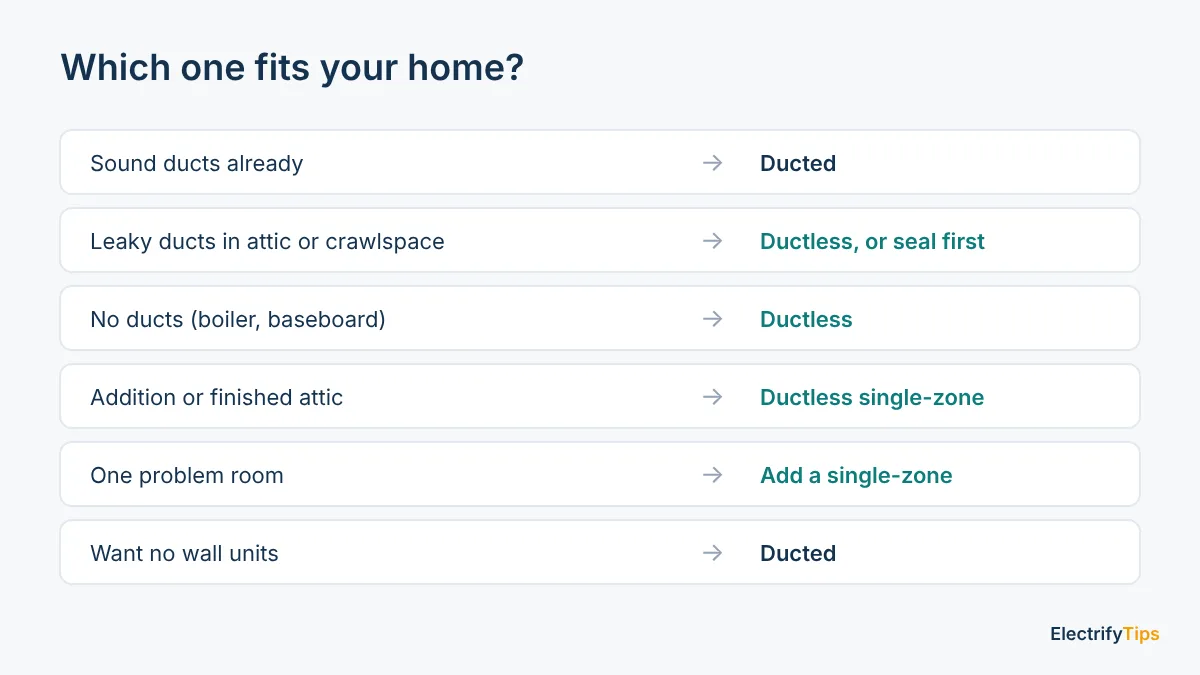
| Central AC or furnace with sound ducts | Ducted | Reuses what you have, with vents and no wall units |
| Ducts in an attic or crawlspace, leaky or undersized | Ductless, or ducted after sealing and repair | Duct losses can exceed 30% (DOE) |
| No ducts: boiler, baseboard or wall heaters | Ductless | No new ductwork needed, just a three-inch hole per line set |
| An addition, garage room or finished attic | Ductless (single-zone) | DOE notes ductless is often installed in additions |
| One or two rooms that are always too hot or cold | Ductless (single-zone) added to your current system | Targets just those rooms |
| You care about how rooms look | Ducted | Ductless puts a visible unit in each zone |
Mixing ducted and ductless
You don’t have to pick one for the whole house. A common-sense setup is a ducted heat pump for the main floors, plus a single-zone mini-split for an addition or a room the ducts never reached well.
In a cold climate, either type can also be paired with a gas furnace as backup. DOE describes these dual-fuel systems as combining “the efficiency of a heat pump with the reliability of a gas furnace”. Our cold-climate guide covers backup heat in detail.
Questions to ask your installer
- For ducted: Are my ducts sealed, insulated and big enough for this heat pump’s airflow? What would duct repair add to the quote?
- For ductless: How many indoor units do I need, and where will each one go? Where will the condensate drain?
- For both: Will you do a room-by-room load calculation? DOE warns that an oversized system costs more to buy and run.
- Is it a cold-climate model? That matters if your winters drop well below freezing.
- Does this job qualify for HEEHR or utility rebates, and do I need approval before you start? HEEHR (formerly HEAR) pays up to $8,000 toward a heat pump for eligible households, and since May 2026 only for upgrades from electric equipment. It requires approval before installation. See our rebates guide.
Frequently asked questions
Do I need ducts for a heat pump?
No. Ductless mini-splits need no ductwork: DOE says only a three-inch hole through the wall is needed to connect the outdoor unit to each indoor unit. Ducted heat pumps do need ducts, and they’re usually the easier choice if you already have ducts in good shape.
Is ductless more efficient than ducted?
Often, because ductless avoids duct losses, which DOE says can exceed 30% of the energy used for heating and cooling. The best ductless models also reach higher ratings: DOE puts ductless at 15.2–35 SEER2 and ducted at 15.2–25 SEER2. Sealed, insulated ducts inside your living space shrink the gap.
How many rooms can one mini-split outdoor unit serve?
It depends on the model. DOE says many multi-zone models support up to four indoor units connected to one outdoor unit, each with its own control.
Is a mini-split cheaper than a ducted heat pump?
Not always. DOE says mini-splits can be more expensive to install than some other systems, and the price rises with each indoor unit. In a home with no ducts, though, ductless avoids the large cost of adding ductwork. Get a quote for each option for the same rooms.
Can I use a mini-split alongside my existing system?
Yes. A single-zone mini-split is one way to heat and cool an addition, or a room your current system doesn’t reach well. DOE notes ductless systems are often installed in additions.
Keep reading
- What size heat pump do I need?
- Heat pumps: the complete homeowner’s guide
- How much does a heat pump cost to install?
- Do heat pumps work in cold climates?
- Heat pump vs air conditioner: what’s the difference?
- Heat pump rebates and incentives: complete guide (2026)
- How much does a mini-split cost to install?
Sources & references
- https://web.archive.org/web/20260603064036/https://www.energy.gov/energysaver/ductless-minisplit-heat-pumps
- https://web.archive.org/web/20260602160945/https://www.energy.gov/energysaver/air-source-heat-pumps
- https://web.archive.org/web/20260613031412/https://www.energy.gov/energysaver/minimizing-energy-losses-ducts
- https://web.archive.org/web/20260531150702/https://www.energy.gov/energysaver/heat-pump-systems
- https://www.nescaum.org/documents/Heat-Pumps-in-the-Northeast-and-Mid-Atlantic---Costs-and-Market-Trends.pdf
- https://www.govinfo.gov/link/uscode/42/18795a