Quick answer
SEER2 measures cooling efficiency over a season, HSPF2 measures heating efficiency over a season, and COP is heat out divided by electricity in. Higher is better for all three. The federal minimums for split heat pumps are 14.3 SEER2 and 7.5 HSPF2; ENERGY STAR asks for at least 15.2 SEER2 and 7.8 HSPF2. In warm climates SEER2 matters more, in cold climates HSPF2 does.
Every heat pump quote comes with a string of letters and numbers: 16 SEER2, 8.1 HSPF2, maybe 11 EER2. They decide how much electricity the system uses, so they’re worth understanding, and they’re simpler than they look. SEER2 measures cooling efficiency, HSPF2 measures heating efficiency, and COP is the plain “heat out per unit of electricity” number engineers use. For all three, higher means less electricity for the same comfort. If you’re new to heat pumps, start with our complete heat pump guide.
The short answer
- SEER2 is cooling efficiency over a whole season. Higher is better. The federal minimum for a split-system heat pump is 14.3 SEER2.
- HSPF2 is heating efficiency over a whole season. Higher is better. The federal minimum is 7.5 HSPF2.
- EER2 is cooling efficiency on a hot day, measured at a single test condition rather than across a season.
- COP is heat delivered divided by electricity used, at one moment. To turn HSPF2 into an average heating COP, divide it by 3.412.
- Which matters most depends on where you live. DOE says: “In warmer climates, SEER is more important than HSPF. In colder climates, focus on getting the highest HSPF feasible.”
- Higher ratings cost more. DOE notes “the higher the HSPF and SEER, the higher the cost of the unit”, so it’s a trade-off between purchase price and running cost.
What each rating measures
| Rating | What it measures | Units | Higher means |
|---|---|---|---|
| SEER2 | Cooling over a typical cooling season | Btu of heat removed per watt-hour of electricity | Less electricity to cool |
| HSPF2 | Heating over a typical heating season | Btu of heat delivered per watt-hour | Less electricity to heat |
| EER2 | Cooling at one hot test condition | Btu per hour per watt | Better on the hottest days |
| COP | Heat out ÷ electricity in, at one moment | No units (a ratio) | More heat per unit of power |
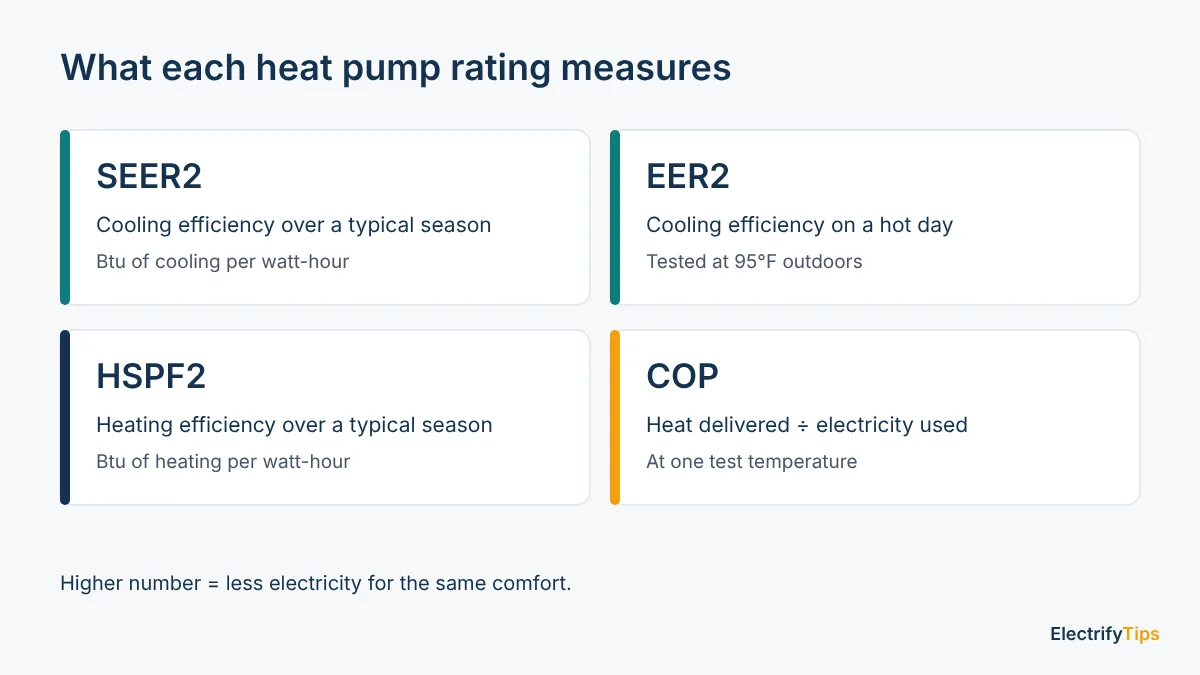
In DOE’s words, HSPF “measures the total heat provided over a heating season divided by the total electrical energy consumed.” SEER is the same idea for cooling: total heat removed, divided by electricity used.
Two details worth knowing:
- HSPF counts backup heat. ENERGY STAR defines it as total heating output “including supplementary electric heat”. So the rating reflects the whole system, not just the heat pump.
- EER is a snapshot. ENERGY STAR describes it as “a measure of the instantaneous energy efficiency of cooling equipment”, tested at 95°F outdoors. That makes it a useful check on performance during very hot weather.
Why there’s a “2” on the end now
Since January 1, 2023, ratings use updated federal test procedures. DOE says these were “designed to produce measures of energy efficiency that better reflect real-world installation and use.” That’s why SEER became SEER2, HSPF became HSPF2 and EER became EER2.
The catch: DOE says the new ratings “are not directly comparable” with the old ones. A unit rated 16 SEER under the old test isn’t the same as 16 SEER2. When comparing quotes, make sure every unit is rated with the “2” version, and don’t compare an old SEER number with a new SEER2 number.
The numbers to know: federal minimums and ENERGY STAR
| Equipment | SEER2 | EER2 | HSPF2 |
|---|---|---|---|
| Federal minimum: split-system heat pump (all regions, since 2023) | 14.3 | — | 7.5 |
| Federal minimum: split-system central AC, North | 13.4 | — | — |
| Federal minimum: split-system central AC, Southeast and Southwest (under 45,000 Btu/h) | 14.3 | — | — |
| ENERGY STAR: split-system heat pump | 15.2 or higher | 11.0 or higher | 7.8 or higher |
| ENERGY STAR Cold Climate: ducted split heat pump | 15.2 or higher | — | 8.1 or higher |
| ENERGY STAR Cold Climate: ductless split heat pump | 15.2 or higher | — | 8.5 or higher |
Sources: DOE 2023 standards FAQ, ENERGY STAR Heat Pump Specification Version 6.2 (effective January 1, 2023). The Southwest AC standard also includes EER2 levels.
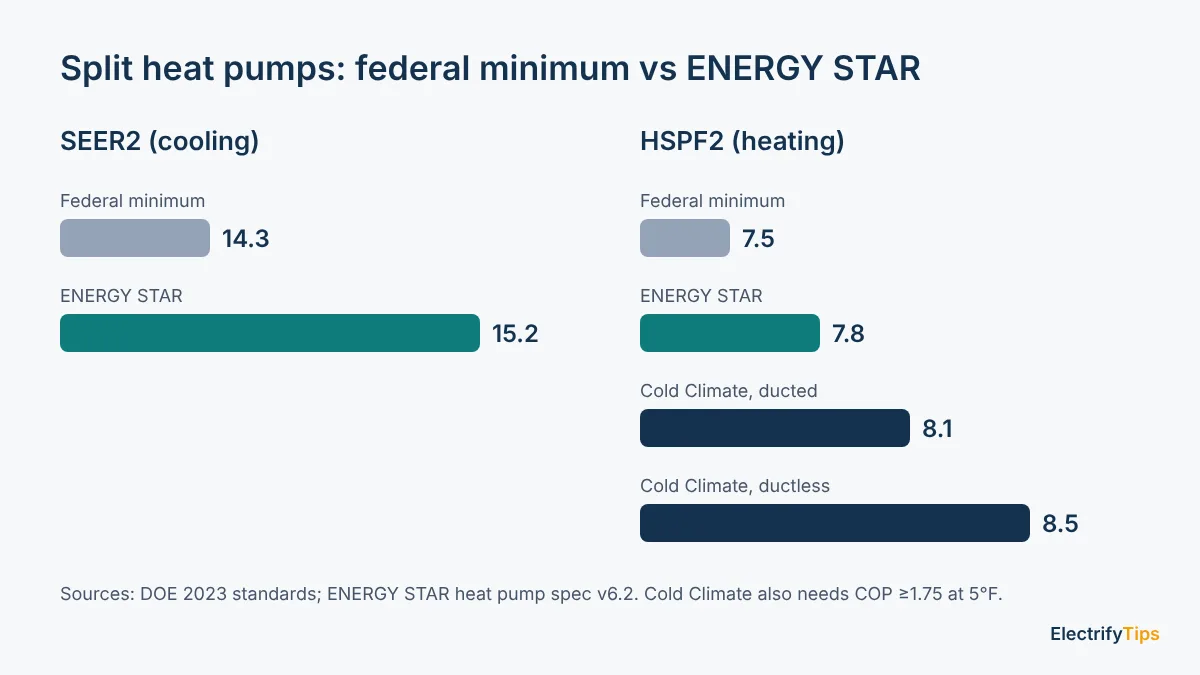
ENERGY STAR’s Cold Climate label adds two tests at 5°F: a COP of at least 1.75, and at least 70% of rated heating capacity. DOE suggests looking for the Cold Climate label “if you live in a region where temperatures regularly dip below freezing”.
What a higher rating means for your electricity use
Because SEER2 and HSPF2 are “Btu per watt-hour”, electricity use goes down in proportion as the rating goes up, for the same amount of heating or cooling. The math is simple: 1 − (old rating ÷ new rating).
| Upgrade | Electricity used for that job |
|---|---|
| 14.3 → 16 SEER2 | About 11% less for cooling |
| 14.3 → 18 SEER2 | About 21% less for cooling |
| 14.3 → 20 SEER2 | About 28% less for cooling |
| 7.5 → 8.1 HSPF2 | About 7% less for heating |
| 7.5 → 9 HSPF2 | About 17% less for heating |
| 7.5 → 10 HSPF2 | About 25% less for heating |
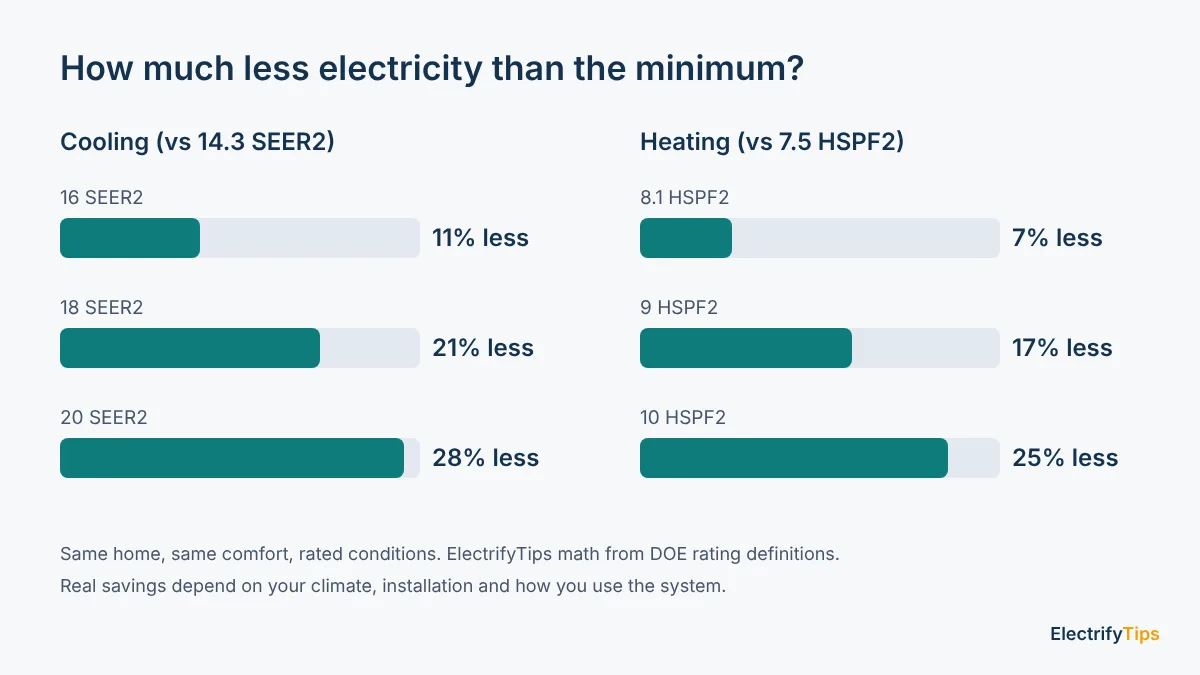
What this means in dollars depends on how much you heat and cool, and on your electricity rate. A 21% cut in a small cooling bill is a few dollars a year, while the same cut in a large one is real money. Our Operating Cost Comparison tool lets you test your own numbers.
Two cautions:
- Ratings assume a proper install. DOE says split-system heat pumps “that have the correct refrigerant charge and airflow usually perform very close to” their listed ratings. A poor install can mean lower real-world efficiency than the label shows.
- Ratings come from a standard test. Your real-world efficiency depends on your climate, ducts and how the system is set up.
HSPF2 and COP: how they connect
COP (coefficient of performance) is heat delivered divided by electricity used, both in the same units. HSPF2 uses Btu for heat and watt-hours for electricity, and one watt-hour equals 3.412 Btu (EIA). So you can turn HSPF2 into an average seasonal COP by dividing by 3.412:
| HSPF2 | Average heating COP (HSPF2 ÷ 3.412) |
|---|---|
| 7.5 (federal minimum) | 2.2 |
| 7.8 (ENERGY STAR) | 2.3 |
| 8.1 (Cold Climate, ducted) | 2.4 |
| 8.5 (Cold Climate, ductless) | 2.5 |
| 10 | 2.9 |
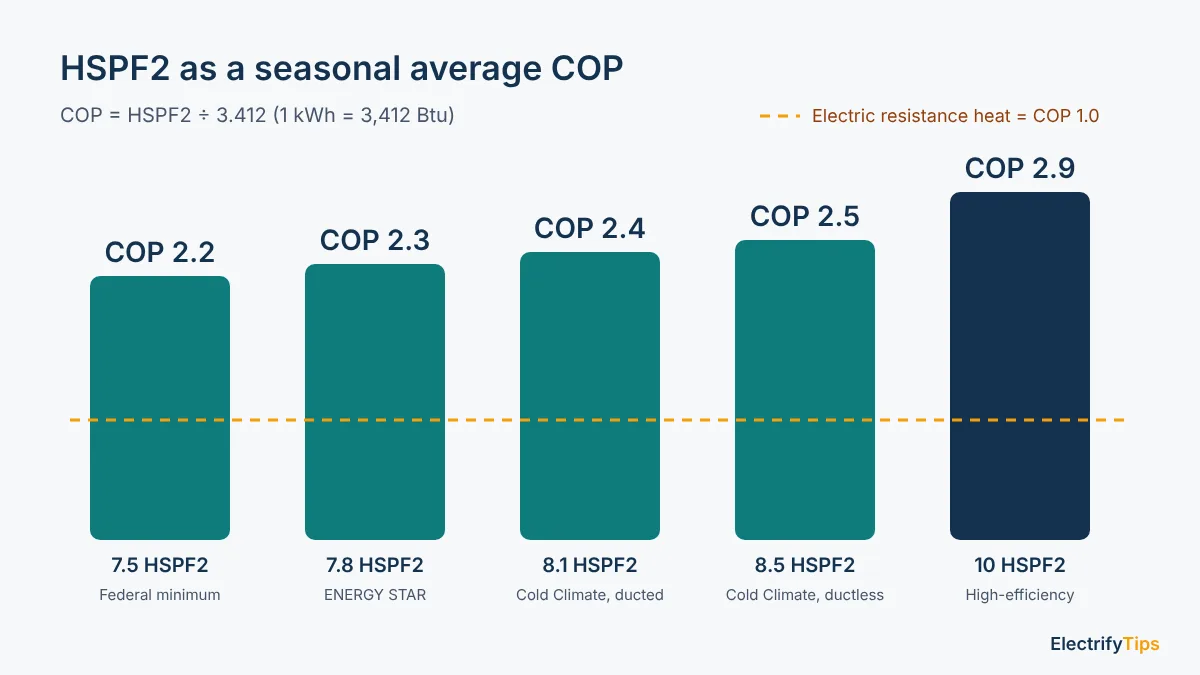
Read it this way: a 7.5 HSPF2 heat pump delivers, on average over the rating test, about 2.2 units of heat for every unit of electricity. Electric baseboard heat is always about 1. On any given day, the real COP is higher in mild weather and lower in deep cold. That’s why our cold-climate guide looks at COP at 5°F.
Which rating matters most where you live
DOE’s rule of thumb: “In warmer climates, SEER is more important than HSPF. In colder climates, focus on getting the highest HSPF feasible.”
| Your climate | Put more weight on | Also check |
|---|---|---|
| Hot, long summers, mild winters | SEER2, and EER2 for very hot days | HSPF2 at or above the minimum |
| Mixed (real summers and real winters) | Both SEER2 and HSPF2 | ENERGY STAR certification |
| Cold winters | HSPF2 | ENERGY STAR Cold Climate label: COP and capacity at 5°F |
In a cold climate, HSPF2 alone doesn’t tell the whole story. It’s a seasonal average from a standard test, so it doesn’t show how the unit performs on your coldest nights. The Cold Climate label’s 5°F tests fill that gap. Our cold-climate guide explains them, along with DOE’s field-test results. If you’re choosing between a heat pump and a plain AC, the heat pump vs air conditioner comparison shows how their ratings line up.
How to read the ratings on a quote
When a quote or spec sheet lands in your inbox, check five things:
- Is every rating a “2” rating? SEER2, HSPF2 and EER2, not SEER, HSPF or EER. DOE says the old and new ratings “are not directly comparable”.
- Is the rating for the matched system? A split heat pump’s rating applies to a specific outdoor unit paired with a specific indoor unit. Ask the installer to confirm the rating is for the exact combination they’re installing.
- Does it meet the minimum? At least 14.3 SEER2 and 7.5 HSPF2 for a split heat pump.
- Is it ENERGY STAR certified, and Cold Climate certified if your winters freeze? You can compare certified models in ENERGY STAR’s Product Finder.
- Does the higher rating pay for itself? Get the price for two efficiency levels, then use our Operating Cost Comparison tool to see what each saves at your electricity rate.
One more thing: ratings only matter if the system is the right size and installed properly. An oversized heat pump cycles on and off and won’t reach its rated efficiency. See what size heat pump you need.
Frequently asked questions
Can I compare an old SEER rating with a SEER2 rating?
Not directly. DOE says the old and new ratings “are not directly comparable” because they come from different test procedures. Compare SEER2 with SEER2.
What is the minimum SEER2 and HSPF2 for a heat pump?
For split-system heat pumps installed since January 1, 2023, the federal minimums are 14.3 SEER2 and 7.5 HSPF2, nationwide.
What ratings does ENERGY STAR require?
For split-system heat pumps: at least 15.2 SEER2, 11.0 EER2 and 7.8 HSPF2. Cold Climate models need a higher HSPF2 (8.5 ductless, 8.1 ducted) and must pass extra tests at 5°F.
Is a higher SEER2 always worth paying for?
Not always. DOE notes that higher ratings mean a higher price. The extra efficiency pays back faster if you run the system a lot and your electricity is expensive. Get prices for two efficiency levels and compare them with our Operating Cost Comparison tool.
What does COP mean on a heat pump?
COP is heat delivered divided by electricity used, at one test temperature. A COP of 2 means two units of heat for every unit of electricity. Electric resistance heat has a COP of 1.
Which matters more, SEER2 or HSPF2?
It depends on your climate. DOE says SEER matters more in warm climates and HSPF matters more in cold ones. In mixed climates, look at both.
Keep reading
- Heat pumps: the complete homeowner’s guide
- Do heat pumps work in cold climates?
- What size heat pump do I need?
- How much does a heat pump cost to install?
- Heat pump rebates and incentives (2026)
- Heat pump vs gas furnace
- Operating Cost Comparison tool
- Why is my heat pump running constantly in winter?
- Heat pump vs electric baseboard heat
Sources & references
- https://web.archive.org/web/20260602160945/https://www.energy.gov/energysaver/air-source-heat-pumps
- https://www1.eere.energy.gov/buildings/appliance_standards/pdfs/2023_CAC_Standards_FAQ_10-5-2022_Final.pdf
- https://www.energystar.gov/sites/default/files/2025-04/ENERGY STAR Version 6.2 Heat Pump Specification Rev. March 2025.pdf
- https://www.energystar.gov/sites/default/files/Final_CAC_ASHP_Eligibility_Criteria.pdf
- https://web.archive.org/web/20260531150702/https://www.energy.gov/energysaver/heat-pump-systems
- https://www.eia.gov/energyexplained/units-and-calculators/british-thermal-units.php