Quick answer
Seal air leaks, insulate the attic and seal ducts before the heat pump, or in the same project, then size the heat pump with a Manual J load calculation on the improved home. HEEHR and Mass Save whole-home rebates can require the insulation step first.
Official guidance points one way: do the air sealing and insulation before a heat pump goes in, or as part of the same project, and size the heat pump for the improved home. NYSERDA says it’s a good idea to seal and insulate first, before investing in new equipment, and ENERGY STAR says better insulation may let you choose a smaller, less expensive heat pump. Some rebate programs now make insulation before a heat pump a condition. The main exception is a heating system that has already failed. If you’re still learning how heat pumps work, start with our complete heat pump guide.
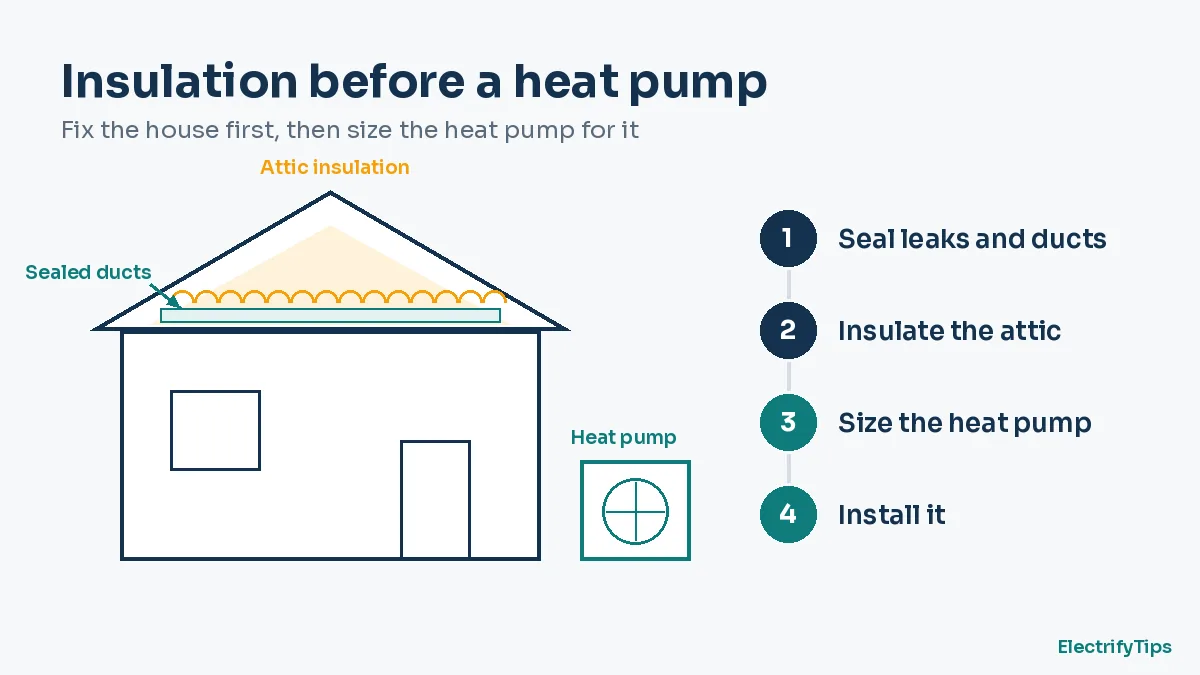
Why insulation before a heat pump changes the size you buy
A heat pump is sized to how much heat your home loses on a cold day. The DOE-funded Building America Solution Center (run by PNNL) says the Manual J load calculation needs accurate data on the home’s air leakage and insulation levels. It names a blower door test as the most accurate way to measure air leakage.
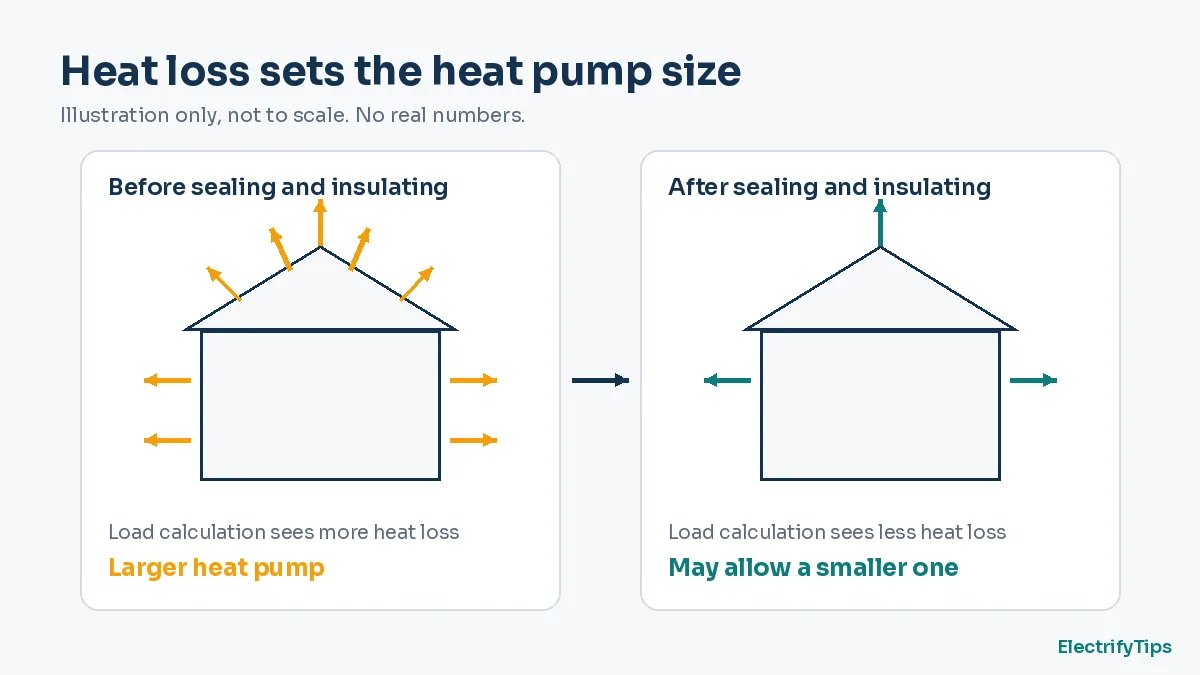
That is why the order matters. If the load calculation is done on a leaky, under-insulated house and you fix the house a year later, the heat pump was sized for heat loss the home no longer has.
ENERGY STAR puts it plainly: adding insulation “may also allow you to choose a smaller, less expensive heat pump.” NYSERDA says the same about air sealing and insulating first. Neither gives a fixed percentage, because the size drop depends on how leaky and under-insulated the home was to begin with. Our guide to what size heat pump you need explains the load calculation in more detail.
Ducts count too. If your ducts run through an attic, crawl space or garage, ENERGY STAR says leaky ducts can reduce heating and cooling efficiency by as much as 20 percent. It adds that a well-sealed duct system may let you move to a smaller, less costly system.
What sealing and insulating saves by itself
The EPA estimates that air sealing and insulation save homeowners an average of 15% on heating and cooling costs, or about 11% on total energy costs. ENERGY STAR also says 9 out of 10 US homes are under-insulated.
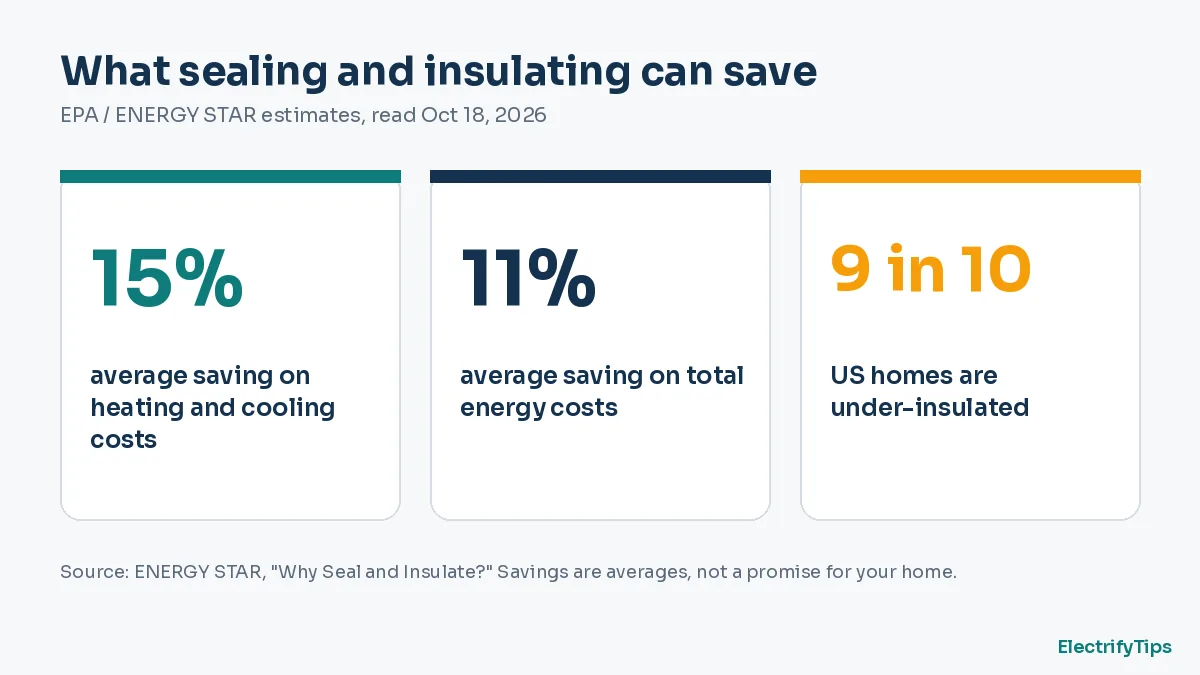
Those savings come from the house, not the heating equipment, so they don’t depend on when the heat pump arrives.
Rebates that make insulation first a rule
For some homeowners, the order isn’t a choice. Check which program you plan to use before you book anything.
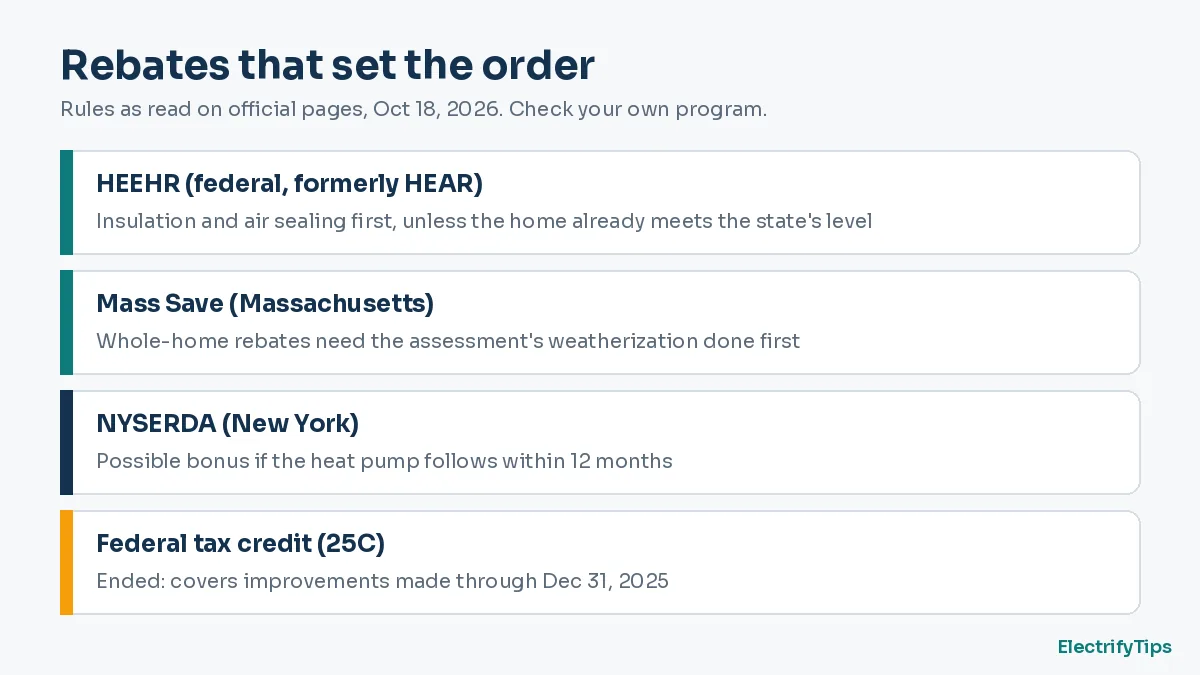
HEEHR (the federal program formerly called HEAR). DOE’s Program Notice 26-2, effective May 29, 2026, requires homes to use the rebates for insulation and air sealing before heating and cooling upgrades. The exception is a home already insulated and sealed to a DOE-approved, state-specified level. The same notice limits rebates to upgrades from existing electric equipment, so HEEHR won’t pay to replace a gas, oil or propane system. Under the law, insulation, air sealing and ventilation can get up to $1,600, a heat pump up to $8,000, with a $14,000 limit per household.
States word the rule in their own way. North Carolina’s program page, for example, says insulation and air sealing “may be required alongside” a heat pump project. Your state’s program page is the final word. Our heat pump rebates guide shows each state’s status.
Mass Save (Massachusetts). If heat pumps will be your only heating and cooling, Mass Save requires you to complete the weatherization recommended in a Home Energy Assessment to get whole-home rebates. A home counts as done if it was built in 2000 or later, if the assessment recommends less than $1,000 of weatherization, or if recommendations made in 2013 or later have been completed. Homes that don’t meet this may only get partial-home rebate amounts.
NYSERDA (New York). NYSERDA says contractors may offer bonus incentives when a heat pump is installed within 12 months of finishing air sealing and insulation.
The federal tax credit has ended. The IRS says the Energy Efficient Home Improvement Credit covers improvements made through December 31, 2025. Insulation added in 2026 no longer qualifies, even though some older pages still mention the credit.
When the heat pump may have to come first
Two situations can change this answer.
Your heating has already failed. If the furnace or heat pump stops working in winter, waiting for an insulation crew may not be realistic. Ask the contractor which air leakage and insulation figures went into the load calculation, so you know what the size is based on. Planning ahead leaves time for the insulation step; our guide on replacing your furnace now or waiting covers that timing.
Your home is already tight and well insulated. HEEHR exempts homes that already meet the state’s level. Mass Save treats homes built in 2000 or later as sufficiently weatherized. An assessment shows whether there is much left to fix.
The order of work, step by step
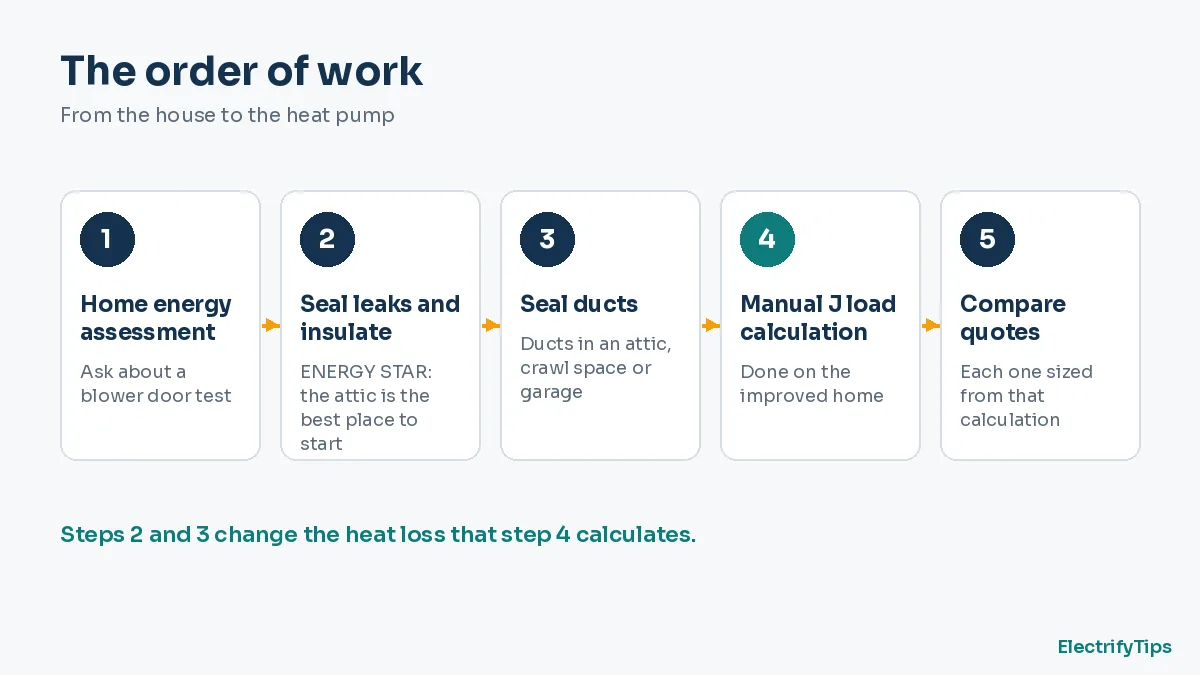
- Get a home energy assessment. NYSERDA recommends starting with one, and Mass Save requires it for whole-home rebates. Ask whether it includes a blower door test.
- Seal air leaks and insulate the attic. ENERGY STAR calls the attic the best place to start.
- Seal ducts in unheated spaces. This matters most when ducts run through an attic, crawl space or garage.
- Get a Manual J load calculation on the improved home. For a rough first number, try our heat pump sizing calculator; the contractor’s calculation is the one that counts.
- Get and compare quotes. Check that each one is sized from a load calculation. Our guide on how to compare heat pump quotes lists what to look for.
The assessment is the first step NYSERDA recommends. It tells you how much sealing and insulation your home needs, whether your rebate requires it, and what numbers the heat pump should be sized on.
Sources & references
- https://www.energy.gov/documents/program-notice-26-2
- https://www.law.cornell.edu/uscode/text/42/18795a
- https://www.deq.nc.gov/energy-climate/state-energy-office/energy-saver-north-carolina/hear-updates-and-program-changes
- https://basc.pnnl.gov/resource-guides/cold-climate-heat-pump-sizing-and-selection
- https://www.energystar.gov/products/ask-the-experts/improved-home-insulation-helps-heat-pump-perform-better
- https://www.energystar.gov/saveathome/seal_insulate/why-seal-and-insulate
- https://www.energystar.gov/saveathome/heating-cooling/duct-sealing/benefits
- https://www.nyserda.ny.gov/Residents-and-Homeowners/Home-Equipment-Replacements
- https://www.nyserda.ny.gov/ny/New-HVAC-System
- https://www.masssave.com/heatpump/efficiency-first
- https://www.irs.gov/credits-deductions/energy-efficient-home-improvement-credit