Quick answer
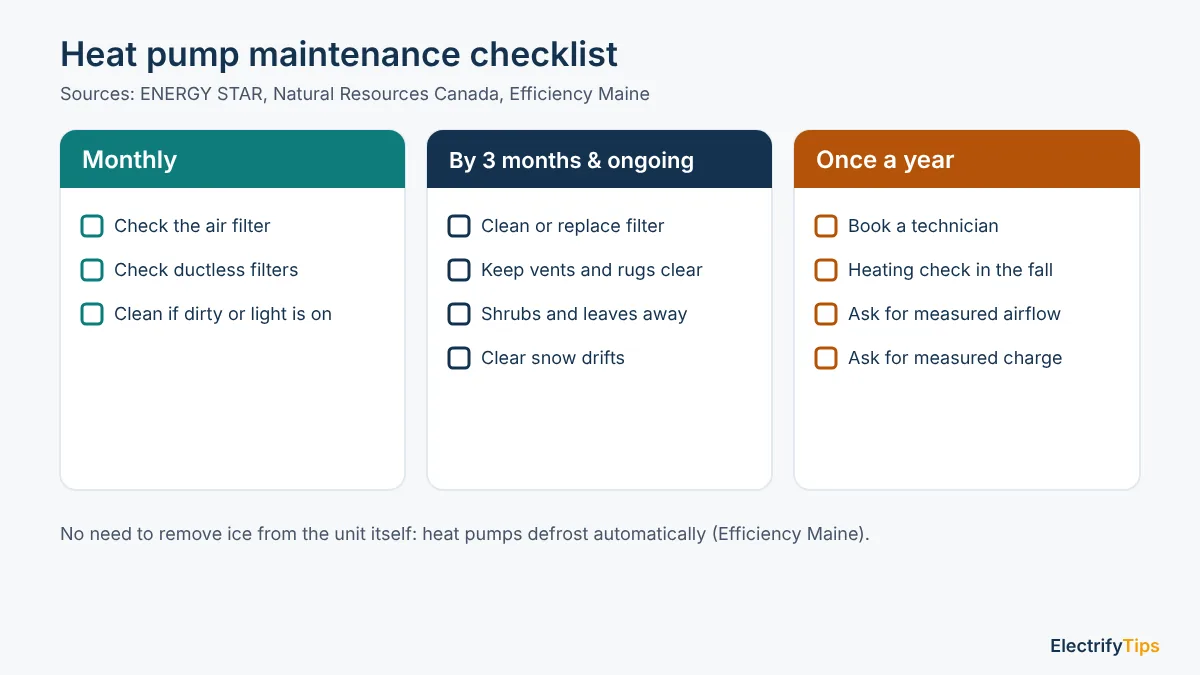
Check the air filter monthly and clean or replace it at least every 3 months; clean ductless filters whenever they look dirty or the indicator light comes on. Keep vents clear, keep shrubs and leaves away from the outdoor unit and clear snow drifts around it. There is no need to remove ice from the unit, because heat pumps defrost automatically. Book a qualified technician once a year for refrigerant, electrical, airflow, drain and coil checks.
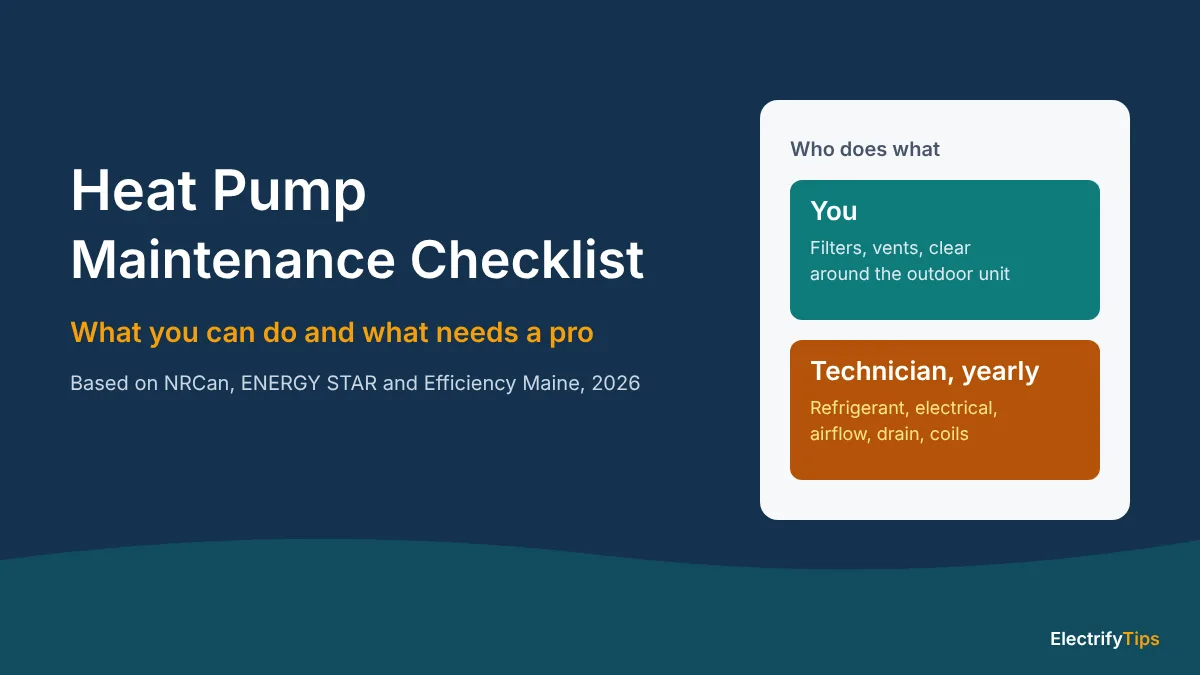
Heat pump maintenance comes in two parts. The first is filters and keeping the outdoor unit clear, which you can do yourself. The second is a yearly visit from a qualified technician. This checklist sorts each task by how often it’s due and who should do it, using guidance from Natural Resources Canada, ENERGY STAR and Efficiency Maine. New to heat pumps? Start with our complete heat pump guide.
The short answer
- Filters are your main job. ENERGY STAR says to inspect, clean or change them once a month. Natural Resources Canada says to change or clean them at least every 3 months.
- Keep the outdoor unit clear. Efficiency Maine advises keeping shrubs and leaves away and clearing snow drifts from around it.
- Book a technician once a year. Natural Resources Canada says “you should have a qualified contractor do annual maintenance on your unit.”
- Leave refrigerant and electrical work to the pro. Those checks are on ENERGY STAR’s list of what a contractor’s check-up should cover.
- Neglect costs money. DOE’s guide said the energy-use gap between a well-maintained heat pump and a severely neglected one can range from 10% to 25%.
Why maintenance matters
Natural Resources Canada puts it simply: “Proper maintenance is critical to ensure your heat pump operates efficiently, reliably, and has a long service life.” Airflow is a big part of it. ENERGY STAR says “airflow problems can reduce your system’s efficiency by up to 15 percent,” and Natural Resources Canada warns that poor airflow “can shorten equipment lifespans.” A dirty filter, blocked vents or a smothered outdoor unit all restrict airflow.
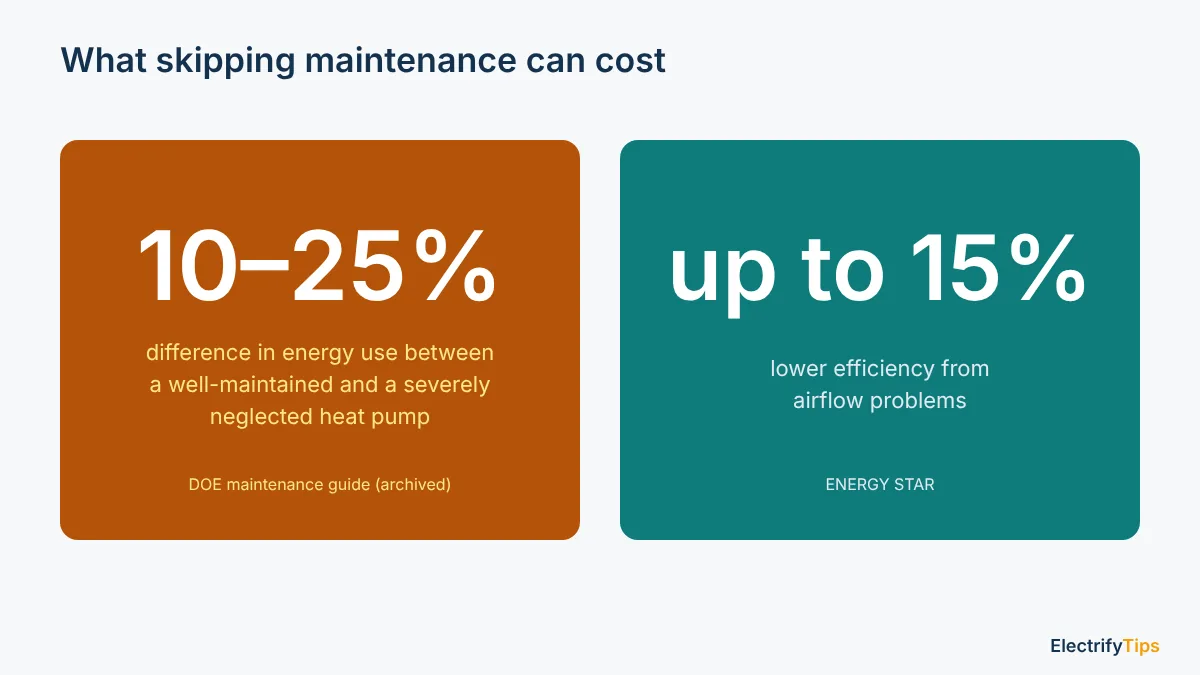
The cost of skipping care adds up. DOE’s maintenance guide, now archived, put the difference in energy use between a well-maintained heat pump and “a severely neglected one” at 10% to 25%. For how maintenance affects how long a heat pump lasts, see how long do heat pumps last.
The checklist at a glance
| Task | How often | Who |
|---|---|---|
| Check the air filter | Monthly | You |
| Clean or replace the filter | At least every 3 months, sooner if it looks dirty | You |
| Clean ductless indoor-unit filters | When visibly dirty or the indicator light comes on | You |
| Keep vents and registers clear of furniture and rugs | Ongoing | You |
| Keep shrubs, leaves and clutter away from the outdoor unit | Ongoing, more in fall | You |
| Clear snow drifts from around the outdoor unit | After snowfall | You |
| Professional check-up | Once a year, ideally in the fall | Technician |
Sources: ENERGY STAR, Natural Resources Canada, Efficiency Maine.
Filters: monthly check, clean or replace by 3 months
The filter is the task you’ll do most often. ENERGY STAR says to “inspect, clean, or change air filters once a month,” and warns that a dirty filter “can increase energy costs and damage your equipment, leading to early failure.” Natural Resources Canada’s limit is every 3 months, because “clogged filters will decrease airflow and reduce the efficiency of your system.”
In practice, check it monthly and change or clean it when it looks dirty, and at the latest every 3 months. If you’re not sure where the filter is or how to change it, ENERGY STAR notes that your contractor can show you.
Ductless mini-splits have a filter in each indoor unit. Efficiency Maine says to “vacuum, rinse or replace” them, depending on type, “whenever they become visibly dirty or when the indicator light comes on,” and that this can range “from weeks to months depending on use and dust volume.” Check your manual for how to remove them.
Indoors: keep the air moving
Natural Resources Canada asks owners to make sure “vents and air registers in your home are not blocked by furniture or carpeting,” because poor airflow “can shorten equipment lifespans and reduce efficiency of the system.” Check again whenever you move furniture or rugs.
Outdoors: keep the unit clear
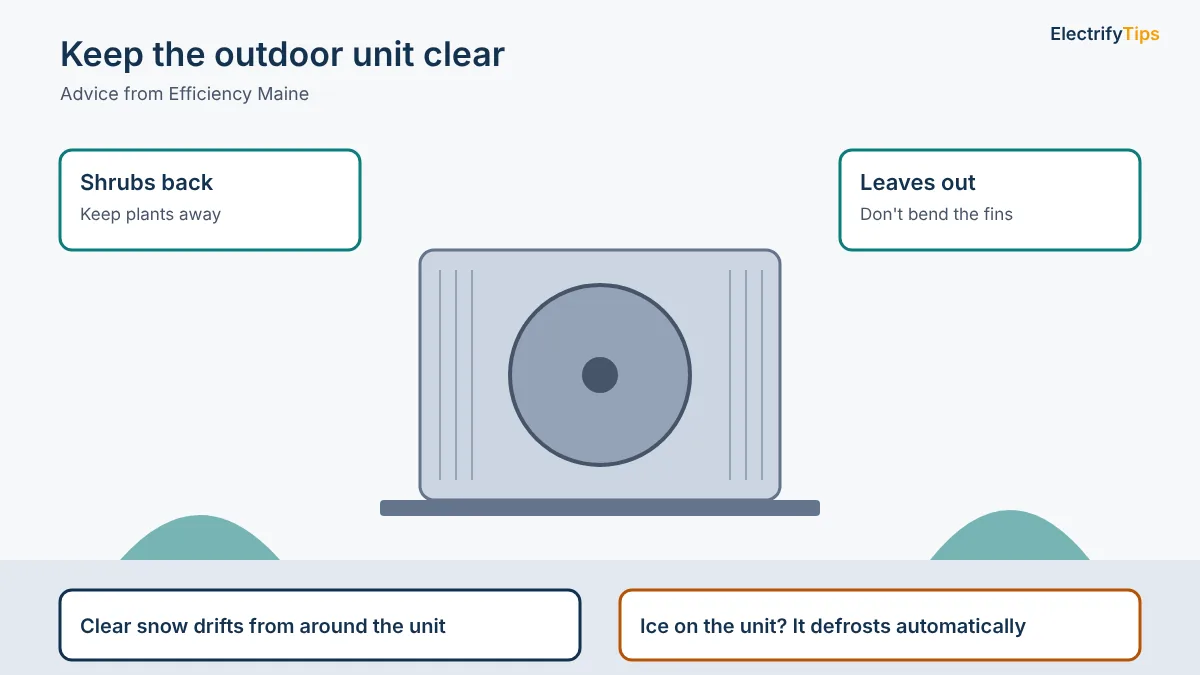
The outdoor unit pulls heat from the air around it, so keep the space around it open. Efficiency Maine’s advice:
- Plants and leaves. “Keep shrubs away from outdoor units and remove leaves that may become stuck in them, being careful not to bend the fins.”
- Snow. “Clear snow drifts away from outdoor units but don’t worry about snow and ice accumulating on them. Heat pumps automatically defrost.”
If the coil itself looks dirty, check your manual. Efficiency Maine says to follow the manufacturer’s recommendations for professional cleaning, and ENERGY STAR lists coil cleaning as part of a contractor’s check-up.
The yearly technician visit
Natural Resources Canada recommends annual maintenance by a qualified contractor. ENERGY STAR suggests booking “annual pre-season check-ups” and having heating checked in the fall, before contractors get busy. Here’s what a check-up should cover, according to ENERGY STAR’s checklist and DOE’s archived maintenance guide:
| Check | Why it matters | Source |
|---|---|---|
| Thermostat settings and system controls | Confirms the system “starts, operates, and shuts off properly” | ENERGY STAR |
| Electrical connections, voltage and current on motors | Faulty connections “can cause unsafe operation” and shorten the life of major parts | ENERGY STAR |
| Lubricate moving parts | Friction increases electricity use | ENERGY STAR |
| Condensate drain | “A plugged drain can cause water damage in the house” | ENERGY STAR |
| Clean indoor and outdoor coils | Dirty coils make the system run longer | ENERGY STAR |
| Refrigerant charge, checked by measurement, and leaks | “Too much or too little refrigerant” reduces performance | ENERGY STAR, DOE |
| Blower and airflow, measured | Airflow problems can cut efficiency by up to 15% | ENERGY STAR, DOE |
| Ducts: obstructions and leakage | Leaky ducts waste heated and cooled air | DOE |
DOE’s list uses the words “by measurement” for both airflow and refrigerant charge. When you book, it’s fair to ask whether the technician will measure them or only look.
Refrigerant, electrical and drain work are on the contractor’s side of ENERGY STAR’s list. Leave them to the technician.
When to call between visits
- Water near the indoor unit. ENERGY STAR warns that a plugged condensate drain can cause water damage, so don’t wait for the yearly visit.
- Weak heat or very long run times after you’ve checked the filter and cleared the outdoor unit. Our guide to a heat pump running constantly in winter walks through the checks in order.
- Anything that needs a panel opened, or involves refrigerant lines or wiring.
Frequently asked questions
How often should a heat pump be serviced?
Once a year by a qualified contractor, according to Natural Resources Canada. ENERGY STAR suggests annual pre-season check-ups, with the heating check in the fall.
How often should I change my heat pump filter?
Check it monthly, as ENERGY STAR advises, and clean or replace it at least every 3 months, per Natural Resources Canada. For ductless units, Efficiency Maine says to clean the filters whenever they’re visibly dirty or the indicator light comes on.
Should I remove ice from my heat pump?
No. Efficiency Maine says not to worry about snow and ice on the outdoor unit, because “heat pumps automatically defrost.” Do clear snow drifts from around it.
Can I clean the outdoor coil myself?
Check your manual first. Efficiency Maine says to follow the manufacturer’s recommendations for professional cleaning, and ENERGY STAR includes coil cleaning in a contractor’s check-up.
Does maintenance really save energy?
Yes. DOE’s guide put the energy-use gap between a well-maintained and a severely neglected heat pump at 10% to 25%, and ENERGY STAR says airflow problems alone can cut efficiency by up to 15%.
Keep reading
- Heat pumps: the complete homeowner’s guide
- Why is my heat pump running constantly in winter?
- How long do heat pumps last?
- Do heat pumps work in cold climates?
- Ducted vs ductless heat pumps
- Dual fuel heat pump systems
Sources & references
- https://natural-resources.canada.ca/energy-efficiency/energy-star/heating-cooling-heat-pump
- https://www.energystar.gov/saveathome/heating-cooling/maintenance-checklist
- https://www.efficiencymaine.com/docs/Heat-Pump-User-Tips.pdf
- https://web.archive.org/web/20260529112831/https://www.energy.gov/energysaver/operating-and-maintaining-your-heat-pump