Quick answer
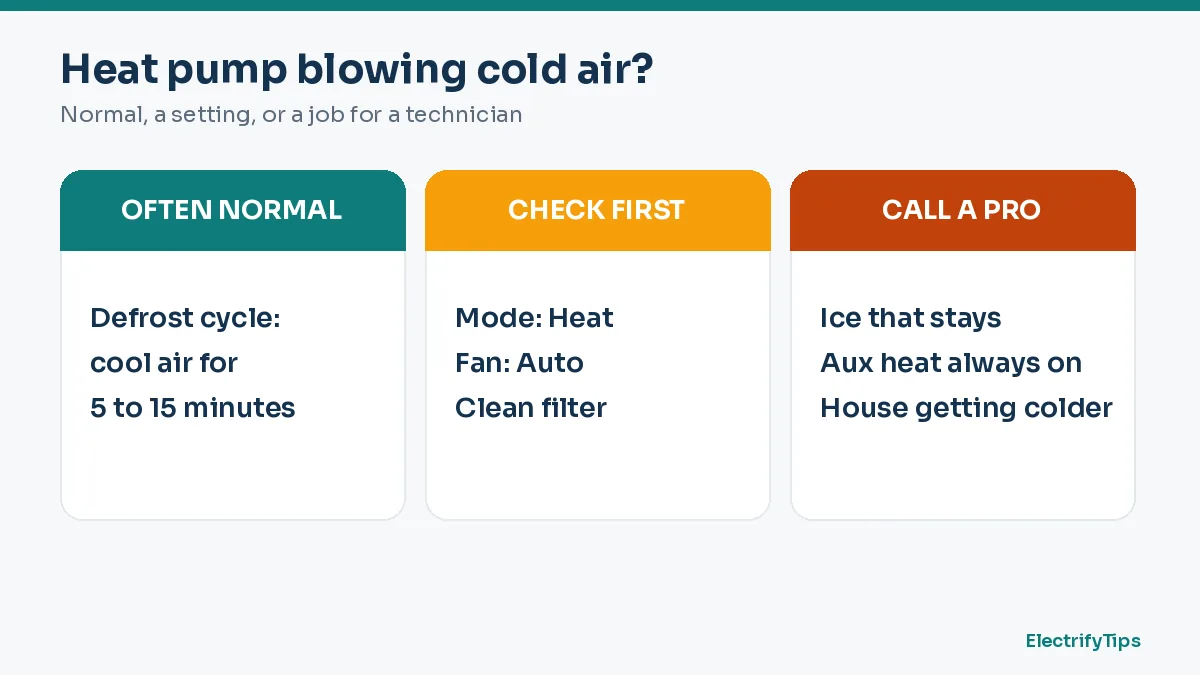
Short bursts of cool air during defrost are normal, and heat pump air always feels cooler than furnace air. If the air stays cold, check the mode is Heat, the fan is Auto, the filter is clean and the outdoor unit is clear. Ice that stays, cold air for more than about 15 minutes, or constant aux heat means a technician visit.
Your heat pump is on, it is cold outside, and the air from the vents feels cool. That is worrying, but it is not always a problem. Some cool air is normal with a heat pump. Other times a setting is wrong, or a part needs a technician. This guide helps you tell the difference, starting with the simple causes.
Quick answer
- Heat pump air is cooler than furnace air. It can feel cool on your hand even when the system is heating well.
- During a defrost cycle, a heat pump can blow cool air for a few minutes. This is normal.
- If the cool air does not stop, check that the thermostat is in Heat mode, the fan is set to Auto, and the filter is clean.
- Call a technician if the outdoor unit stays covered in ice, a defrost seems to last much longer than 15 minutes, or the thermostat shows aux heat all the time.
First, is the air cool or really cold?
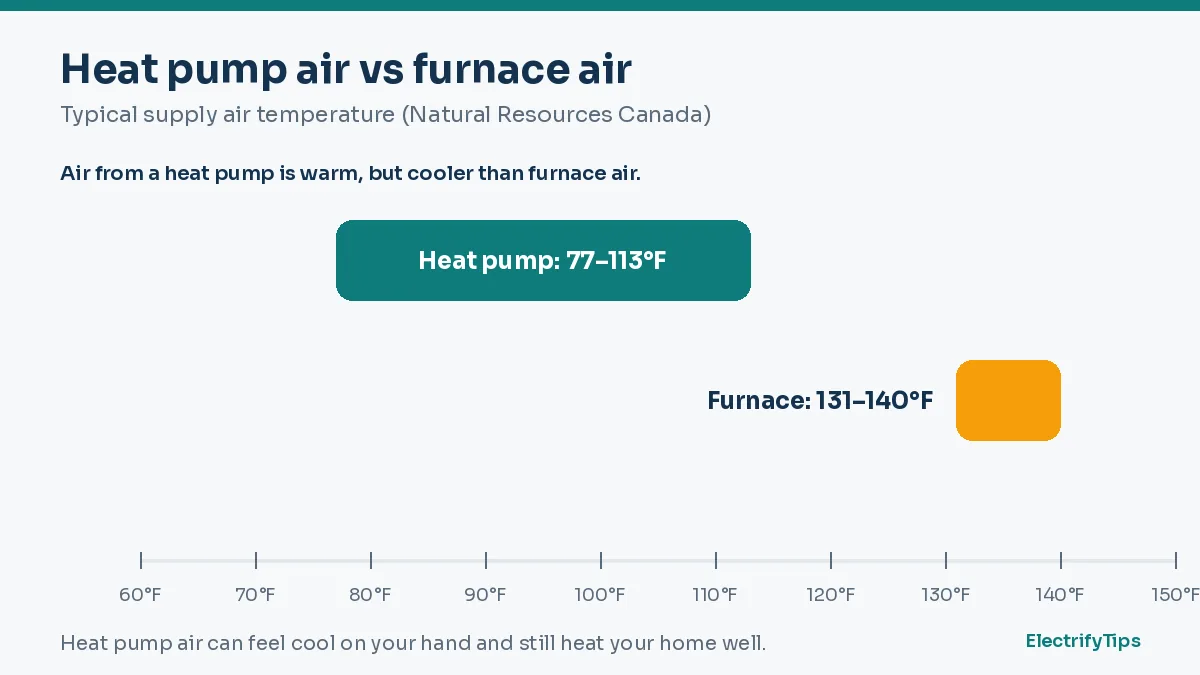
An air-source heat pump usually heats air to about 77–113°F (25–45°C). A furnace heats it to about 131–140°F (55–60°C), according to Natural Resources Canada. If you had a furnace before, you will notice the difference. Air at the lower end of that range can feel cool on your hand, because it is close to skin temperature and it is moving.
The best test is simple: does your home reach the temperature set on the thermostat? If it does, the heat pump is most likely doing its job, even if the air feels mild.
| What you notice | Likely cause | What to do |
|---|---|---|
| Cool air for a few minutes, and the outdoor fan has stopped | Defrost cycle | Wait. This is normal. |
| Mild air all the time, but the house stays warm | Normal heat pump air | Nothing. Keep the fan on Auto. |
| Cool air between heating cycles | Fan set to On | Set the fan to Auto. |
| Weak airflow and cool air | Dirty filter or blocked vents | Clean or replace the filter, open the vents. |
| Cold air and the house is getting colder | Wrong mode, or a problem with refrigerant or a part | Check the settings, then call a technician. |
| The outdoor unit stays covered in ice | Defrost problem | Call a technician. |
Normal cause: the defrost cycle
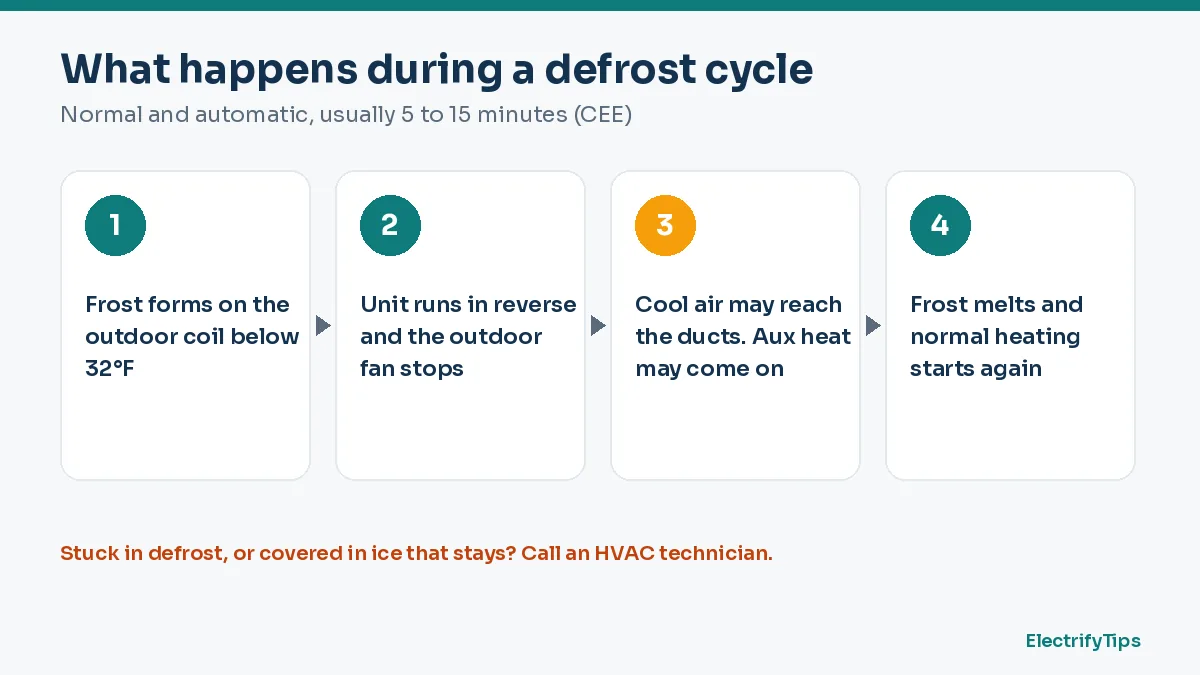
In cold, damp weather, frost forms on the outdoor coil when the coil drops below 32°F. Frost blocks the coil, so the heat pump melts it by running in reverse for a short time. Natural Resources Canada explains that the reversing valve switches the unit to cooling mode and the outdoor fan stops. While this happens, the heat pump is cooling the air in the ducts.
What a normal defrost looks like:
- The outdoor fan stops, but the unit is still running.
- It typically lasts 5 to 15 minutes, according to the Consortium for Energy Efficiency (CEE).
- The indoor fan may stop or slow down.
- Many systems turn on backup heat (aux heat) during defrost, so the air may not feel cold at all.
- On ductless (mini-split) systems, the indoor unit may blow some cool air or pause.
Defrost can start every 30, 60 or 90 minutes, depending on the climate and the system. It is normal and automatic. Do not turn the heat pump off when it happens. To learn what the backup heat is doing, read our guide to aux heat vs emergency heat.
Check your thermostat settings (5 minutes)
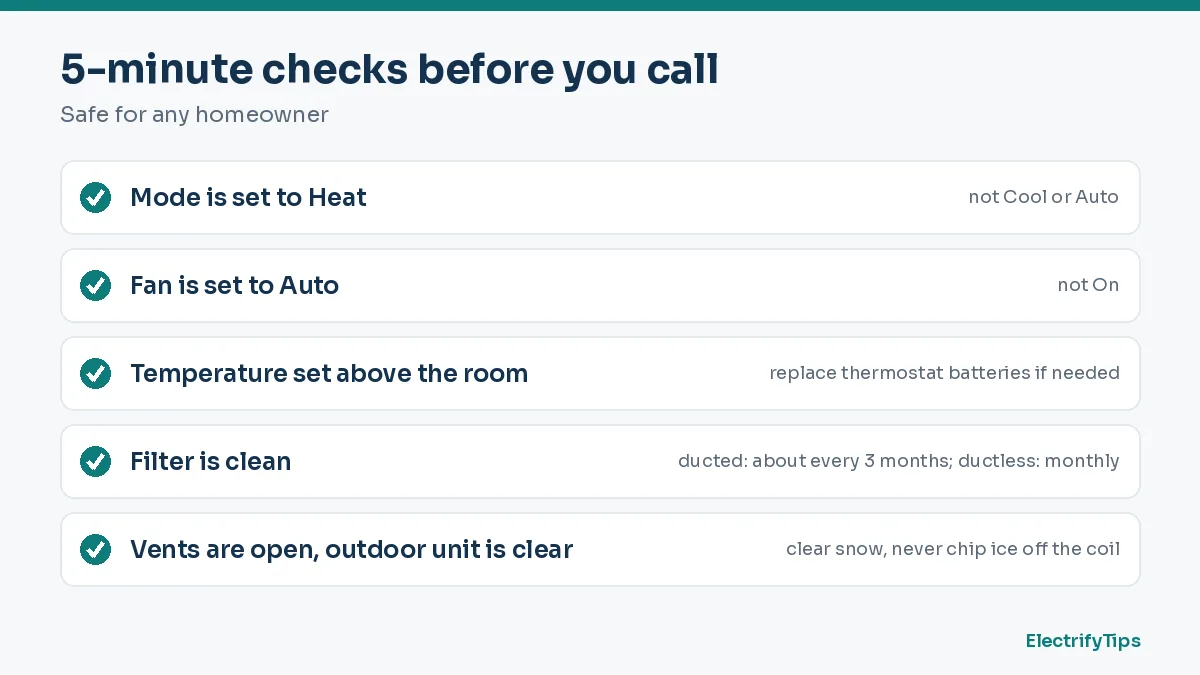
- Mode: Heat, not Cool or Auto. In Auto mode, the heat pump switches between Cool and Heat by itself. Efficiency Maine warns that this can air-condition your home on a sunny winter day. CEE also recommends Heat mode in winter.
- Fan: Auto, not On. With the fan set to On, the indoor fan keeps running even when the heat pump is not heating, so you feel room-temperature air moving. CEE says continuous indoor fan operation can harm heat pump performance.
- Temperature: set above the room temperature. If the thermostat uses batteries and the screen is blank or faint, replace them.
- Emergency heat: only when you need it. Emergency heat turns off the heat pump and uses only the backup heat. If someone switched it on by mistake, switch it back. Our aux heat vs emergency heat guide explains when to use it.
Check the airflow (5 minutes)
- Filter. A dirty filter cuts airflow, and the DOE says heat pump performance drops when airflow is too low. Replace or clean a ducted system filter about every 3 months, and clean a ductless filter at least once a month (CEE).
- Vents and registers. Make sure they are open and not blocked by furniture or carpets.
- Outdoor unit. Clear snow drifts away from it. Do not try to break ice off the coil. If ice stays on it, call a technician.
Our heat pump maintenance checklist lists every safe task you can do yourself.
When to call a technician
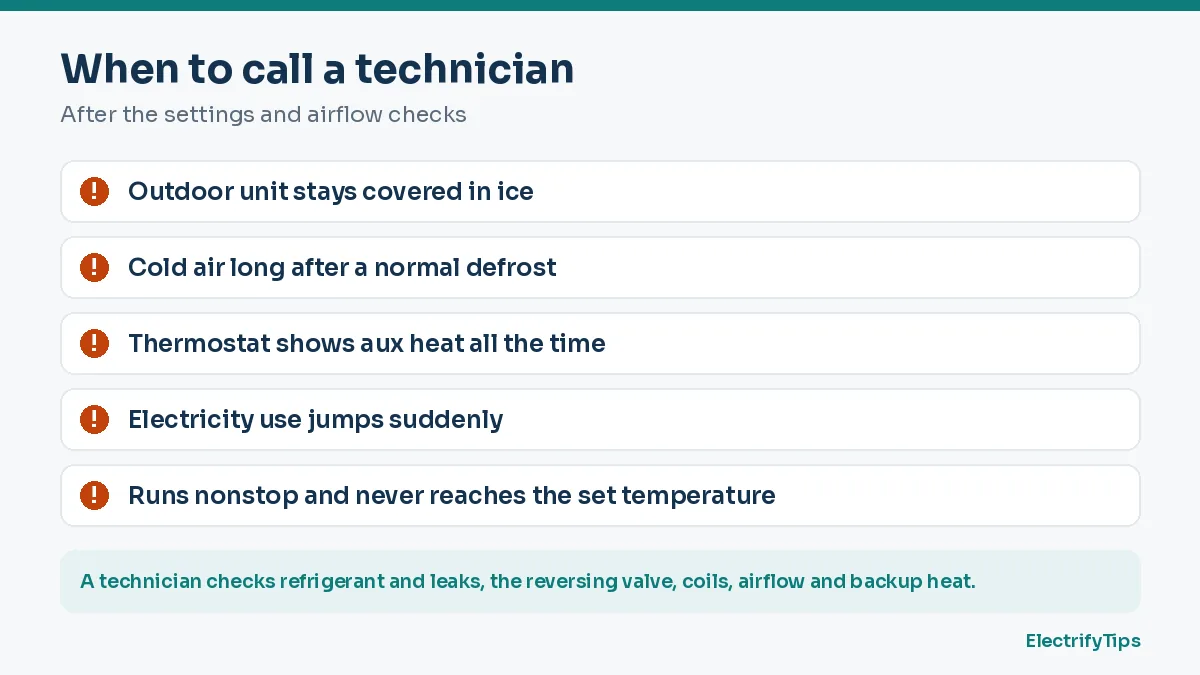
After you check the settings and the airflow, call an HVAC technician if:
- The outdoor unit stays covered in ice, or it seems stuck in defrost.
- The air stays cold long after a normal defrost, and the house is getting colder.
- The thermostat shows aux heat all the time.
- Your electricity use jumps suddenly, which CEE calls the most common sign of a problem.
- The heat pump runs nonstop and never reaches the set temperature. See why a heat pump runs constantly in winter.
A technician can check things you should not try yourself:
- Refrigerant. Too much or too little refrigerant reduces heat pump performance, says the DOE. The technician checks the charge and looks for leaks.
- Reversing valve. This part switches the system between heating and cooling. If it fails, the heat pump may not heat properly. Learn more in heat pump vs air conditioner.
- Coils, airflow and backup heat. CEE lists cleaning the coils, checking airflow, checking thermostat settings and making sure backup heat only runs when needed.
On very cold days, some heat pumps cannot keep up alone, and backup heat helps. If yours never keeps up, ask the technician whether it is the right size. Our Heat Pump Sizing Calculator gives a rough estimate to start that talk.
FAQ
Is it normal for a heat pump to blow cold air during defrost?
Yes. During defrost the heat pump runs in reverse for a short time to melt frost on the outdoor coil, so a ducted system can blow cool air. It typically lasts 5 to 15 minutes. Many systems turn on backup heat during defrost to keep the air warmer.
Why does my heat pump air feel cool even when it is heating?
Heat pump air is cooler than furnace air, usually about 77–113°F compared with about 131–140°F from a furnace. It can feel cool on your hand. If your home reaches the set temperature, the system is working.
Should my heat pump fan be on Auto or On in winter?
Auto. With the fan set to On, it keeps blowing room-temperature air between heating cycles, which feels cool. CEE says continuous fan operation can also harm heat pump performance.
How long should a heat pump defrost cycle last?
Typically 5 to 15 minutes. If the outdoor unit seems stuck in defrost or stays covered in ice, call an HVAC technician.
Can low refrigerant make a heat pump blow cold air?
It can make the heat pump work poorly. The DOE says too much or too little refrigerant reduces performance. Low refrigerant usually means a leak, so a technician needs to find and fix it.
Sources & references
- https://natural-resources.canada.ca/energy-efficiency/energy-star/heating-cooling-heat-pump
- https://bsesc.energy.gov/sites/default/files/2024-09/CEE_You_Installed_an_ASHP_Now_What_TRC_01.16.24_1.pdf
- https://www.efficiencymaine.com/at-home/heat-pump-user-tips/
- https://www.energy.gov/energysaver/air-source-heat-pumps