Quick answer
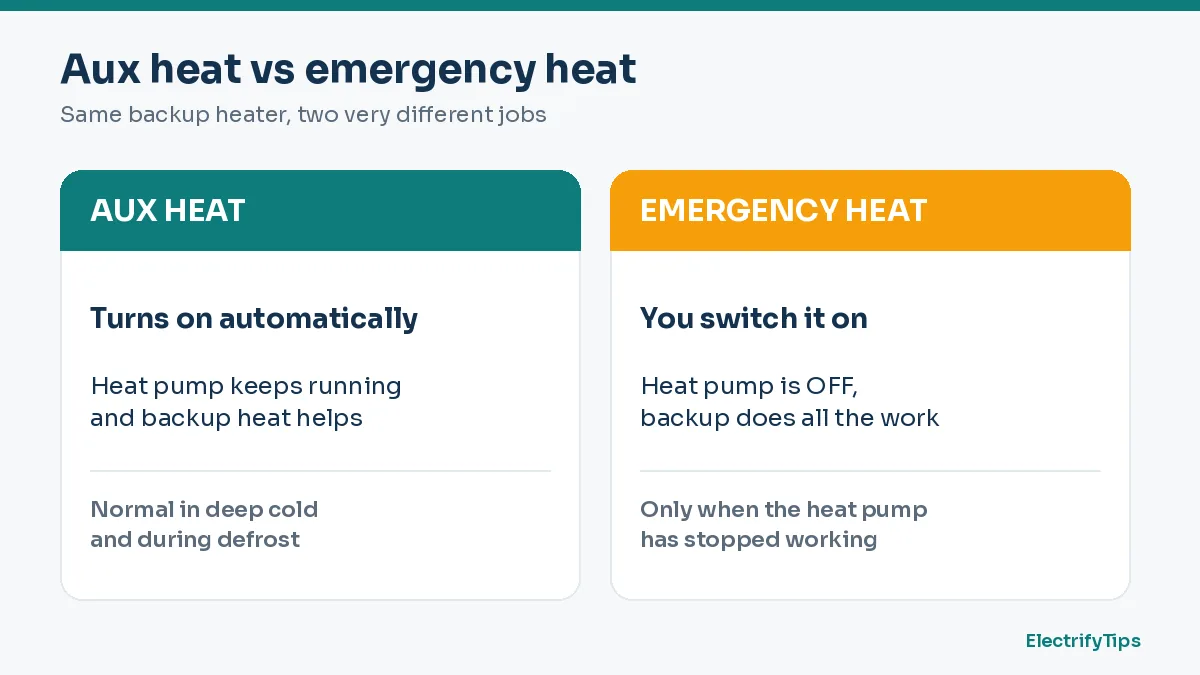
Aux heat is automatic backup that helps your heat pump in deep cold and during defrost. Emergency heat is a manual mode that shuts the heat pump off; use it only when the heat pump has stopped working.
If your thermostat says “Aux Heat On,” your heat pump is getting help from its backup heat. “Em Heat” or “Emergency Heat” is different: it’s a setting you choose, and it turns the heat pump off. That’s the whole story of aux heat vs emergency heat in two sentences. This guide explains what each one does, when each is normal, what it costs, and when to call a technician. It’s part of our complete heat pump guide.
The short answer
- Aux heat is automatic. Honeywell Home describes it as backup heat that turns on to help the compressor hold your temperature setting. The heat pump and the backup can run at the same time.
- Emergency heat is manual. It runs only when you move the thermostat to Em Heat, and then the compressor doesn’t run, Honeywell Home says.
- Often the same heater, used two ways. Honeywell notes the emergency heat and the aux heat are commonly the same source: electric heat strips or a fossil-fuel furnace.
- Some aux heat is normal in very cold weather and during defrost. Aux on most of the time, or on mild days, is worth a service call.
- Use emergency heat only when the heat pump isn’t working, until it’s repaired.
Aux heat vs emergency heat at a glance
| Heat (normal) | Heat with aux | Emergency heat | |
|---|---|---|---|
| How it starts | You set Heat | Automatically, when the thermostat calls for more heat | You choose Em Heat |
| Outdoor heat pump | Runs | Usually keeps running; turns off in a dual fuel system | Off |
| Backup heat | Off | On | On |
| What you’ll see | Heat On | Aux Heat On (wording varies by brand) | Em Heat |
| Normal when | Most of the winter | The coldest hours, defrost, short recoveries | The heat pump has stopped working |
| Running cost | Lowest | Higher while aux runs | Highest with electric strips |
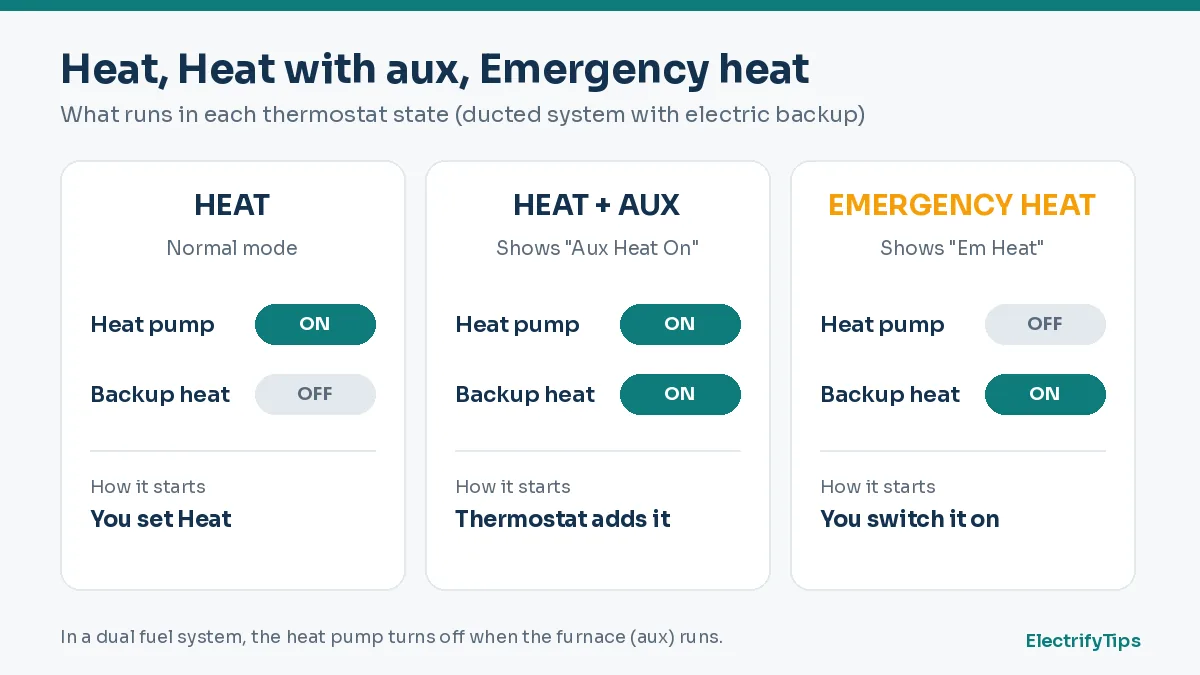
One thing that changes the middle column: what your backup heat is. Lennox explains that with electric heat in the air handler, aux runs alongside the heat pump. With a dual fuel system, the heat pump turns off and only the furnace runs. If you have a ductless mini-split, you may not see Aux or Em Heat at all. Natural Resources Canada (NRCan) notes ductless units usually come with a single-stage thermostat or a remote.
What aux heat is, and why it turns on
Most ducted heat pumps use what NRCan calls a “two-stage heat” thermostat. Stage one calls for heat from the heat pump. Stage two calls for the supplementary heat if the room keeps getting colder. Aux heat is that second stage.
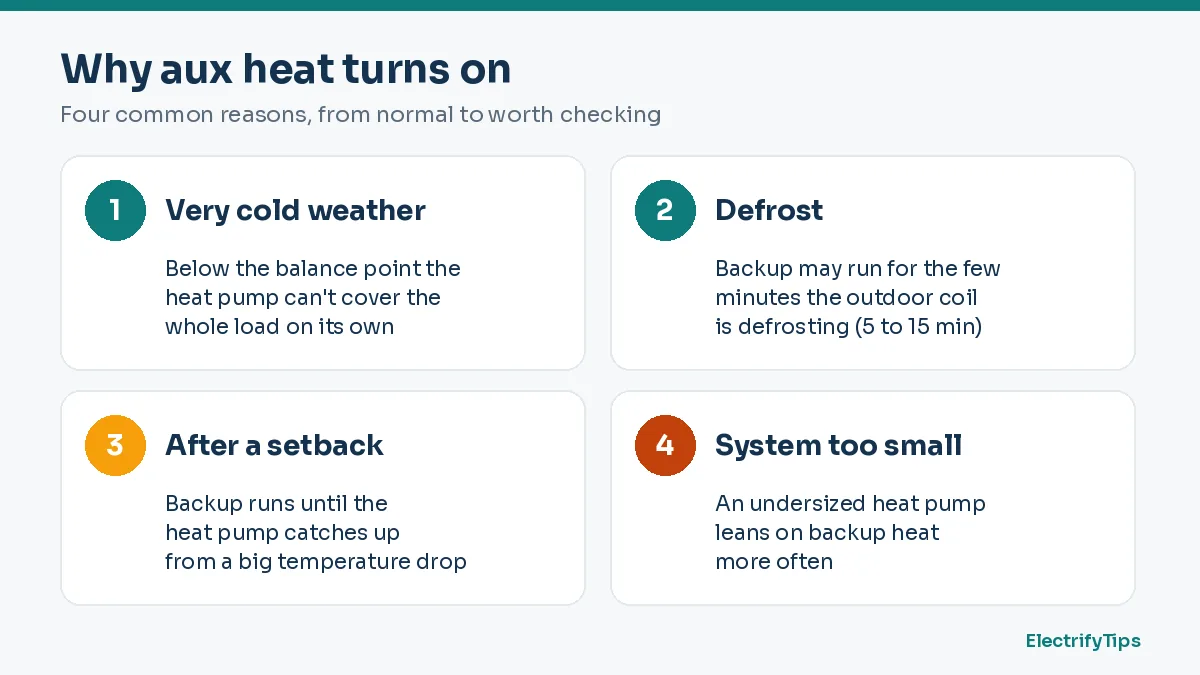
It usually comes on for one of four reasons:
- Very cold weather. A heat pump’s output drops as it gets colder. Below what NRCan calls the thermal balance point, the heat pump “can supply only part of the heat required,” so the backup fills the gap. Walton EMC, a Georgia electric co-op, adds that with a properly sized heat pump this should be rare.
- Defrost. In defrost, the heat pump briefly runs in reverse to melt frost off the outdoor coil, and NRCan notes it cools the air in your ducts while it does. A homeowner guide from the Consortium for Energy Efficiency, hosted by DOE, says ducted systems may run supplemental heat during defrost, and that defrost typically takes 5 to 15 minutes. A short burst of aux with steam rising outside is expected.
- Catching up after a setback. If you turn the heat down at night and back up in the morning, NRCan says the backup may run until the heat pump “catches up.” It recommends setbacks of no more than 2°C (about 4°F), or a thermostat that starts recovery early.
- A heat pump that’s too small. NRCan says an undersized system will use its supplemental heat more often. Our guide to what size heat pump you need explains the load calculation behind sizing.
In a dual fuel system, “aux” means the furnace. NRCan says only one of the two runs at a time. The temperature where it switches over is a setting your installer chooses, and our dual fuel heat pump guide explains how to pick it.
Aux heat lockouts
Many systems have a lockout: an outdoor temperature above which aux heat isn’t allowed to run. Rules differ by place. Washington State’s energy code requires controls that keep supplemental heat off above 40°F, set to 35°F or lower at final inspection, according to a 2024 opinion from the state’s Building Code Council. The Bonneville Power Administration’s PTCS program also specifies 35°F or lower. These are one state’s code and one regional program, not a national rule. If your aux heat runs on mild days, ask your installer what lockout is set, if any.
What emergency heat is, and when to use it
Emergency heat makes the backup do all the work. Lennox describes it as using your supplemental heat “by itself, without the use of your heat pump.” Because it’s a manual setting, it stays on until you switch back to Heat.
The main use is a broken heat pump. Walton EMC’s advice: if the heat pump isn’t keeping the house warm, look at the outdoor unit. If it’s not running, switch to emergency heat and call an HVAC contractor.
What it isn’t for is a cold day. Walton EMC’s member services specialist puts it plainly: “Never switch your heat pump to emergency or auxiliary heat if it’s working properly.” If the heat pump is running, Heat mode already calls for aux heat when it’s needed.
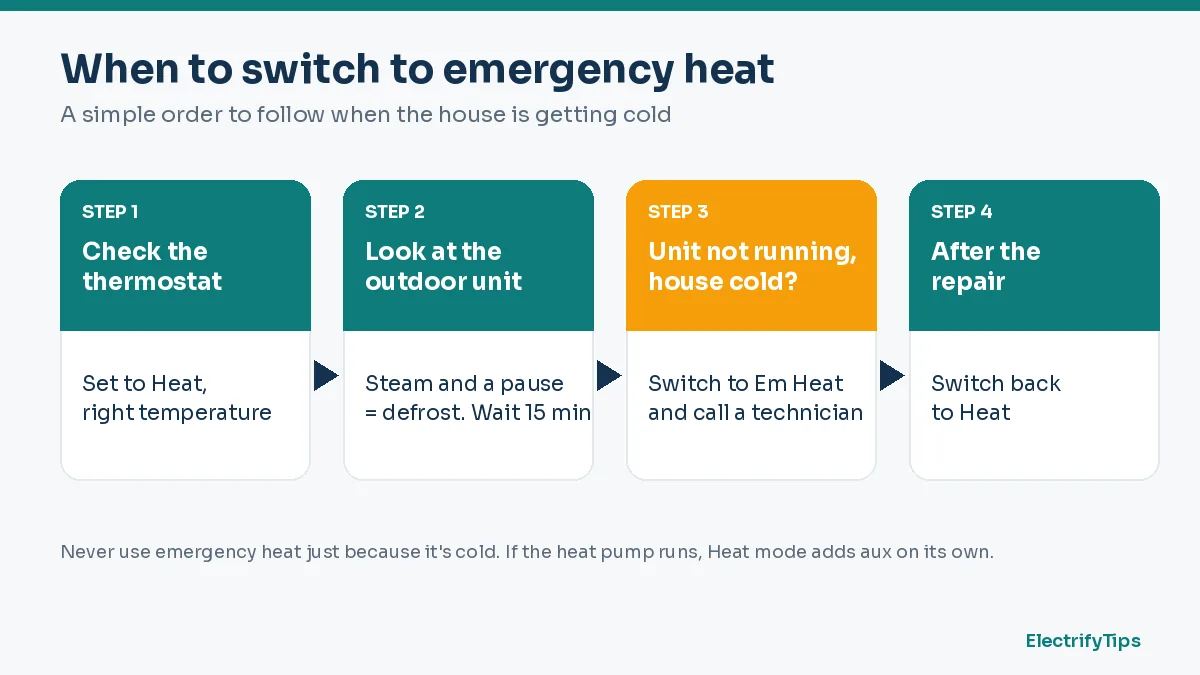
A simple order to follow:
- Check the thermostat. Make sure it’s set to Heat and the temperature is what you expect.
- Look at the outdoor unit. A short pause with steam rising is defrost. Give it 15 minutes.
- If the outdoor unit isn’t running and the house is getting cold, switch to Em Heat and call a technician.
- After the repair, switch back to Heat.
What each mode costs to run
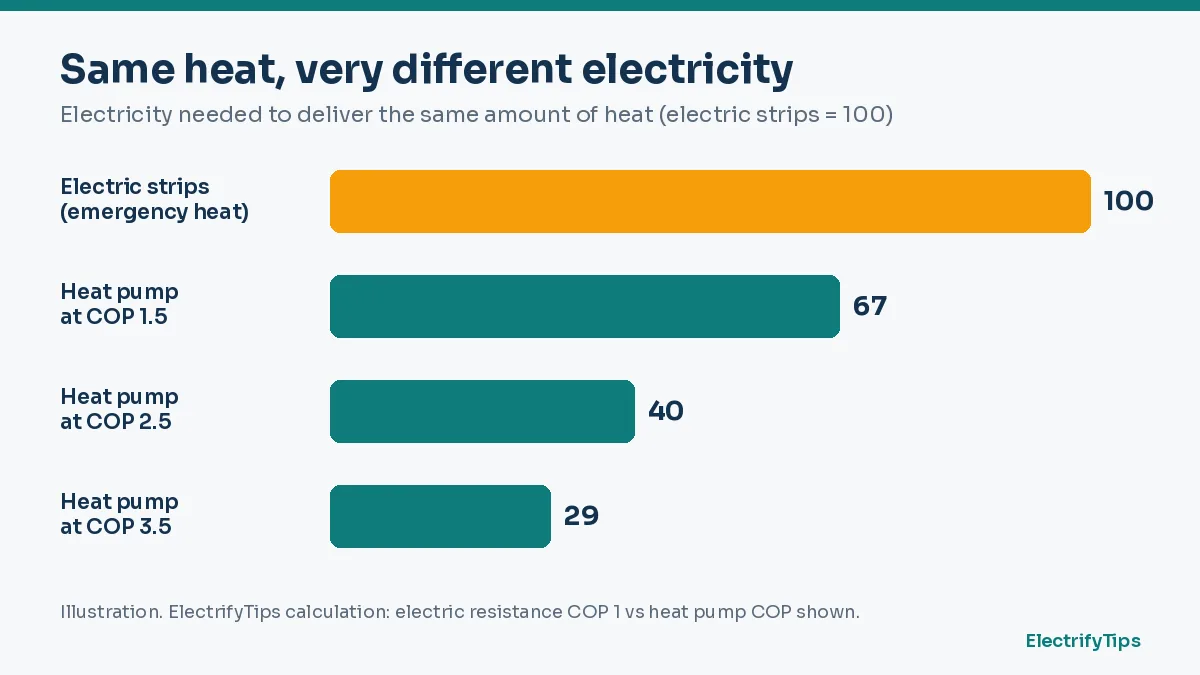
Electric resistance heat has a coefficient of performance (COP) of 1, the CEE guide notes: one unit of heat for each unit of electricity. A heat pump at a COP of 3 gives three. So for the same heat, strip heat uses as many times more electricity as your heat pump’s COP at that moment.
| Heat pump COP at that moment | Electric strips use this much more electricity for the same heat |
|---|---|
| 1.5 | 1.5 times |
| 2.5 | 2.5 times |
| 3.5 | 3.5 times |
ElectrifyTips calculation: strip heat COP 1 ÷ heat pump COP.
NRCan says air-source heat pump COPs typically range from 2.0 to 5.4 at 46°F (8°C) and from 1.1 to 3.7 at 18°F (–8°C). So emergency heat on a mild day costs the most compared with what the heat pump would have used. How much more you pay depends on your heat pump’s COP and the weather. Our SEER2, HSPF2 and COP guide explains COP in more detail.
To estimate the cost of electric strips per hour, ask your installer for the backup heater’s size in kilowatts. Each kilowatt running for one hour uses 1 kWh. For example (made-up numbers), a 10 kW heater running for 2 hours uses 20 kWh; multiply that by your electricity rate. With a dual fuel system, the backup cost depends on your gas or propane price instead. Our Operating Cost Comparison tool compares heating costs at your own rates.
When aux heat is a sign of a problem
| Usually normal | Worth checking |
|---|---|
| Aux for a few minutes during defrost, with steam outside | Aux shown most of the time |
| Aux in the coldest hours of the year | Aux on mild days |
| Aux briefly after you raise the temperature | Em Heat left on by mistake |
| Higher bills in the coldest months | A sudden jump in kWh with no change in weather |
The CEE guide lists “auxiliary heating mode is constantly displayed on the thermostat” as a sign your heat pump isn’t working properly. It calls a sudden increase in electricity use the most common sign.
Before you call, check the easy things: the mode is Heat, not Em Heat; you’re not using deep setbacks; the filter is clean; and snow isn’t blocking the outdoor unit. Our guide to a heat pump running constantly in winter walks through six checks like these.
If aux still runs a lot, call a qualified HVAC technician. The CEE guide says a service visit should check that supplemental heat comes on only when needed. Ask about the lockout setting too. If aux has run heavily since the day the system was installed, ask for the load calculation it was sized from. Our heat pump maintenance checklist covers what to have checked each year.
Frequently asked questions
Is it bad if my thermostat says aux heat?
Not usually. Some aux heat is normal in very cold weather, during defrost and after a temperature increase. It’s worth checking if aux runs most of the time or on mild days.
Should I turn on emergency heat when it’s very cold outside?
No, not if the heat pump is working. In Heat mode the thermostat calls for aux heat automatically when it’s needed. Walton EMC says emergency heat is for when the heat pump malfunctions.
Are aux heat and emergency heat the same heater?
Often, yes. Honeywell Home says they’re commonly the same source, either electric heat strips or a furnace. The difference is that aux works alongside the heat pump (except in dual fuel systems), while emergency heat shuts the heat pump off.
Why does aux heat come on during defrost?
During defrost, the heat pump briefly moves heat outdoors to melt frost, which cools the air in your ducts. The CEE guide says ducted systems may run backup heat for those few minutes to prevent a gap in heating.
Does emergency heat turn off by itself?
No. It’s a manual setting, so switch back to Heat once the heat pump is repaired.
Sources & references
- https://www.honeywellhome.com/blogs/support/prestige-hd-7-day-programmable-thermostat-3
- https://www.honeywellhome.com/blogs/support/7-day-programmable-thermostats-7
- https://www.lennox.com/residential/support/faqs/what-is-the-difference-between-emergency-heat-and-auxiliary-heat
- https://natural-resources.canada.ca/energy-efficiency/energy-star/heating-cooling-heat-pump
- https://www.waltonemc.com/realite-newsletter/knowledge-is-power-emergency-heat/
- https://bsesc.energy.gov/sites/default/files/2024-09/CEE_You_Installed_an_ASHP_Now_What_TRC_01.16.24_1.pdf
- https://sbcc.wa.gov/sites/default/files/2024-07/24_06_WSEC_R406.pdf
- https://www.bpa.gov/-/media/Aep/energy-efficiency/residential/residential-ptcs-essentials/lockout-and-bp-reference.pdf