Quick answer
In many US cities and counties, installing or replacing a heat pump needs a permit, and often an electrical permit too. The installer usually pulls it, but local rules decide. An inspector checks sizing, electrical safety, service space and drainage. Confirm with your building department and get the permit details in writing in every quote.
In most of the US, yes: installing or replacing a heat pump usually needs a permit from your city or county, and often an electrical permit too. A DOE-backed permitting and inspection checklist says a permit must be obtained “BEFORE WORK STARTS.” Rules differ by place, so your local building department has the final say. Here’s how heat pump permit rules work, who usually pulls the permit, what the inspector checks, and what to ask your installer. New to heat pumps? Start with our complete heat pump guide.
Permit rules are set locally. This article explains how they usually work; it isn’t legal advice.
When a heat pump permit is required
There’s no single national rule. Each city or county adopts building, mechanical and electrical codes and decides which jobs need a permit. Here’s how five places put it on their official pages:
| Place | What the official page says |
|---|---|
| Seattle, WA | A refrigeration permit is needed for any split system heat pump. Homeowners need to hire a contractor to get it. |
| Portland, OR | Heat pumps are on the list of projects that need a mechanical permit. Most mechanical equipment projects also need an electrical permit. |
| Minneapolis, MN | “Most heating, air conditioning, ventilation, refrigeration and gas piping work requires a permit.” |
| Massachusetts | Installing a mini-split, as equipment covered by the residential code, triggers a permit. The local building official decides each case. |
| Contra Costa County, CA | Permits are required to install a new unit and to replace an existing one. A duct leakage test by a HERS rater may be required. |
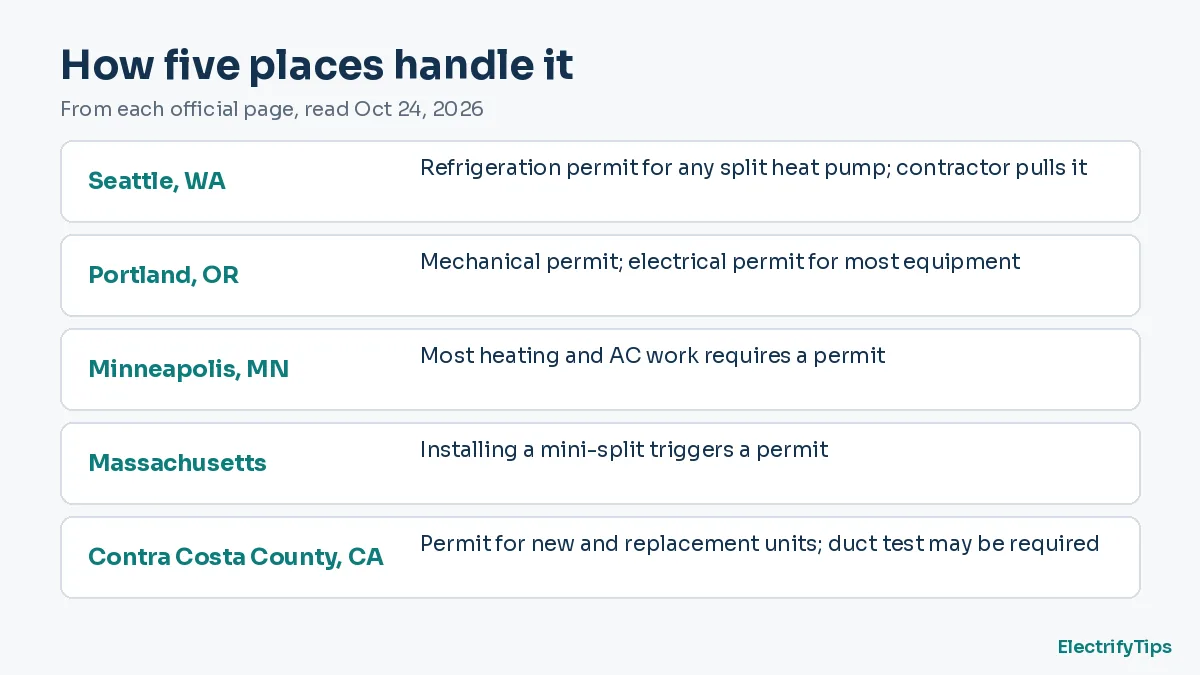
The pattern is clear: replacing an old unit is still permit work in many places, not just new installs. Search “[your city] mechanical permit” or call your building department to confirm.
Who pulls the permit?
Usually the installer does, and the price should include it. But local rules decide who is allowed to:
- Seattle only lets licensed contractors get a heat pump (refrigeration) permit.
- Portland lets homeowners do their own mechanical work on a home they own.
Even where homeowners may pull a permit, refrigerant work is different. EPA says homeowners should work with dealers whose technicians are EPA-certified to handle refrigerants.
Ask every installer, in writing: who pulls the permit, is the permit fee in the price, and who schedules the inspection? Our guide on how to compare heat pump quotes shows where this belongs in a quote.

What the inspector checks
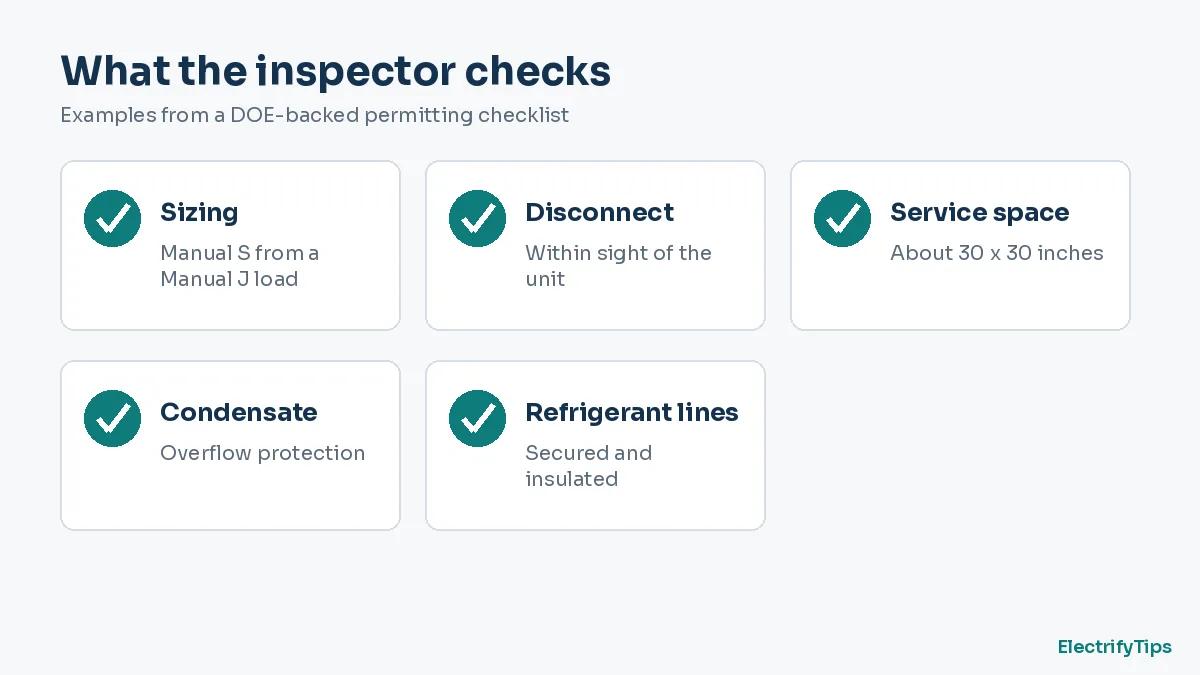
The DOE-backed checklist lists what inspectors typically look at for a heat pump install. A few examples:
- Sizing: the heat pump sized with ACCA Manual S, based on a Manual J load calculation. Our guide on what size heat pump you need explains these.
- Electrical: a disconnect within sight of the unit and readily accessible, and wiring sized for the load.
- Space to work on it: about a 30 by 30 inch level service space on the service side.
- Water: condensate drains with overflow protection where a leak could cause damage.
- Refrigerant lines: secured and insulated.
Some places add their own checks. Seattle, for example, limits heat pump noise to 45 decibels at the property line. In Contra Costa County, California, a duct leakage test by a HERS rater may be required before the final inspection.
What a permit costs, and why skipping it is a bad deal
Permit fees vary by city and job, so check your building department’s fee schedule. Some installers fold the fee into the quote; others list it separately.
Skipping the permit removes an independent check on the install. The inspector looks at sizing, electrical safety and drainage, the same things that decide how well and how safely the system runs. If an installer suggests skipping it, treat that as a warning sign.
Your permit checklist
- Find your city or county building department’s page on mechanical permits.
- In each quote, confirm who pulls the permit and whether the fee is included.
- Ask whether an electrical permit is needed too, especially if the panel or wiring changes.
- Ask whether your area needs extra tests, such as a duct leakage test.
- Keep the permit and the final inspection sign-off with your warranty papers.
- If you’re using a rebate, ask whether the program wants the permit number. Check program rules in our heat pump rebates guide.

For a rough budget, see our heat pump installation cost guide or the heat pump cost calculator.
Sources & references
- https://bsesc.energy.gov/sites/default/files/2024-10/HP-Space-Heating-Permitting-and-Inspection-Checklist.pdf
- https://seattle.gov/documents/Departments/SDCI/Permits/FurnacePermitInfographic.pdf
- https://www.portland.gov/ppd/residential-permitting/residential-mechanical-permits
- https://www.minneapolismn.gov/business-services/licenses-permits-inspections/construction-permits/permits-overview/permit-types/mechanical-heating-permits/
- https://www.mass.gov/doc/minisplit-permitting-and-licensing-guidance-for-1-2-family-dwellings/download
- https://www.contracosta.ca.gov/DocumentCenter/View/44646/RESIDENTIAL-AIR-CONDITIONING-How-to-Guide-PDF
- https://www.epa.gov/ods-phaseout/purchasing-and-repairing-home-air-conditioners-or-heat-pumps