Quick answer
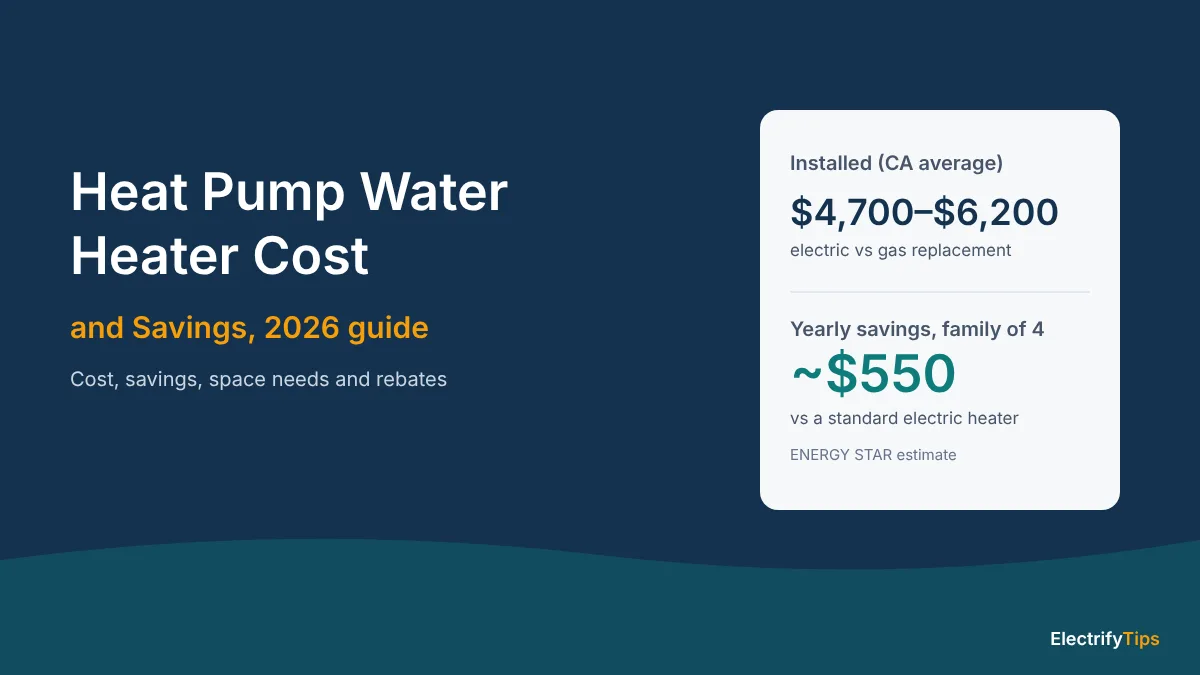
In California program data, a heat pump water heater averaged about $6,200 installed when replacing a gas tank and about $4,700 when replacing an electric one. ENERGY STAR estimates savings of about $550 a year for a family of four versus a standard electric water heater. It needs a space between 40°F and 90°F with at least 1,000 cubic feet of air. The federal HEEHR rebate (up to $1,750) now covers only electric-to-electric replacements.
A heat pump water heater looks like a normal tank with a small heat pump on top, and DOE says it can be two to three times as efficient as a standard electric water heater. It also costs more up front, needs the right space, and makes some noise. This guide uses program data and government sources to show what one costs installed, what it saves, and whether it suits your home. For the bigger picture, see our complete heat pump guide.
The short answer
- Installed cost: in California program data, the average heat pump water heater install was about $6,200 when replacing a gas tank, and about $4,700 when replacing an electric water heater (TECH Clean California data, 2021–2024).
- Yearly savings: ENERGY STAR estimates a certified heat pump water heater saves a family of four about $550 a year compared with a standard electric water heater, or about $270 a year for two people.
- Efficiency: DOE says they “can be two to three times more energy efficient than conventional electric resistance water heaters.”
- Space matters: DOE says they need a space that stays between 40°F and 90°F all year and has at least 1,000 cubic feet of air around the unit.
- Plug-in 120-volt models can skip new wiring. In a 32-home California study, their median total project cost was $5,758.
- Rebates: the federal HEEHR rebate pays up to $1,750, but since May 29, 2026 only when you’re replacing an electric water heater, not gas or propane.
How a heat pump water heater works
DOE puts it simply: heat pump water heaters “use electricity to move heat from one place to another instead of generating heat directly.” A small heat pump on top of the tank pulls heat from the surrounding air and moves it into the water. A standard electric water heater heats the water directly with resistance elements, which takes more electricity for the same hot water.
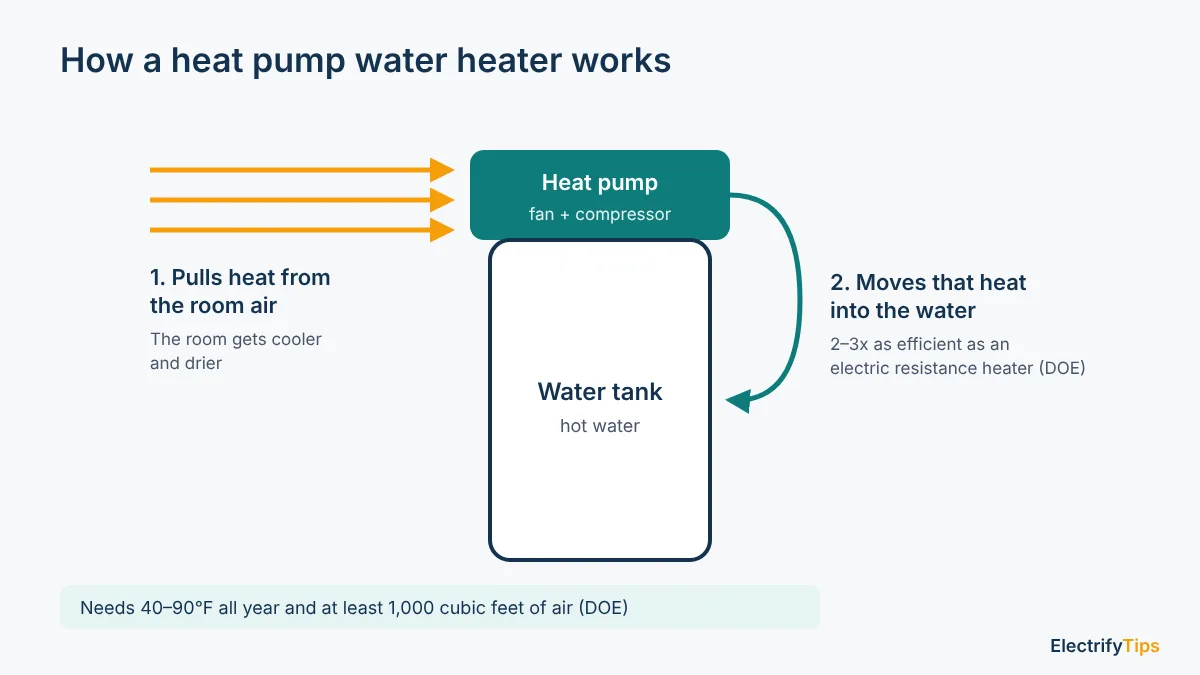
There’s a side effect: because it pulls heat out of the room, a heat pump water heater cools and dries the space it sits in. DOE notes they “will not operate efficiently in a cold space since they tend to cool the space they are in,” while a warm space, like a furnace room, “will increase their efficiency.”
What it costs to install
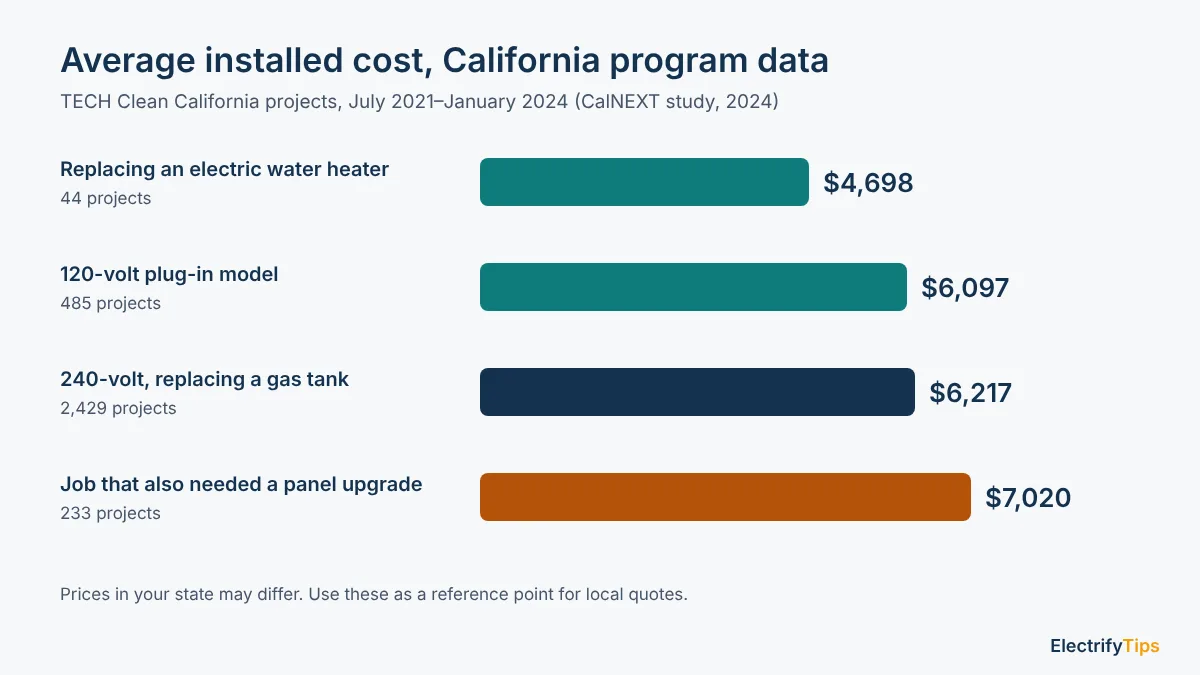
The best large data set comes from TECH Clean California, the state’s heat pump program, analyzed in a 2024 CalNEXT market study. These are average installed costs reported for projects from July 2021 to January 2024:
| Type of job | Average installed cost | Projects |
|---|---|---|
| 240-volt heat pump water heater replacing a gas tank | $6,217 | 2,429 |
| 120-volt plug-in model | $6,097 | 485 |
| Replacing an existing electric water heater | $4,698 | 44 |
| Job that also needed a panel upgrade | $7,020 | 233 |
What this tells you:
- Replacing an electric water heater is the cheapest job. It averaged about $1,500 less than replacing a gas tank. The sample is small (44 projects), so treat it as a rough guide.
- A panel upgrade adds about $800 on average in this data ($7,020 vs $6,217).
- California prices may not match yours. Labor and permit costs vary by state. Use these as a reference point and compare local quotes.
For 120-volt models, a separate field study by the New Buildings Institute, funded by California utilities, TECH Clean California and DOE, found a median total project cost of $5,758 across 32 homes. It found 120-volt installs saved between $800 and $15,000 per household compared with 240-volt installs, mainly because they needed little or no electrical work.
How much it saves
ENERGY STAR estimates the yearly savings of a certified heat pump water heater compared with a standard electric water heater:
| Household | Electricity saved per year | Money saved per year | Payback on the extra cost |
|---|---|---|---|
| 2 people | 1,880 kWh | $270 | 5.5 years |
| 3 people | 2,820 kWh | $410 | 3.7 years |
| 4 people | 3,760 kWh | $550 | 2.7 years |
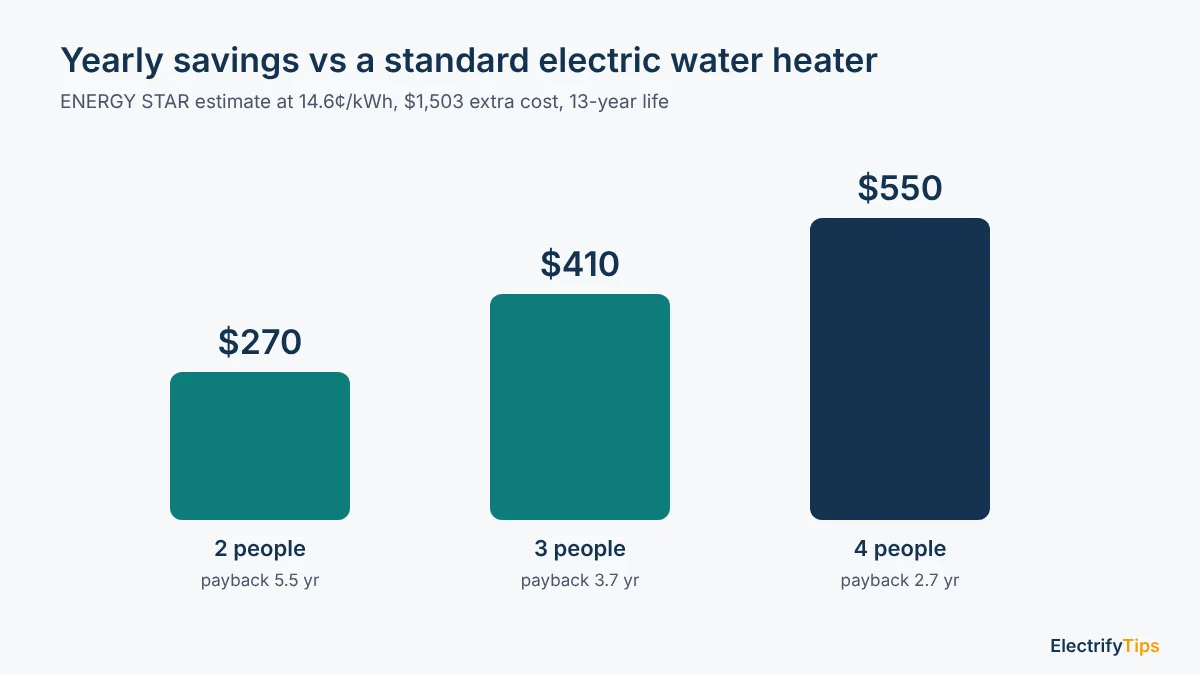
Those figures assume electricity at 14.6¢ per kWh, $1,503 in extra cost over a standard electric water heater, and a 13-year life. If your electricity costs more, you’ll save more. If it costs less, you’ll save less. Bigger households save more because they use more hot water.
Two things to keep in mind:
- These savings are against an electric water heater. If you’re replacing gas, the math depends on your gas and electricity prices, and ENERGY STAR’s figures don’t apply. Our Operating Cost Comparison tool lets you test your own rates.
- The payback is on the extra cost only, not the whole installed price. It assumes you’d be buying a new water heater anyway.
Will it work in your home?
Space and temperature. DOE says heat pump water heaters need a location that stays between 40°F and 90°F all year, with at least 1,000 cubic feet of air space around the unit. For scale, a 10 by 12 foot room with a 9-foot ceiling is 1,080 cubic feet. A garage, basement or utility room can work if it meets both conditions; a small closet won’t on its own, so ask the installer what they’d do.
It cools the room. Because it pulls heat from the air, the space around it gets cooler and drier. In a cold space, DOE says it won’t run efficiently.
Noise. It has a fan and a compressor, so it isn’t silent. In the NBI field study, participants were happy overall (30 of 32 rated it 4 or 5 out of 5), but noise was the part they liked least. Avoid putting it right next to a bedroom.
Hot water supply. In the same study, hot water delivery “typically does not fall below the setpoint temperature range of 115-125°F.”
120-volt plug-in models
Standard heat pump water heaters run on 240 volts, which may mean a new circuit or even a panel upgrade. 120-volt models are designed to avoid most of that electrical work. NBI’s field study found they “can plug into similar wall outlets for easy installation and minimal impact on the existing home electric infrastructure.”
In the TECH data above, 120-volt installs averaged $6,097, close to 240-volt jobs replacing gas ($6,217), so the saving depends on how much electrical work your home would otherwise need. Ask the installer to size the tank for your household’s hot water use.
Rebates in 2026
The federal 25C tax credit doesn’t cover equipment installed in 2026. What’s left:
- HEEHR (formerly HEAR), the state-run federal rebate, pays up to $1,750 toward a heat pump water heater for households at or below 150% of area median income (42 U.S.C. 18795a), where your state’s program is open. Since May 29, 2026, it only covers upgrades from existing electric equipment, so replacing an electric water heater can qualify, but replacing a gas or propane one can’t under new reservations.
- Utility rebates vary by area. Check your electric utility’s site, or ENERGY STAR’s Rebate Finder by ZIP code.
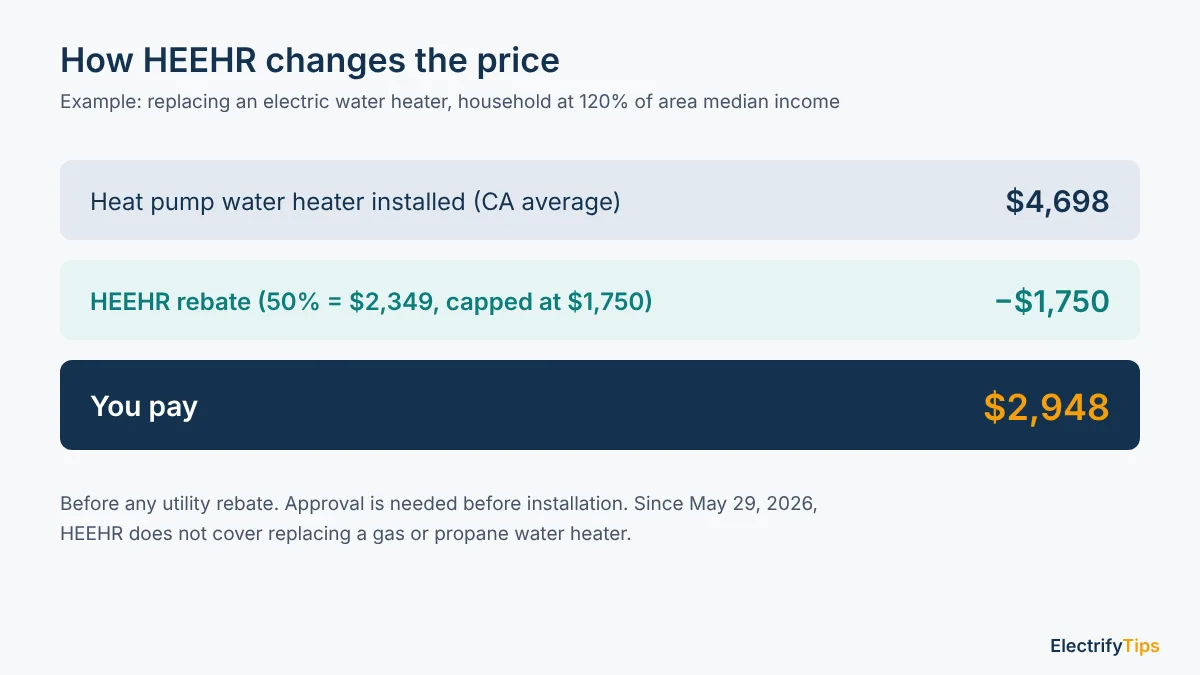
A worked example: replacing an electric water heater at the California average of $4,698, for a household at 120% of area median income. HEEHR covers 50% of the cost at that income ($2,349), but the cap is $1,750, so the rebate is $1,750 and the household pays $2,948 before any utility rebate.
Approval comes first, because federal rules don’t allow retroactive rebates. Our heat pump rebates guide explains who qualifies, state by state.
How to compare quotes
- Same tank size and type. Compare like with like: gallons, and 120-volt or 240-volt.
- Electrical work spelled out. Does it need a new circuit or a panel upgrade? Get it in writing.
- Location checked. Ask how the installer will meet DOE’s 40–90°F and 1,000-cubic-foot needs in the spot they plan to use.
- Everything itemized: equipment, labor, electrical, permits, and removal of the old tank.
- ENERGY STAR certified model, with the model number on the quote.
- Rebate approval before work starts, if you’re applying for one.
Frequently asked questions
How much does a heat pump water heater cost to install?
In California program data from 2021–2024, the average was $6,217 when replacing a gas tank and $4,698 when replacing an electric water heater. Prices vary by state, so get local quotes.
How much will a heat pump water heater save me?
ENERGY STAR estimates about $550 a year for a family of four and $270 for two people, compared with a standard electric water heater at 14.6¢ per kWh.
Is a heat pump water heater worth it if I have gas?
It depends on your gas and electricity prices. ENERGY STAR’s savings figures compare against electric water heaters, not gas. Run your rates through our Operating Cost Comparison tool before deciding.
Can I put a heat pump water heater in a closet?
Only if the space meets DOE’s needs: at least 1,000 cubic feet of air and a temperature between 40°F and 90°F all year. A small closet doesn’t meet that on its own.
Are heat pump water heaters noisy?
They make some noise from the fan and compressor. In a 32-home California study, noise was the feature owners liked least, even though 30 of the 32 rated the unit 4 or 5 out of 5 overall.
How long does a heat pump water heater last?
ENERGY STAR’s savings estimate assumes a 13-year life.
Keep reading
- Heat pumps: the complete homeowner’s guide
- Heat pump rebates and incentives (2026)
- SEER2, HSPF2 and COP explained
- How much does a heat pump cost to install?
- Operating Cost Comparison tool
Sources & references
- https://web.archive.org/web/20260605231828/https://www.energy.gov/energysaver/heat-pump-water-heaters
- https://www.energystar.gov/products/heat_pump_water_heaters/benefits-savings
- https://calnext.com/wp-content/uploads/2024/07/ET23SWE0020_Emergency-Replacement-HPWH-Market-Study_Final-Report.pdf
- https://heatpumpdata.energy.gov/system/files/files/cchp-2025-01/PlugInHeatPumpWaterHeaterFieldStudyFindingsAndMarketCommercializationRecommendations_NBI202308.pdf
- https://www.govinfo.gov/link/uscode/42/18795a
- https://www.energy.gov/documents/program-notice-26-2
- https://www.irs.gov/credits-deductions/energy-efficient-home-improvement-credit
- https://www.energystar.gov/rebate-finder