Quick answer
Natural Resources Canada gives air-source heat pumps a service life of 15 to 20 years. DOE estimates up to 24 years for geothermal indoor parts and 50+ years for the ground loop. Yearly professional service, correct sizing and a good installation help a heat pump reach that range. ENERGY STAR suggests considering replacement after 10 years, especially with frequent repairs and rising bills.
A heat pump is a big purchase, so it’s fair to ask how many years you’ll get out of it. Government guides give clear ranges: about 15 to 20 years for an air-source heat pump, and longer for a geothermal system. How long yours actually lasts depends on how well it was sized and installed, and how well it’s looked after. This guide sets out the official numbers, what wears a heat pump out, and how to decide between repairing and replacing. For the basics, start with our complete heat pump guide.
The short answer
- Air-source heat pumps: Natural Resources Canada’s heat pump guide gives “a service life of between 15 and 20 years.” DOE’s federal buying guide uses 15 years in its cost calculations.
- Geothermal (ground-source) heat pumps: DOE estimates “up to 24 years for the inside components and 50+ years for the ground loop.”
- Heat pump water heaters: ENERGY STAR’s savings figures assume a 13-year life.
- Maintenance matters. NRCan says proper maintenance “is critical” for a long service life. DOE recommends a professional service at least once a year.
- Replacement timing: ENERGY STAR suggests considering a replacement once a heat pump is more than 10 years old, especially if it needs frequent repairs and bills are rising.
Lifespan by type: the official numbers
| Type | Expected life | Source |
|---|---|---|
| Air-source heat pump | 15 to 20 years | Natural Resources Canada |
| Air-source heat pump, in federal cost calculations | 15 years | DOE Federal Energy Management Program |
| Geothermal heat pump, indoor parts | Up to 24 years (DOE); about 20 to 25 years (NRCan) | DOE Energy Saver; NRCan |
| Geothermal ground loop | 50+ years (DOE); approaching 75 years (NRCan) | DOE Energy Saver; NRCan |
| Heat pump water heater | 13 years (assumed in savings estimates) | ENERGY STAR |
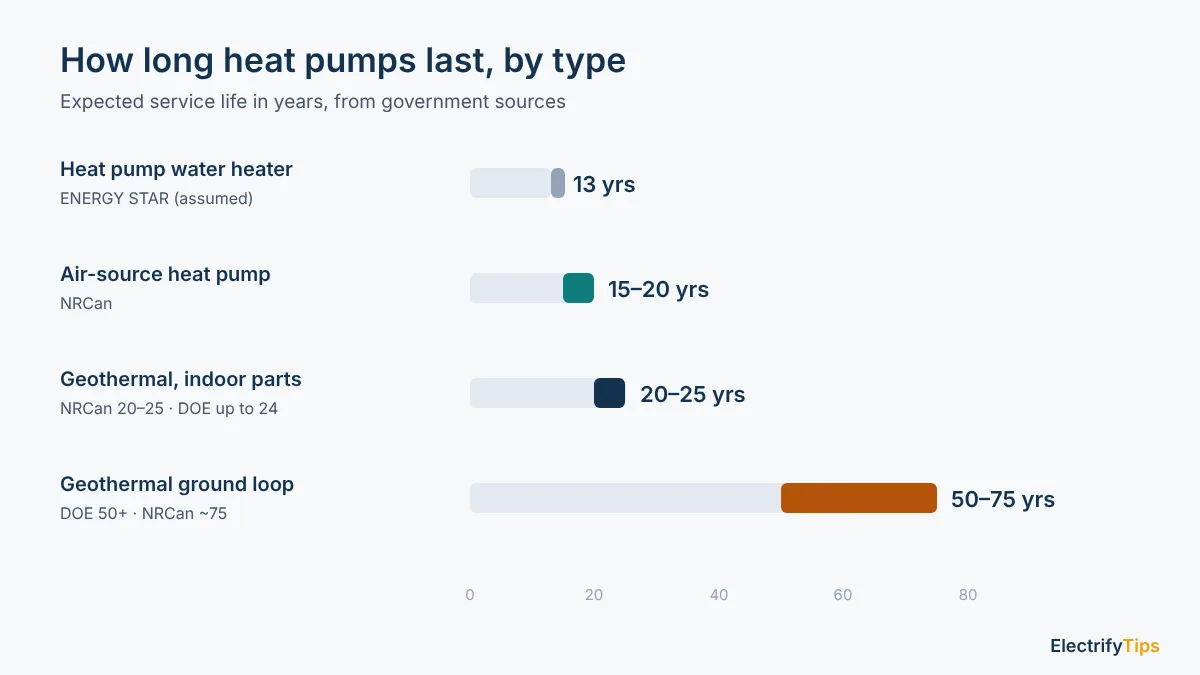
These are typical ranges, not guarantees. How long your own system lasts depends on how it was sized and installed, and how it’s maintained, as the next section explains.
Why geothermal systems last longer
NRCan explains that ground-source heat pumps last longer “because the compressor has less thermal and mechanical stress, and is protected from the environment.” The equipment sits indoors, and DOE notes that a few feet below the surface “the ground remains at a relatively constant temperature year-round.” The buried ground loop is the longest-lasting part of all. DOE also notes that the extra cost “may be returned in energy savings in 5 to 10 years, depending on the cost of energy and available incentives in your area.”
What helps a heat pump last, and what wears it out
1. Regular maintenance. NRCan says “proper maintenance is critical to ensure your heat pump operates efficiently, reliably, and has a long service life.” NRCan adds: “You should have a qualified contractor do annual maintenance on your unit,” and ENERGY STAR recommends yearly pre-season check-ups. Neglect costs you even before anything breaks: DOE says the difference in energy use between a well-maintained heat pump and “a severely neglected one can range from 10% to 25%.”
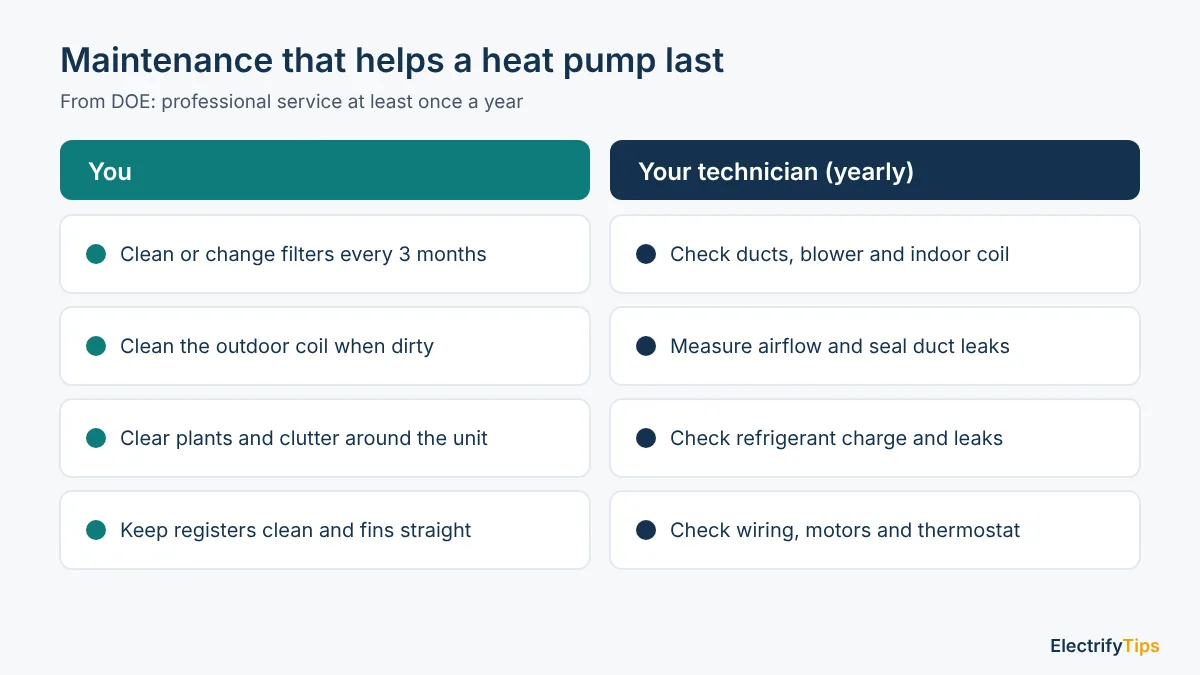
What owners can do, from DOE’s list:
- Clean or change filters every 3 months, or as the manufacturer or installer recommends.
- Clean the outdoor coils whenever they look dirty.
- With the power to the fan turned off, clear vegetation, dust, pollen and clutter from around the outdoor unit.
- Keep supply and return registers clean, and straighten their fins if they’re bent.
What the technician should check, also from DOE’s list: ducts, filters, blower and indoor coil; duct leaks; airflow; refrigerant charge and leaks; electrical connections; motors and belts; and that the controls and thermostat work correctly.
2. The right size. An oversized heat pump runs in short bursts. NRCan says that in milder weather an oversized unit “produces too much heat and the unit cycles on and off leading to discomfort, wear on the heat pump, and stand-by electric power draw.” Sizing from a proper load calculation helps avoid that. See what size heat pump you need.
3. A good installation. DOE says split-system heat pumps with “the correct refrigerant charge and airflow usually perform very close to” their rated efficiency, and that “too much or too little refrigerant” reduces performance. It also recommends that systems be leak-checked at installation and at each service call. Ask your installer how they’ll verify charge and airflow at startup.
4. Where the outdoor unit sits. DOE notes outdoor units “should be protected from high winds, which can cause defrosting problems,” and the unit needs clear airflow around it. Our guide to why a heat pump runs constantly in winter covers what to check if it’s struggling.
Repair or replace?
There’s no single official rule for when to stop repairing. ENERGY STAR lists signs that it may be time to consider replacing heating and cooling equipment:
- “Your heat pump or air conditioner is more than 10 years old.”
- “Your equipment needs frequent repairs and your energy bills are going up.”
- “Some rooms in your home are too hot or too cold.”
- “Your home has humidity problems.”
- “Your home has excessive dust.”
- “Your heating or cooling system is noisy.”
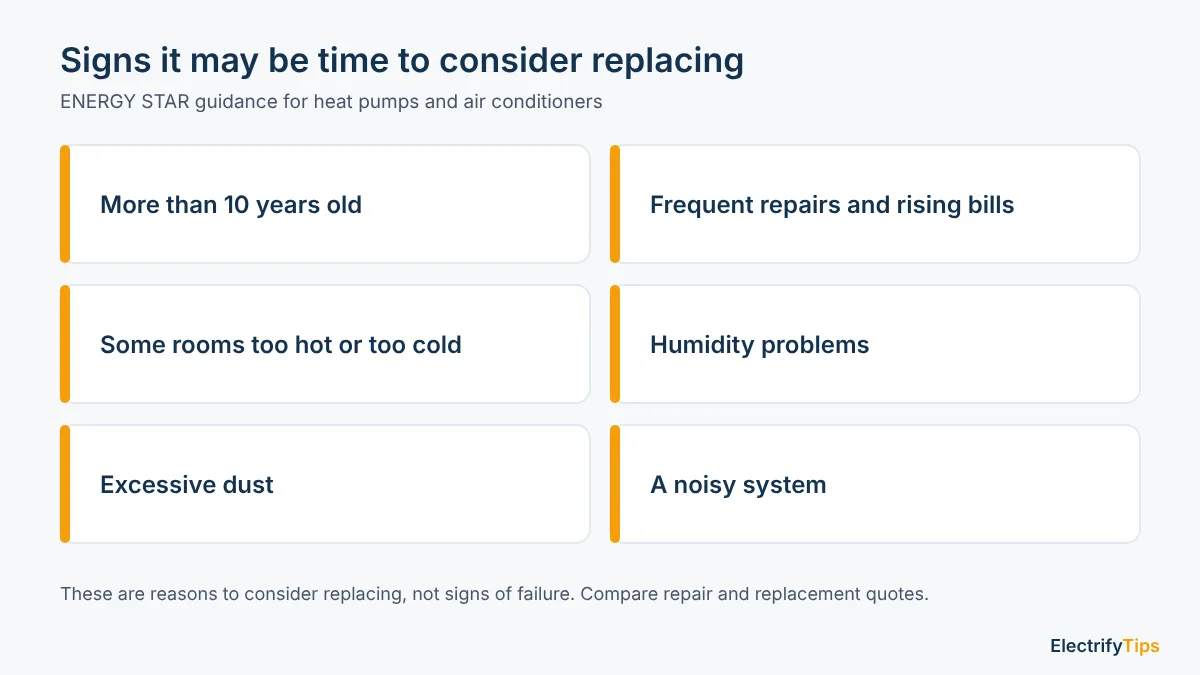
Notice that ENERGY STAR’s 10-year mark comes earlier than NRCan’s 15- to 20-year service life. ENERGY STAR doesn’t say a 10-year-old heat pump is about to fail. It says that’s the age to start considering a replacement, especially alongside frequent repairs and rising bills.
Questions to ask before deciding:
- How old is it, and what’s its efficiency rating? Since January 1, 2023, new split heat pumps must meet at least 14.3 SEER2 and 7.5 HSPF2. Our SEER2, HSPF2 and COP guide explains how to compare an old rating with a new one.
- What exactly failed, and what’s the repair quote? Get it in writing, and ask whether other parts are near the end of their life.
- Is any of it still under warranty? Check the manufacturer’s warranty and the installer’s labor warranty before paying.
- Does the house still need the same size? If you’ve added insulation or air sealing since it was installed, a new load calculation may show a smaller unit will do.
- What rebates apply? Rules have changed for 2026. Check our heat pump rebates guide and your state program before you sign.
If you’re pricing a replacement, our heat pump installation cost guide and Heat Pump Cost Calculator help you budget.
Frequently asked questions
How long does an air-source heat pump last?
Natural Resources Canada gives a service life of 15 to 20 years. DOE’s federal buying guide uses 15 years in its cost calculations.
How long does a geothermal heat pump last?
DOE estimates up to 24 years for the indoor components and 50+ years for the ground loop. NRCan gives about 20 to 25 years for the heat pump and says the ground loop’s life approaches 75 years.
When should I think about replacing a heat pump compared with a furnace?
ENERGY STAR suggests considering replacement of a heat pump after 10 years and of a furnace or boiler after 15 years. These are points to consider replacing for efficiency, not failure ages.
Does maintenance really make a difference?
Yes. NRCan calls proper maintenance critical for a long service life, and DOE says a severely neglected heat pump can use 10% to 25% more energy than a well-maintained one.
Should I replace my heat pump at 10 years old?
Not automatically. ENERGY STAR suggests considering it after 10 years, especially with frequent repairs and rising bills. If it still runs well, get a repair quote and a replacement quote and compare.
Keep reading
- Heat pumps: the complete homeowner’s guide
- Why is my heat pump running constantly in winter?
- What size heat pump do I need?
- How much does a heat pump cost to install?
- SEER2, HSPF2 and COP explained
- Heat Pump Cost Calculator
- Heat pump maintenance checklist
Sources & references
- https://natural-resources.canada.ca/energy-efficiency/energy-star/heating-cooling-heat-pump
- https://web.archive.org/web/20260529112817/https://www.energy.gov/energysaver/geothermal-heat-pumps
- https://www.energy.gov/cmei/femp/purchasing-energy-efficient-residential-air-source-heat-pumps
- https://web.archive.org/web/20260529112831/https://www.energy.gov/energysaver/operating-and-maintaining-your-heat-pump
- https://web.archive.org/web/20260602160945/https://www.energy.gov/energysaver/air-source-heat-pumps
- https://www.energystar.gov/saveathome/heating-cooling/replace
- https://www.energystar.gov/products/heat_pump_water_heaters/benefits-savings
- https://www1.eere.energy.gov/buildings/appliance_standards/pdfs/2023_CAC_Standards_FAQ_10-5-2022_Final.pdf
- https://www.energystar.gov/saveathome/heating-cooling/maintenance-checklist