Quick answer
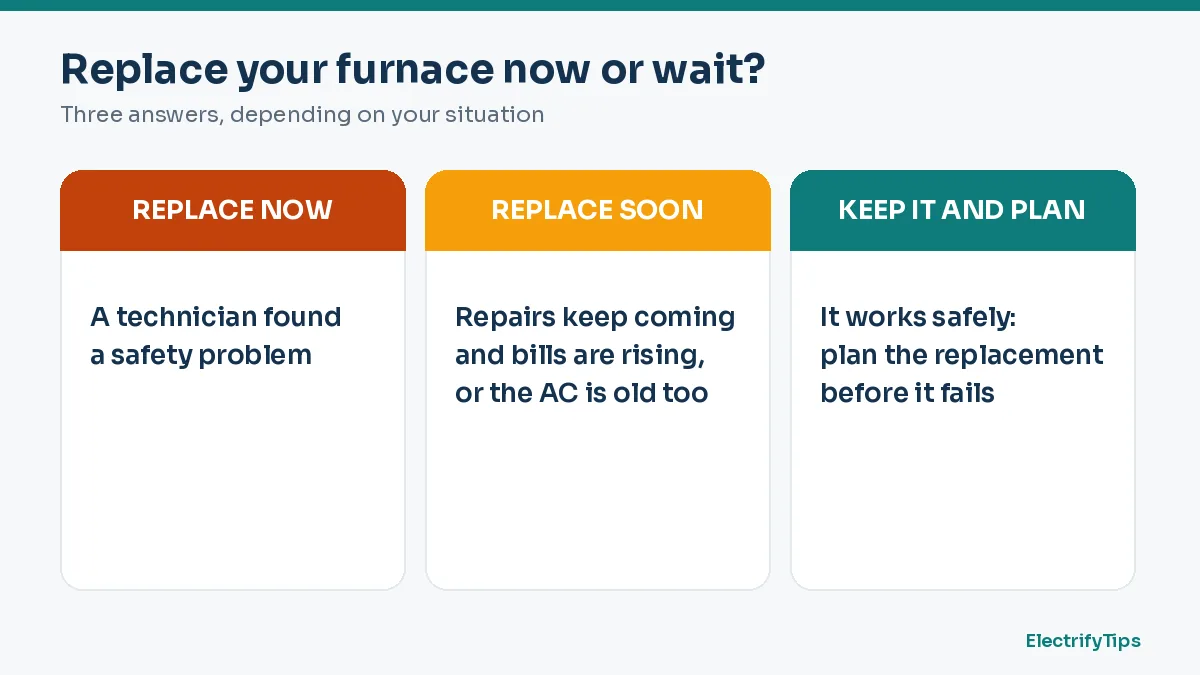
If your furnace works safely, you don't have to replace it right away, but don't wait for it to fail. Replace soon if repairs keep coming or your AC is old too, and plan the replacement now so you have time for quotes and rebates.
If your furnace still heats the house safely, you usually don’t have to replace it this week. But waiting until it breaks leaves you the fewest choices. If you’re deciding whether to replace your furnace now or wait, a middle path works for many homes: keep the furnace running while you plan its replacement. This guide covers the signs to watch, what changed in 2026, and a plan you can start today. It’s part of our complete heat pump guide.
The short answer
- Replace soon if there’s a safety problem, the repairs keep coming, or your central AC is old too. ENERGY STAR lists frequent repairs with rising bills as a sign it may be time.
- Age alone is a reason to plan, not to panic. ENERGY STAR says to consider replacing a furnace or boiler that’s “more than 15 years old.” That’s a point to start planning, not a deadline.
- Don’t wait for a breakdown. ENERGY STAR notes equipment usually shows signs of underperforming “well before you reach the point of needing an emergency replacement,” which gives you time to plan.
- There’s no tax credit to chase. The federal 25C credit covered improvements “made through December 31, 2025,” according to the IRS.
- The 2028 furnace rule is uncertain. It’s being challenged in court and at DOE, so don’t time your purchase around it alone.
Signs it’s time to replace your furnace
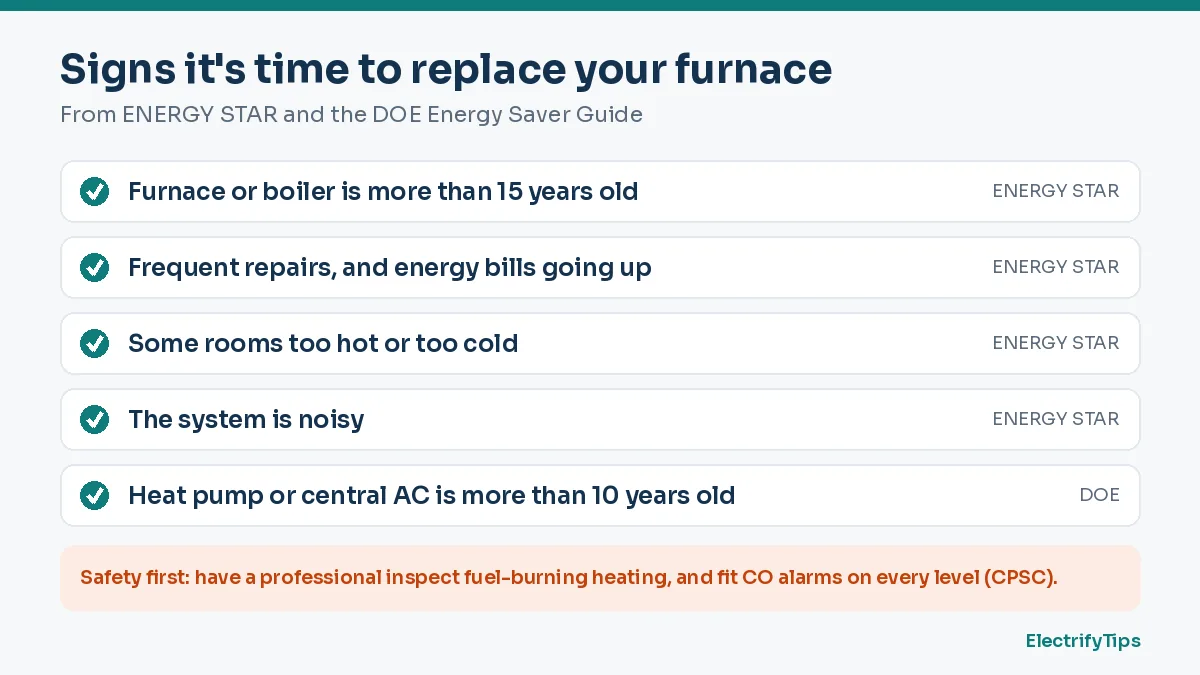
ENERGY STAR’s replacement checklist suggests calling a contractor when:
- your furnace or boiler is more than 15 years old,
- the equipment needs frequent repairs and your energy bills are going up,
- some rooms are too hot or too cold, or
- the system is noisy.
The DOE Energy Saver Guide adds one more that matters for this decision: “Your heat pump or air conditioner is more than 10 years old.” If your furnace and your central AC are both near the end, a single heat pump can replace both.
Safety comes first
A fuel-burning furnace can leak carbon monoxide (CO). The Consumer Product Safety Commission advises: “Have a professional inspect all fuel-burning heating systems,” and says “CO alarms should be placed on every level of the home and outside sleeping areas.” CPSC lists CO symptoms as “headache, dizziness, weakness, nausea, vomiting, sleepiness, and confusion.” Any safety problem a technician finds is a reason to act now, not a reason to wait.
Replace your furnace now or wait: a quick guide
There’s no official formula. These are the situations that most often tip the decision, based on the signs above.
| Your situation | What it points to | Why |
|---|---|---|
| A technician found a safety problem | Replace now | Safety can’t wait for a better season |
| Repairs keep coming and bills are rising | Replace soon | ENERGY STAR’s own sign that it may be time |
| Furnace works, but your central AC is also old | Plan to replace both together | One heat pump can replace both systems |
| Furnace is over 15 years old but runs well | Keep it and start planning | Age is ENERGY STAR’s cue to consider, not a deadline |
| Furnace is under 15 years old and trouble-free | Keep it | Keep up the yearly safety inspection |
| You heat with propane or oil | Compare a heat pump before you decide | Running costs can differ a lot by fuel |
What could tip your own answer: your local fuel and electricity prices, how leaky the house is, whether your ducts are in good shape, and whether you’d keep the furnace as backup.
Why waiting for a breakdown costs you options
When a furnace fails in cold weather, you need heat fast. That leaves little time for the steps that lead to a better choice:
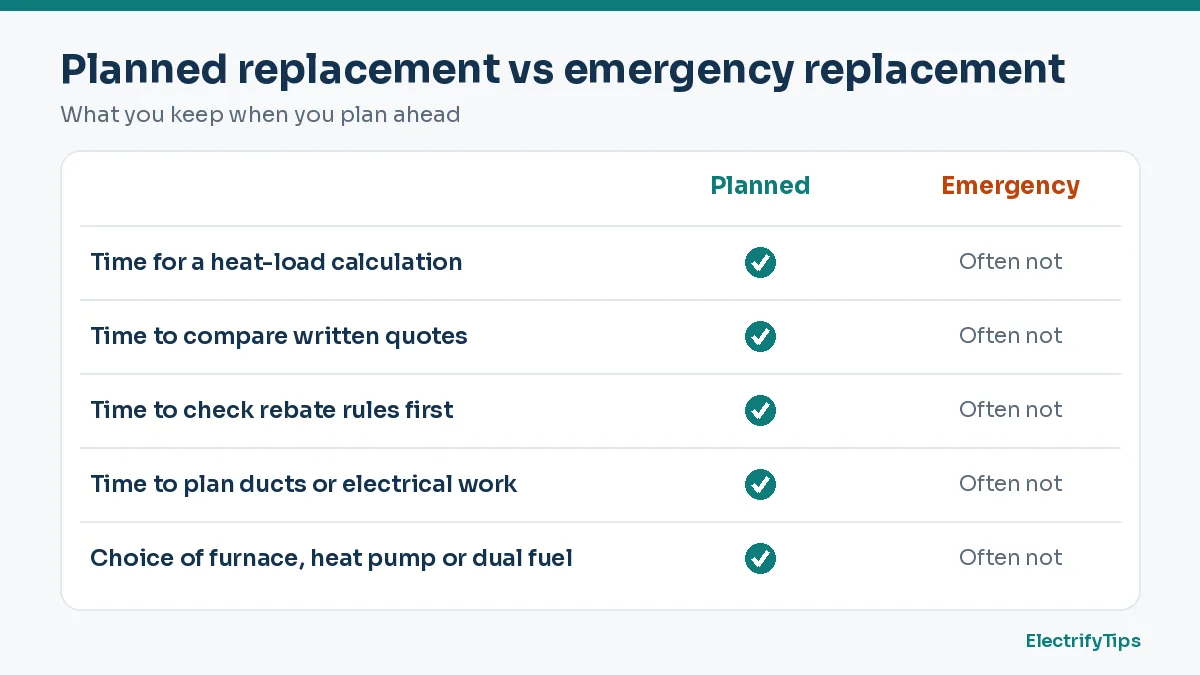
- No time for a proper sizing. A heat-load calculation takes a home visit. Our guide to comparing heat pump quotes explains why it beats “same size as the old one.”
- No time to compare quotes. Written quotes from more than one contractor take days to arrange.
- Rebates can be lost. Some programs only pay for work started after you apply or after the program opens. New Hampshire, for example, says its rebates won’t cover projects started before launch. Our heat pump rebates guide tracks state programs.
- Switching to a heat pump gets harder. Natural Resources Canada notes a new heat pump may need changes to ductwork or the electrical service. Those take time to plan.
ENERGY STAR puts it simply: spotting the symptoms early “can help you plan for a non-emergency replacement.”
What changed in 2026
Three changes affect timing this year.
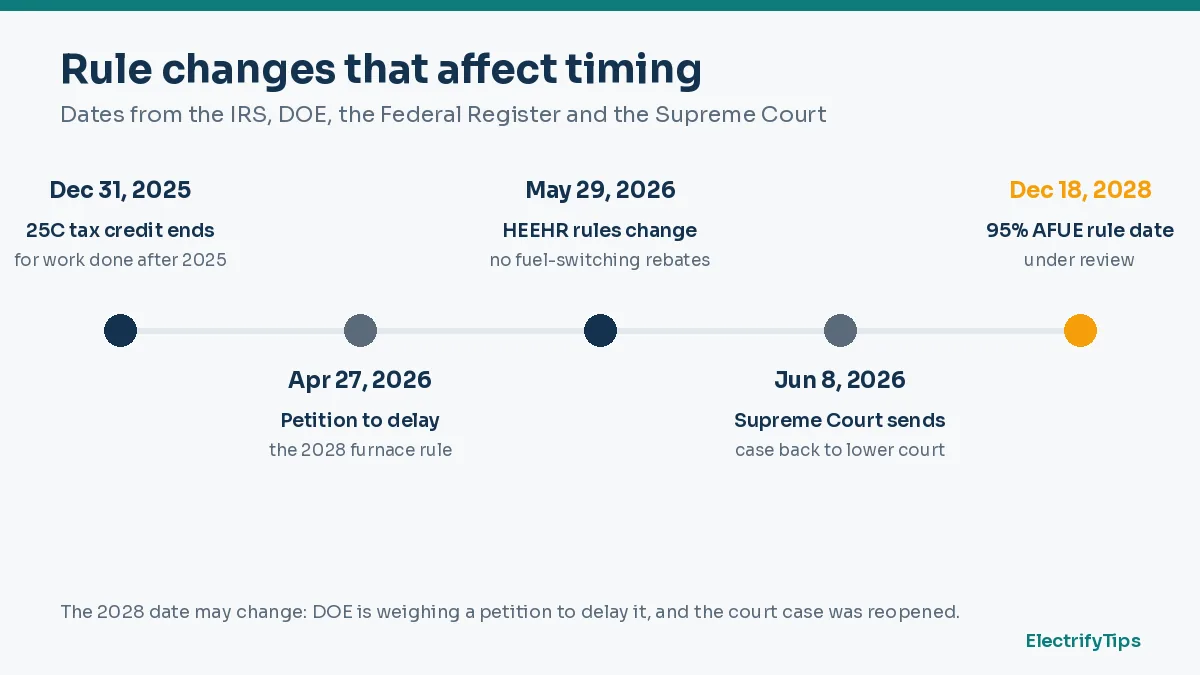
1. The federal tax credit ended. The 25C Energy Efficient Home Improvement Credit applied to improvements “made through December 31, 2025,” according to the IRS. There’s no federal credit to rush for in 2026.
2. The federal rebate rules changed. Under DOE Program Notice 26-2, effective May 29, 2026, the state-run HEEHR rebate (formerly HEAR) no longer pays for switching from gas, oil or propane to a heat pump. It does let homes “retain existing fossil-fuel HVAC systems when installing a heat pump.” It also asks homes to use the rebates for insulation and air sealing first, unless they already meet a state-specified level. How this works depends on your state, so check before you sign.
3. The 2028 gas furnace rule is in doubt. A 2023 DOE rule requires most new gas furnaces to reach 95% AFUE starting December 18, 2028. A 2026 notice says this level “effectively require[s] the use of condensing technology.” But the rule is now being reconsidered:
- Gas and propane industry groups asked DOE to move the date to January 1, 2030, according to a Federal Register notice from April 27, 2026. DOE hasn’t decided.
- On June 8, 2026, the Supreme Court sent the court challenge back to the appeals court for another look.
The rule covers new furnaces made from that date, not furnaces already in homes. So it doesn’t force anyone to replace a working furnace. If you plan to buy a new gas furnace, ask your installer which models fit your home, since the rule’s future is unclear.
Your options when you replace
- A new furnace. The simplest swap. ENERGY STAR says certified gas furnaces are up to 16% (South) or 18% (North) more efficient than baseline models.
- A heat pump. It heats and cools, so it can replace both a furnace and an AC. DOE says heat pumps “are an efficient option for all-electric houses or houses with central propane or oil.” Compare running costs in our heat pump vs gas furnace and heat pump vs propane furnace guides.
- Dual fuel. Add a heat pump and keep the furnace for the coldest days. Our dual fuel guide explains how the switchover works.
For price ranges, see our heat pump installation cost guide. To compare running costs at your own rates, try our Operating Cost Comparison tool.
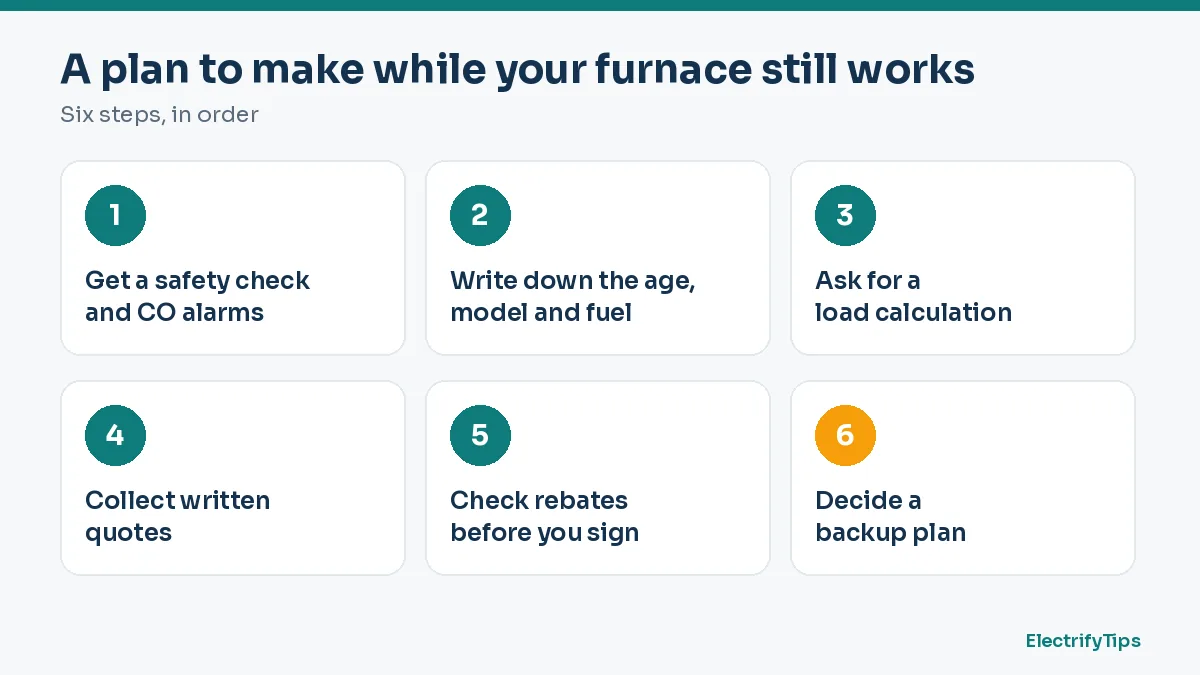
A plan to make while your furnace still works
The DOE Energy Saver Guide suggests making “a timeline of projects to do now, in the near future, and over the long term.” For a furnace, that could look like this:
- Get a safety check now. Have a professional inspect the furnace, and put CO alarms on every level and outside bedrooms, as CPSC advises.
- Write down what you have. Note the furnace’s age, model and fuel from its label, plus the age of your AC.
- Ask for a load calculation. It shows what size of system your home really needs.
- Collect written quotes for each option you’re weighing, and compare them line by line.
- Check rebates before you sign. Look up your state and utility programs and their rules.
- Decide on a backup plan. Know who you’ll call and what you’ll install if the furnace fails before you’re ready.
Frequently asked questions
How old is too old for a furnace?
There’s no fixed age. ENERGY STAR suggests considering replacement once a furnace or boiler is more than 15 years old, especially if repairs are frequent and bills are rising.
Should I replace my furnace and air conditioner at the same time?
If both are old, it’s worth pricing them together. A heat pump can replace both, and DOE suggests considering replacement once a heat pump or AC is more than 10 years old.
Can I still get a tax credit for a new furnace or heat pump?
Not the federal 25C credit. The IRS says it covered improvements made through December 31, 2025. State and utility rebates may still apply.
Do I have to replace my furnace because of the 2028 rule?
No. The rule covers new furnaces made from December 18, 2028, and that date is under review in 2026. It doesn’t require you to replace a furnace you already have.
Sources & references
- https://www.energystar.gov/saveathome/heating-cooling/replace
- https://www.energy.gov/sites/default/files/2022-08/energy-saver-guide-2022.pdf
- https://www.energystar.gov/sites/default/files/2024-07/HP HVAC_Toolkit_2024.pdf
- https://cpsc.gov/Newsroom/News-Releases/2026/Keep-Warm-and-Safe-This-Winter-Tips-for-Using-Generators-Furnaces-and-Space-Heaters
- https://www.cpsc.gov/Safety-Education/Safety-Education-Centers/Carbon-Monoxide-Information-Center
- https://www.irs.gov/credits-deductions/energy-efficient-home-improvement-credit
- https://www.energy.gov/documents/program-notice-26-2
- https://www.govinfo.gov/content/pkg/FR-2023-12-18/html/2023-25514.htm
- https://www.federalregister.gov/documents/2026/04/27/2026-08145/energy-conservation-program-notification-of-petition-for-rulemaking
- https://www.supremecourt.gov/docket/docketfiles/html/public/25-879.html
- https://www.energystar.gov/products/furnaces
- https://natural-resources.canada.ca/energy-efficiency/energy-star/heating-cooling-heat-pump
- https://www.energy.nh.gov/funding-opportunities/funding-opportunities-homeowners/home-electrification-and-appliance-rebates