Quick answer
Light frost on a heat pump's outdoor unit is normal: it melts in a defrost cycle that typically lasts 5 to 15 minutes. Ice that stays after defrost, a unit covered in ice, or one stuck in defrost needs an HVAC professional. Clear snow drifts, but never chip ice off the coil.
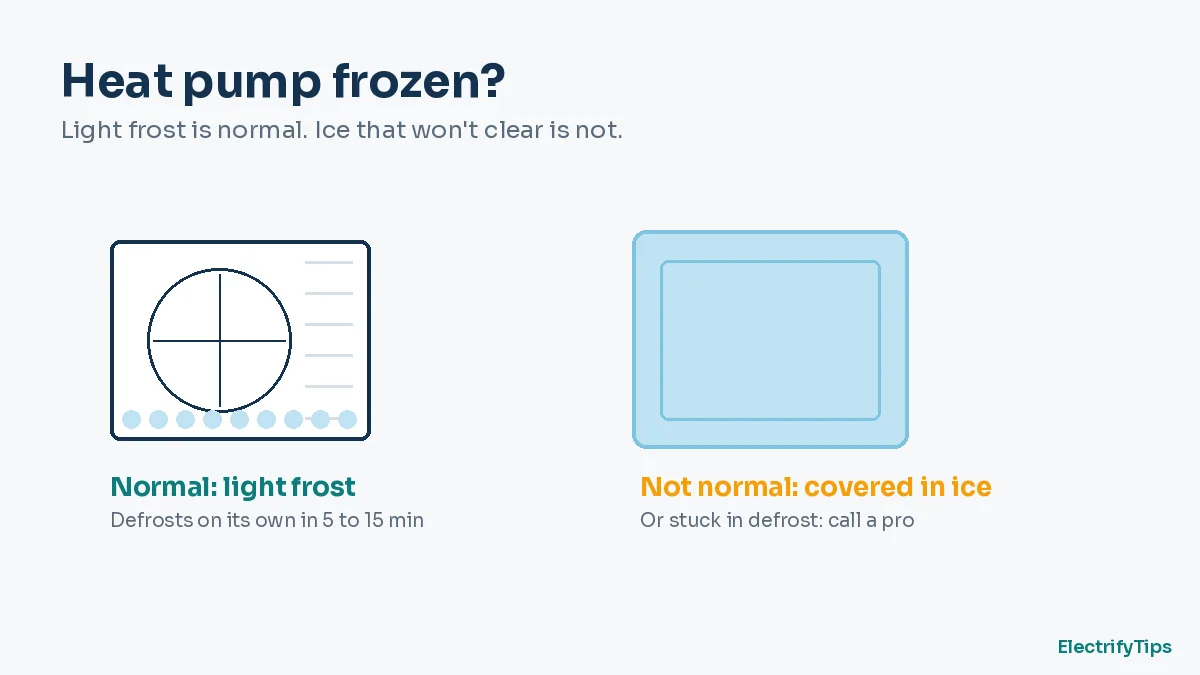
A heat pump frozen with a light layer of frost is usually doing exactly what it should. In cold, damp weather, frost forms on the outdoor unit, and the heat pump melts it with a short defrost cycle that NYSERDA says typically lasts 5 to 15 minutes. Ice that stays after defrost, a unit covered in ice, or one that seems stuck in defrost is different: a homeowner guide on DOE’s Building Science Education site says to call an HVAC professional. Here’s how to tell the two apart, what you can safely check, and what never to do. New to heat pumps? Start with our complete heat pump guide.
Why frost forms, and how defrost clears it
Natural Resources Canada explains that when it’s near or below freezing, moisture in the air passing over the outdoor coil freezes on it. The frost makes the coil worse at pulling heat from the air, so it has to come off.
To melt it, the heat pump switches to defrost mode:
- The reversing valve flips the system to cooling mode for a few minutes.
- Hot refrigerant gas goes to the outdoor coil and melts the frost.
- The outdoor fan stops, so you may hear the unit go quiet and see water drip.
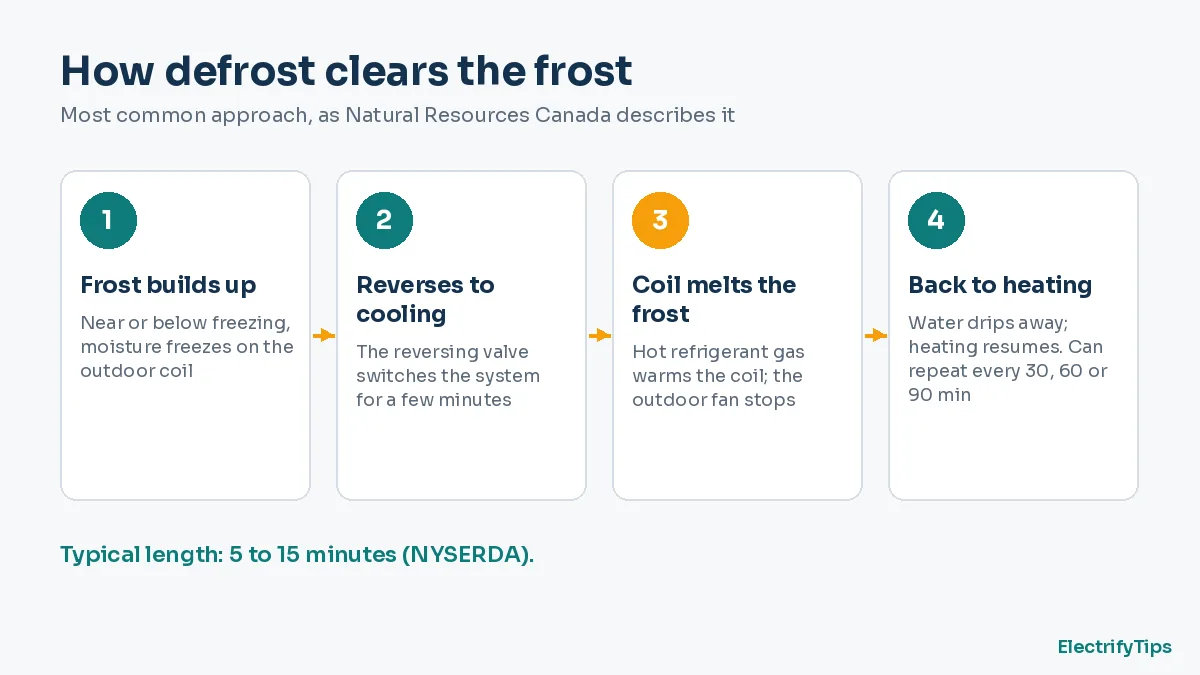
Defrost can start every 30, 60 or 90 minutes, depending on the climate and the system. NRCan says demand-frost controls, which defrost only when frost is detected, are generally more efficient than a fixed timer.
Inside, the air may feel cool for those minutes, or backup heat may come on. Our guide on why a heat pump blows cold air covers that, and our cold climate heat pump guide explains the steam you may see.
When a frozen heat pump is not normal
Use what you see outside to decide what to do next.
| What you see | Normal? | What to do |
|---|---|---|
| Light white frost on the coil on a cold, damp day | Normal | Nothing. It defrosts on its own. |
| The unit pauses, the fan stops and water drips for 5 to 15 minutes | Normal (defrost) | Leave it running. |
| Snow and some ice on the cabinet after a storm | Usually normal | Clear snow drifts away from the unit. |
| Ice still on the coil after defrost cycles, or a thick coat of clear ice | Not normal | Do the safe checks below, then call a pro. |
| The whole unit covered in ice, or it seems stuck in defrost | Not normal | Call an HVAC professional. |
| Ice building on the top or one side, under a roof edge | Placement problem | See “Why some units ice up again and again”. |
| A puddle from the unit refreezing on a path | Drainage problem | Ask your installer to redirect the water. |
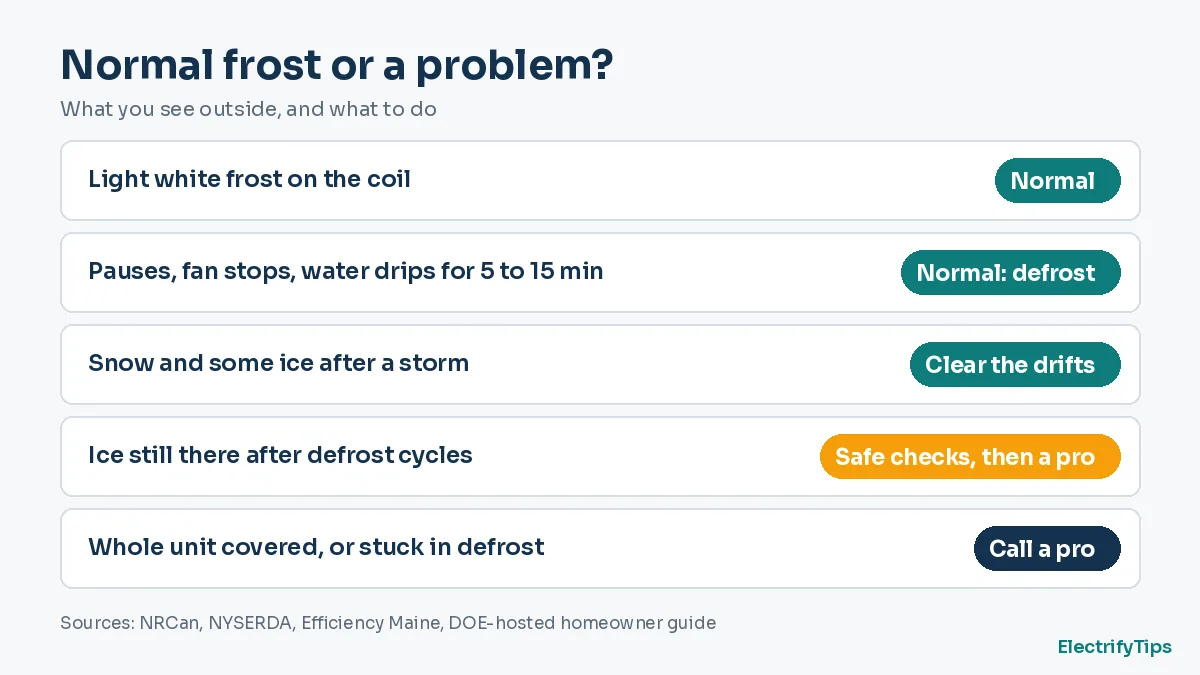
Efficiency Maine puts the normal case simply: “don’t worry about snow and ice accumulating on them. Heat pumps automatically defrost.” The warning signs are ice that stays, and a unit that never finishes defrosting.
Safe checks you can do
These take a few minutes and need no tools or panels opened.
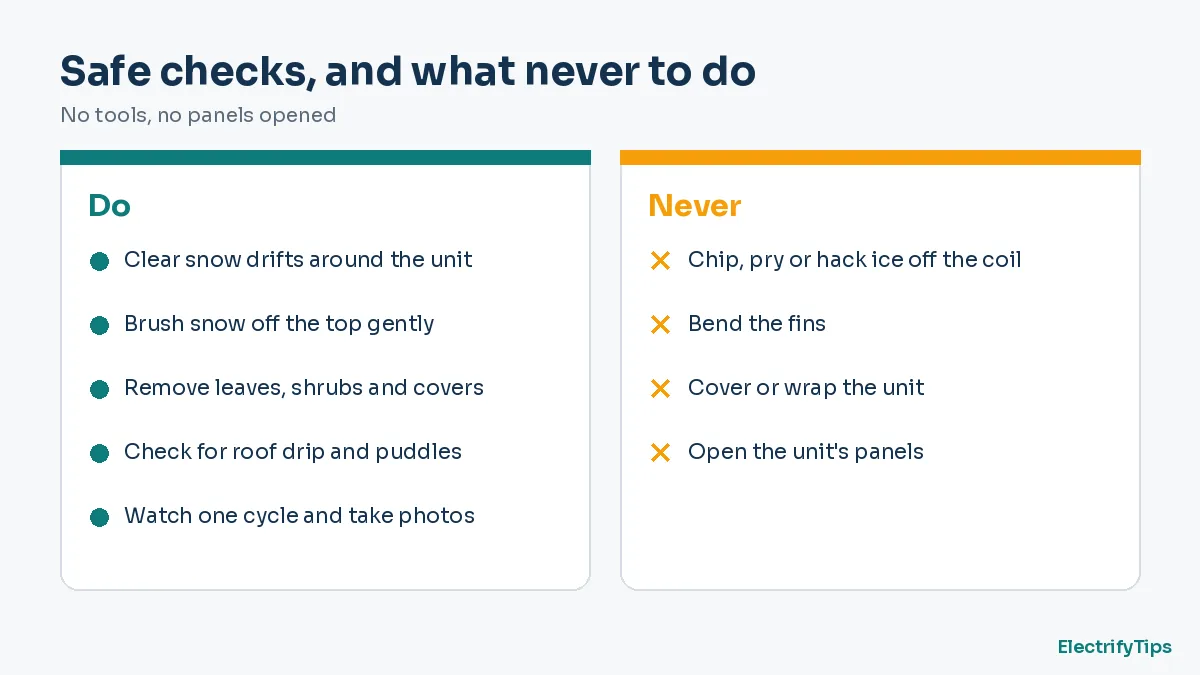
- Clear snow around the unit. Efficiency Maine says to clear snow drifts away from outdoor units. NYSERDA adds that after a significant snowfall, you should keep the unit clear of snow and ice. Use a soft broom, and brush snow off the top gently.
- Remove anything blocking air. Leaves, shrubs and covers all cut airflow. The DOE-hosted guide says to avoid covering your heat pump in winter.
- Look up. Check whether water or snow drips from the roof edge onto the unit.
- Look down. Check where the defrost water goes. It should drain away, not pool and refreeze on a walkway.
- Watch one cycle. Note roughly how long defrost lasts, and whether the ice clears afterward. Take a photo before and after.
Never do these:
- Don’t chip, pry or hack ice off the coil. Efficiency Maine warns about bending the fins, and the unit is built to defrost itself.
- Don’t wrap or cover the unit with a tarp.
- Don’t open the unit’s panels. Anything inside is a job for a technician.
Why some units ice up again and again
When the same unit keeps icing in the same spot, check where it sits. Two official checklists set out what a good spot looks like.
Efficiency Maine’s installation checklist asks for the outdoor unit to be:
- 18 inches above any surface where snow will accumulate,
- protected from roof runoff by a gutter, rain cap, gable end or overhang,
- placed so defrost water won’t form ice on a walkway.
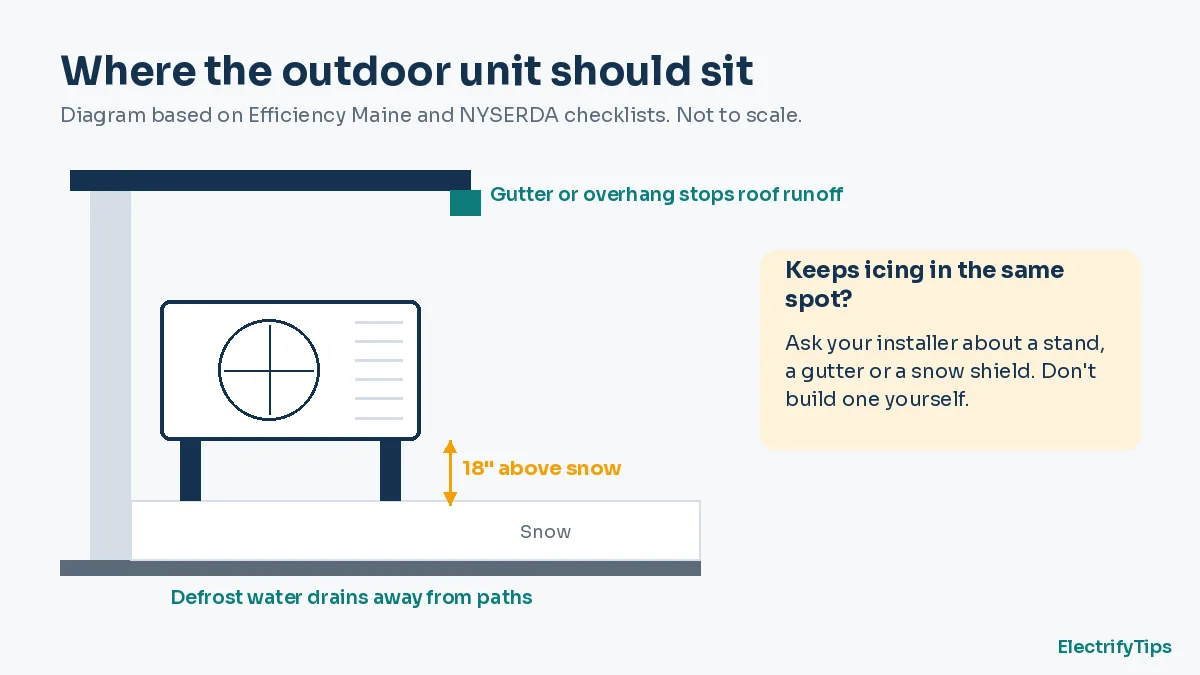
NYSERDA’s post-install checklist agrees that the unit should be protected from excess snow off the roof. It lists options like the gable end of the home, completely under the eave, under a deck, or a protective snow shield.
If your unit sits low, or right under a dripping roof edge, ask your installer about a stand, a gutter or a shield. Don’t build one yourself: the unit needs clear airflow around it.
When to call a technician
Call your installer or an HVAC technician if:
- ice stays on the coil after defrost cycles, or covers the whole unit,
- the unit seems stuck in defrost,
- the house is getting colder, or backup heat runs most of the time. Our guide to aux heat vs emergency heat explains what that backup is doing.
NYSERDA lists checks a heat pump technician should be able to do, including checking the refrigerant charge and leaks, verifying airflow, and cleaning the coils and drain pan. Tell them what you saw, when it started, how long defrost seemed to last, and send your photos.
Our heat pump maintenance checklist shows what you can do and what to leave to a pro. If the technician says the system needs replacing, the heat pump cost calculator gives a rough starting price.
Sources & references
- https://natural-resources.canada.ca/energy-efficiency/energy-star/heating-cooling-heat-pump
- https://www.nyserda.ny.gov/-/media/Project/Nyserda/Files/Publications/Fact-Sheets/CHC-CON-ASHP-Q-fs-1-v1.pdf
- https://www.nyserda.ny.gov/-/media/Project/Nyserda/Files/Publications/Fact-Sheets/CHC-CON-ASHP-main-fs-1-v1.pdf
- https://bsesc.energy.gov/sites/default/files/2024-09/CEE_You_Installed_an_ASHP_Now_What_TRC_01.16.24_1.pdf
- https://www.efficiencymaine.com/heat-pump-user-tips/
- https://www.efficiencymaine.com/docs/Residential-Heat-Pump-Installation-Checklist.pdf