Quick answer
A dual fuel system pairs a heat pump with a gas or propane furnace, and only one runs at a time. Natural Resources Canada says the switchover is usually set at the economic balance point, where the furnace becomes cheaper to run. At winter 2025–26 US average prices, a heat pump beat a 95% propane furnace whenever its COP was above about 1.8, but needed a COP above about 3.3 to beat a 95% gas furnace. HEEHR now allows homes to keep a fossil-fuel system when installing a heat pump, depending on state rules.
A dual fuel system pairs an electric heat pump with a gas or propane furnace. The heat pump heats your home in milder weather, and the furnace takes over when it gets cold. It lets you add a heat pump without giving up the furnace you already have. This guide explains how the switchover works, how to choose the temperature where it happens, and what it means for your bills with gas and with propane. For the basics, see our complete heat pump guide.
The short answer
- What it is: DOE describes dual-fuel systems as combining “the efficiency of a heat pump with the reliability of a gas furnace.” The heat pump handles “most of the heating needs in milder weather, while the furnace takes over during colder temperatures.”
- Only one runs at a time. Natural Resources Canada explains that “either the heat pump operates or the gas/oil furnace operates.”
- The switchover point matters most. Ideally it’s set at the economic balance point: the outdoor temperature below which the furnace becomes the cheaper way to heat.
- With propane, the heat pump wins down to cold temperatures. At winter 2025–26 US average prices, a heat pump beat a 95% propane furnace whenever its COP was above about 1.8 (our calculation).
- With natural gas, the margin is thin. At the same prices, a heat pump needed a COP above about 3.3 to beat a 95% gas furnace. That’s mostly mild-weather territory.
How a dual fuel system works
In a ducted dual fuel setup, the heat pump’s outdoor unit works with the furnace indoors, and a thermostat or control decides which one runs. Natural Resources Canada notes that a heat pump is often added to an existing system “when a heat pump is installed as a replacement for a central air-conditioner.” In summer, the heat pump cools like an air conditioner. In winter, it heats until the control hands over to the furnace.
Natural Resources Canada describes three temperatures an installer can work with:
| Temperature | What it means |
|---|---|
| Thermal balance point | “The temperature below which the heat pump does not have enough capacity to meet the heating needs of the building on its own” |
| Economic balance point | “The temperature below which the ratio of electricity to a supplemental fuel (e.g., natural gas) means that using the supplementary system is more cost effective” |
| Cut-off temperature | “The minimum operating temperature for the heat pump” |
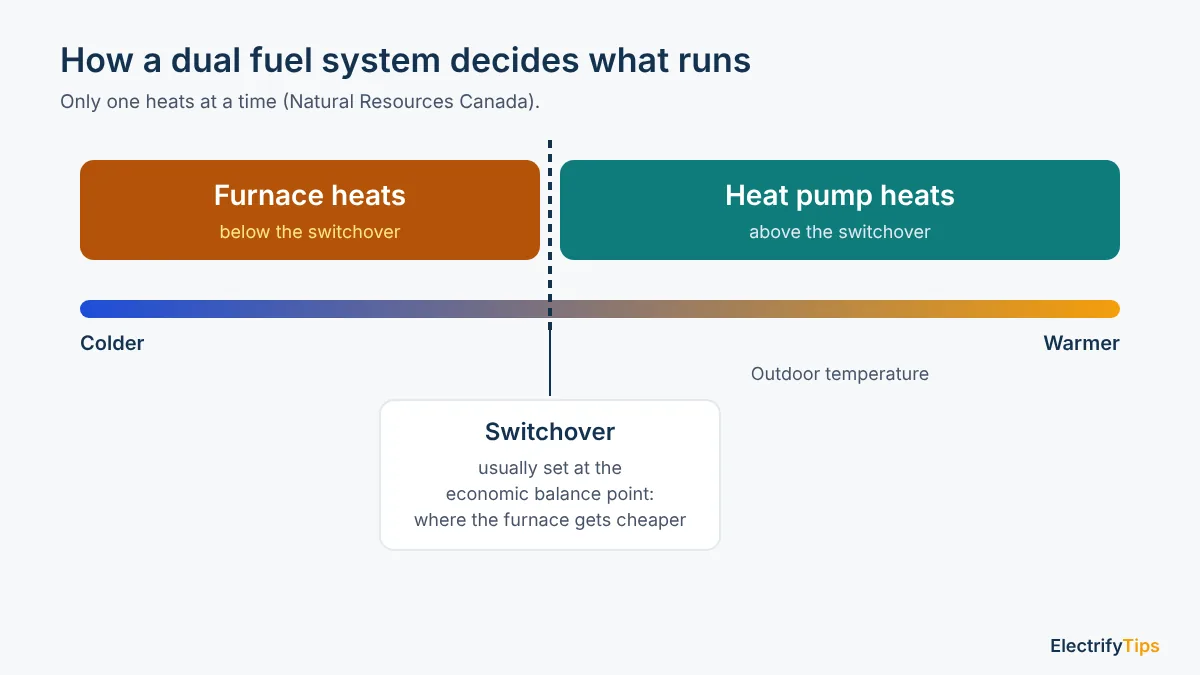
In a dual fuel system, the switchover “is usually set to shut off at the temperature corresponding to the economic balance point,” according to the same guide. The thermal balance point matters too: below it, the heat pump can’t keep the house warm on its own, so the furnace needs to take over by then at the latest.
Where to set the switchover: the break-even COP
A heat pump’s efficiency (its COP) drops as the outdoor temperature falls. A furnace’s cost per unit of heat depends only on your fuel price and its AFUE. So there’s a COP below which the furnace becomes cheaper to run. We call that the break-even COP. The outdoor temperature where your heat pump falls to that COP is your economic balance point. Our SEER2, HSPF2 and COP guide explains COP in more detail.
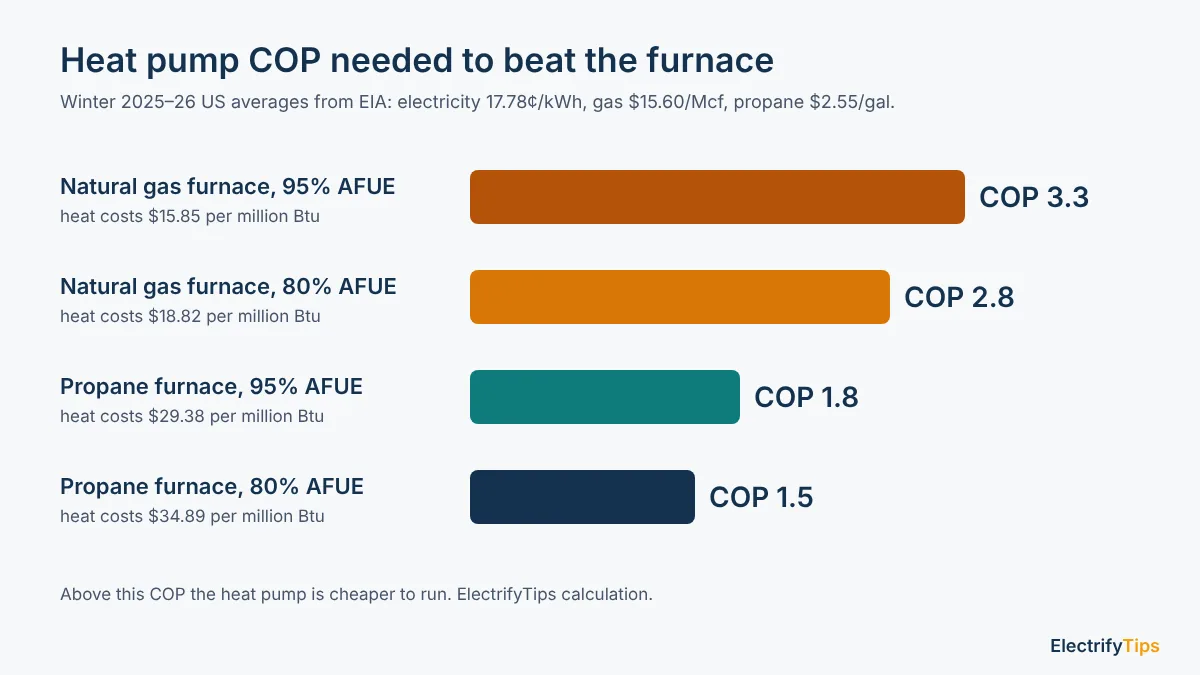
At winter 2025–26 US average prices (electricity 17.78¢ per kWh, natural gas $15.60 per thousand cubic feet, propane about $2.55 a gallon, all from EIA), the numbers work out like this:
| Furnace | Cost of its heat per million Btu | Heat pump is cheaper when its COP is above |
|---|---|---|
| Natural gas, 95% AFUE | $15.85 | about 3.3 |
| Natural gas, 80% AFUE | $18.82 | about 2.8 |
| Propane, 95% AFUE | $29.38 | about 1.8 |
| Propane, 80% AFUE | $34.89 | about 1.5 |
ElectrifyTips calculation. Heat pump heat at COP 1 costs $52.11 per million Btu at 17.78¢ per kWh; break-even COP = $52.11 ÷ the furnace’s cost. Propane uses the exact winter average of $2.553 per gallon. Energy content (EIA): 1,036 Btu per cubic foot of gas, 91,452 Btu per gallon of propane.
Now compare those with real heat pump COPs. Natural Resources Canada says COPs at 46°F (8°C) “typically range from between 2.0 and 5.4,” and at 18°F (–8°C) “can range from 1.1 to 3.7.” An ENERGY STAR Cold Climate heat pump must reach a COP of at least 1.75 at 5°F.
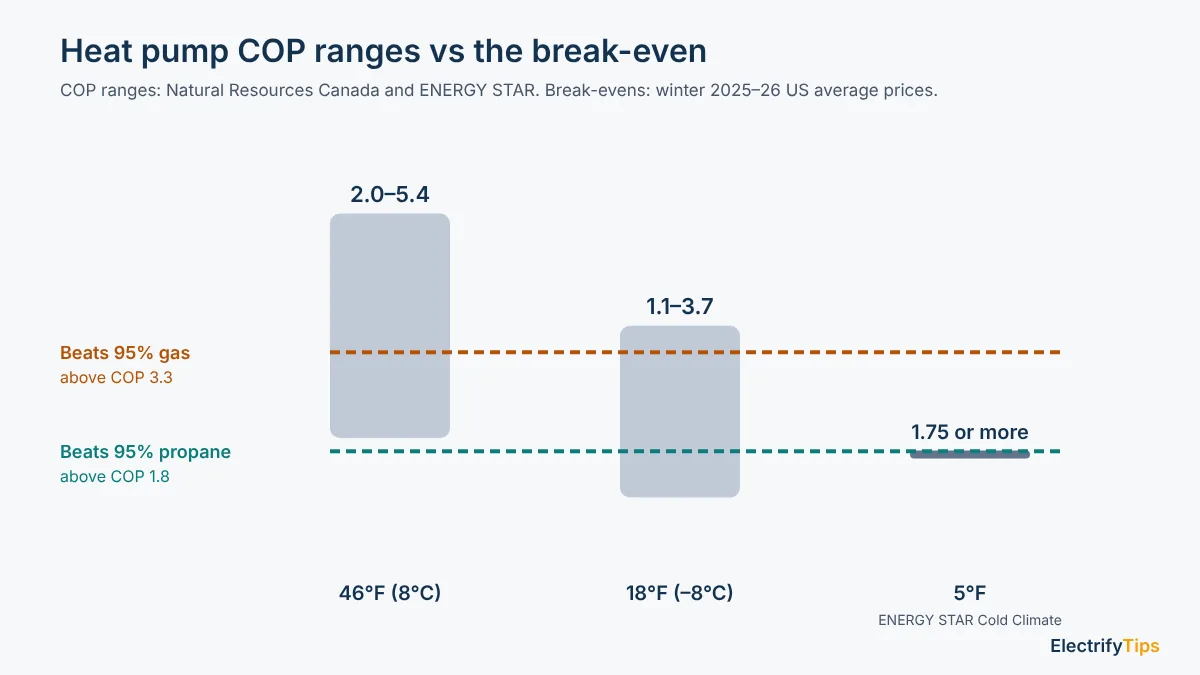
- With propane, the break-even is low. A cold-climate heat pump stays cheaper than an 80% propane furnace even at 5°F, and roughly ties a 95% one there. The switchover can be set at a cold temperature, so the heat pump does most of the heating.
- With natural gas, the break-even is high. At 18°F, only heat pumps near the top of that range beat a 95% gas furnace. Even at 46°F, the low end of the range is below 3.3. Depending on the model, the furnace can be the cheaper choice for much of the winter at these prices.
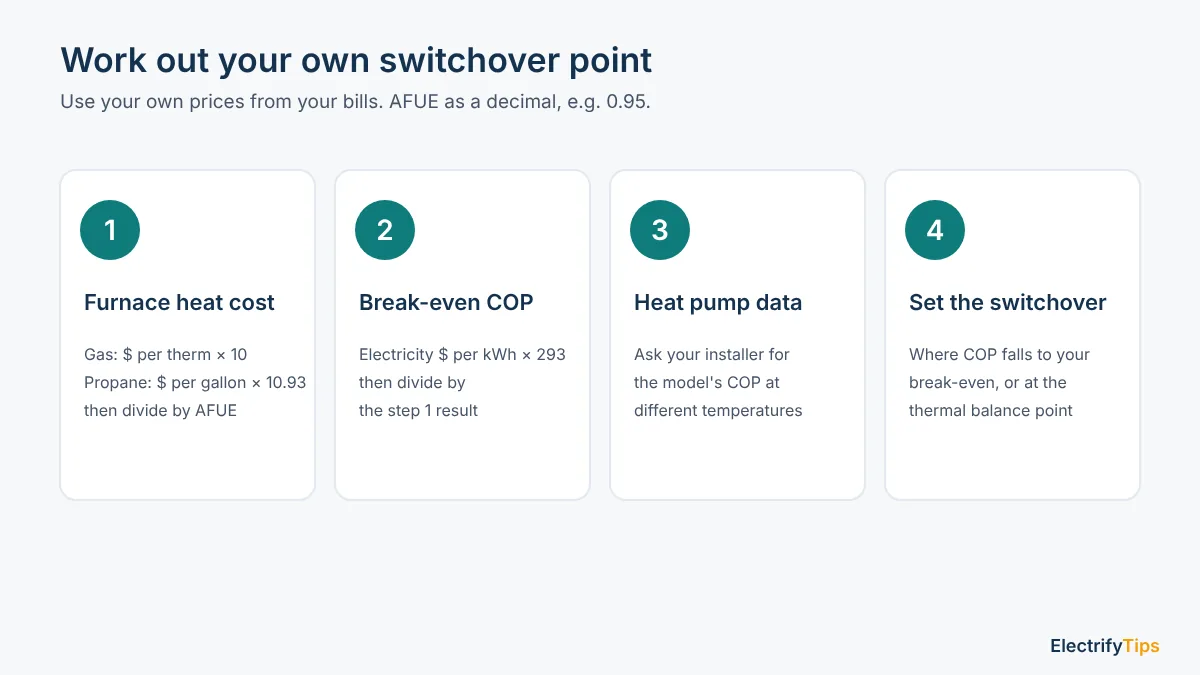
Work out your own break-even
Your prices will differ from the US averages, so do the math for your home. Use the per-unit rates on your bills: EIA’s averages also include fixed monthly charges, which you pay whichever system runs.
- Find your furnace’s cost per million Btu of heat. For natural gas, multiply your price per therm by 10, then divide by the AFUE (0.95 for a 95% furnace). For propane, multiply your price per gallon by 10.93, then divide by the AFUE.
- Find your break-even COP. Multiply your electricity price per kWh (in dollars) by 293, then divide by the number from step 1.
- Check the heat pump’s COP at different temperatures. Ask your installer for the model’s performance data. ENERGY STAR requires manufacturers of certified heat pumps to report the COP at 5°F.
- Set the switchover where the COP falls to your break-even, or at the thermal balance point if that comes first.
Our Operating Cost Comparison tool does the price side of this for you. Check again if your rates change a lot.
Who dual fuel suits
Dual fuel tends to fit when:
- your furnace works well but your central air conditioner needs replacing. A heat pump can take the AC’s place and add heating, which is the add-on case Natural Resources Canada describes.
- you heat with propane. The low break-even COP means the heat pump can carry most of the season, with propane kept for the coldest days. See heat pump vs propane furnace.
- you want a backup for very cold weather, or your heat pump can’t cover your home’s full heating load on the coldest days. Our cold climate heat pump guide covers models built for those conditions.
An all-electric heat pump may suit you better if your furnace needs replacing anyway and a cold-climate heat pump sized for your home can cover the coldest days alone. Our guide to heat pump sizing explains the load calculation behind that. And if natural gas is cheap where you live and electricity is expensive, keeping the furnace as your main heat may still cost least to run. Our heat pump vs gas furnace comparison goes through that case.
Costs and rebates
There’s no reliable national price for a dual fuel install, because it depends on whether you’re adding a heat pump to an existing furnace or replacing both. Our heat pump installation cost guide sets out published price data for the heat pump itself.
On rebates, the federal 25C tax credit doesn’t cover heat pumps placed in service in 2026. The state-run HEEHR rebate now allows homes to “retain existing fossil-fuel HVAC systems when installing a heat pump,” under DOE’s May 29, 2026 notice. The same notice ended rebates for fuel switching. It also requires homes to use the rebates for insulation and air sealing before heating and cooling upgrades, unless they’re already insulated and sealed to a state-specified level. Whether your project qualifies depends on how your state applies these rules, so check with your state energy office before you sign. Our heat pump rebates guide tracks state programs.
What to watch for
- The switchover setting. Set too warm, the furnace runs on days the heat pump would have been cheaper. Set too cold, the heat pump runs when the furnace would have cost less. Ask your installer what temperature they set and why.
- Two systems to look after. Natural Resources Canada recommends annual maintenance by a qualified contractor, and ENERGY STAR suggests yearly pre-season check-ups. The furnace needs its own care too.
- Weatherization. DOE advises homeowners replacing a gas heating system with a heat pump to weatherize their homes first.
Frequently asked questions
What is a dual fuel heat pump?
It’s a heat pump paired with a gas or propane furnace. The heat pump heats in milder weather, and the furnace takes over when it gets colder. Only one runs at a time.
What temperature should a dual fuel system switch to the furnace?
There’s no single right number. Natural Resources Canada says the switchover is usually set at the economic balance point, where the furnace becomes the cheaper option. That depends on your fuel and electricity prices and on your heat pump’s COP at different temperatures.
Can the heat pump and furnace run at the same time?
No. Natural Resources Canada explains that in these hybrid systems “either the heat pump operates or the gas/oil furnace operates.”
Is dual fuel worth it with natural gas?
It depends on your prices. At winter 2025–26 US averages, a heat pump needed a COP above about 3.3 to beat a 95% gas furnace, so the furnace may do much of the winter heating. Run your own numbers with your rates.
Do rebates cover a dual fuel system?
Possibly. HEEHR now allows homes to keep their existing fossil-fuel system when installing a heat pump, but eligibility depends on your state’s rules. The 25C tax credit doesn’t cover heat pumps placed in service in 2026.
Keep reading
- Heat pumps: the complete homeowner’s guide
- Heat pump vs gas furnace
- Heat pump vs propane furnace
- SEER2, HSPF2 and COP explained
- Cold climate heat pumps
- What size heat pump do I need?
- Heat pump rebates and incentives (2026)
- Operating Cost Comparison tool
Sources & references
- https://natural-resources.canada.ca/energy-efficiency/energy-star/heating-cooling-heat-pump
- https://web.archive.org/web/20260531150702/https://www.energy.gov/energysaver/heat-pump-systems
- https://www.energystar.gov/sites/default/files/2025-04/ENERGY STAR Version 6.2 Heat Pump Specification Rev. March 2025.pdf
- https://www.eia.gov/dnav/ng/hist/n3010us3m.htm
- https://www.eia.gov/dnav/pet/hist/LeafHandler.ashx?n=PET&s=W_EPLLPA_PRS_NUS_DPG&f=W
- https://www.eia.gov/electricity/monthly/epm_table_grapher.php?t=table_5_03
- https://www.eia.gov/energyexplained/units-and-calculators/british-thermal-units.php
- https://www.energy.gov/documents/program-notice-26-2
- https://web.archive.org/web/20260529112831/https://www.energy.gov/energysaver/operating-and-maintaining-your-heat-pump
- https://www.irs.gov/credits-deductions/energy-efficient-home-improvement-credit
- https://www.energystar.gov/saveathome/heating-cooling/maintenance-checklist