Quick answer
Long run times in cold weather are usually normal: as it gets colder, a heat pump pulls less heat from outdoor air while your home loses heat faster. Check thermostat setbacks, the filter, the outdoor unit, vents, thermostat settings and how often backup heat runs. Call a technician if the house can't stay warm, backup heat runs often in mild weather, or the problem started suddenly.
A furnace blasts hot air for a few minutes, then stops. A heat pump in January often just keeps going. That catches a lot of new owners off guard, but in cold weather long run times are usually normal. It becomes a problem when the house isn’t staying warm, when backup heat keeps kicking in on mild days, or when the unit runs nonstop in weather it should handle easily. This guide shows how to tell the difference. It’s part of our complete heat pump guide.
The short answer
- Long run times in cold weather are usually normal. As it gets colder, a heat pump can pull less heat from outdoor air, while your house loses heat faster. So it runs longer to keep up.
- Heat pumps are built to hold a steady temperature. They send out a larger volume of air at a lower temperature than a furnace, so they run longer and feel different.
- Check six things yourself first: thermostat setbacks, the air filter, snow or debris around the outdoor unit, blocked vents, thermostat settings, and how often backup heat comes on.
- Call a technician if the house can’t reach its set temperature in mild weather, backup heat runs often, or the problem started suddenly. Refrigerant, airflow and defrost problems need a pro.
Why a heat pump runs longer when it’s cold
An air-source heat pump moves heat from the outdoor air into your home. Natural Resources Canada’s heat pump guide puts it simply: as the outdoor temperature drops, “the ability of the heat pump to absorb heat also drops.”
At the same time, your house loses heat faster the colder it gets outside. Put those two together, and the heat pump has to run longer to deliver the same comfort.
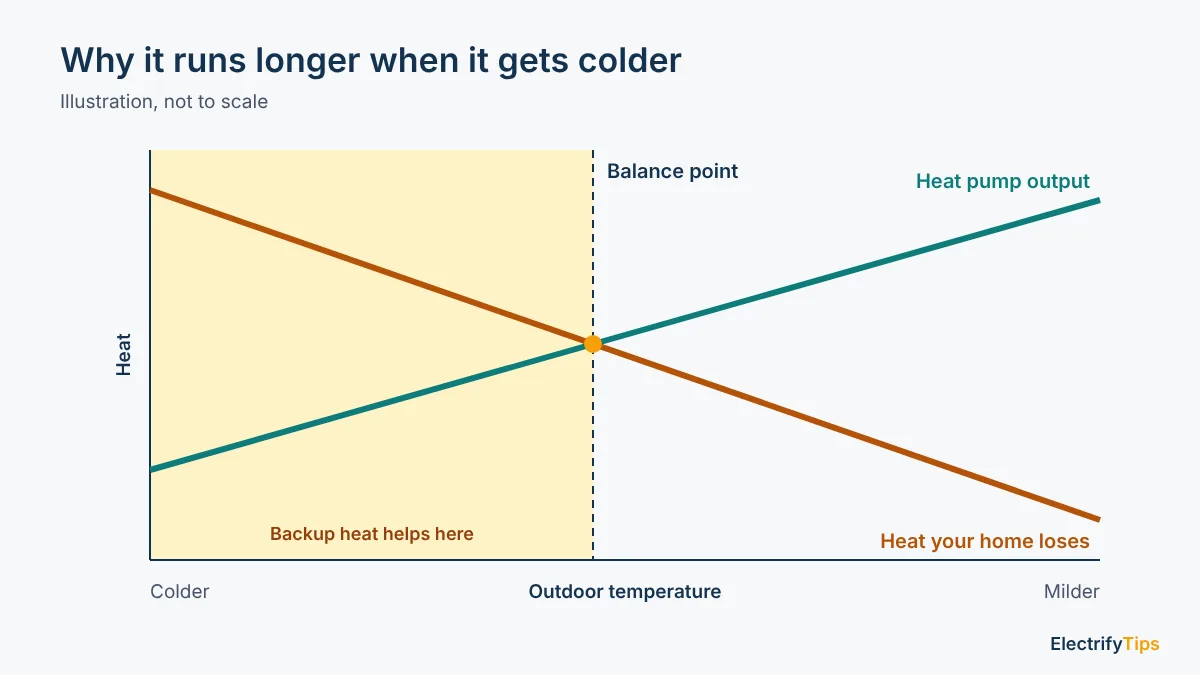
At some outdoor temperature, the two lines cross. NRCan calls this the balance point: “the temperature below which the heat pump does not have enough capacity to meet the heating needs of the building on its own.” Below it, the heat pump runs all the time and a backup heat source makes up the difference. That’s why NRCan notes that “most air-source installations require a supplementary heating source to maintain indoor temperatures during the coldest days.”
There’s a comfort difference too. According to NRCan, heat pumps deliver “a higher volume of warm air” heated to about 77–113°F (25–45°C), while a furnace delivers less air at about 131–140°F (55–60°C). Air at 90°F feels warm, but not as hot as a furnace’s blast. So a heat pump heats steadily over longer cycles instead of in short bursts.
Efficiency Maine, the state’s efficiency program, advises owners: “Heat pumps operate most efficiently when holding a steady temperature,” and “It’s best to set them at a comfortable temperature and forget it.”
Normal, or a sign of a problem?
| Usually normal | Worth checking |
|---|---|
| Long run times when it’s well below freezing outside | Long run times in mild weather |
| House holds the temperature you set | House can’t reach the set temperature |
| Air from vents feels warm but not hot | Air from vents feels cool for long stretches, outside of defrost |
| Short pauses with steam from the outdoor unit (defrost) | Thick ice that stays on the outdoor unit |
| “Aux” heat on during the coldest hours | “Aux” or “Emergency” heat on much of the time, or on mild days |
| Bills higher in the coldest months | A sudden jump in bills with no change in weather |
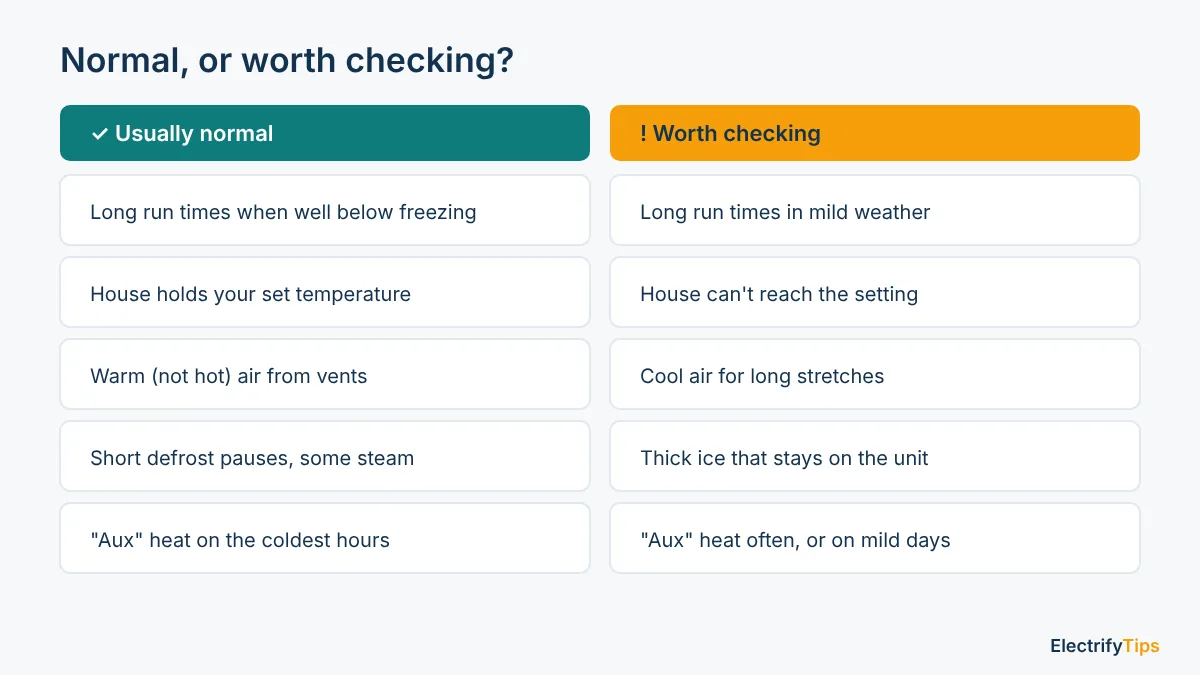
One caveat: there’s no official “normal” number of hours for a heat pump to run. It depends on your climate, your home’s insulation and the size of the system. Use the pattern above, not a stopwatch.
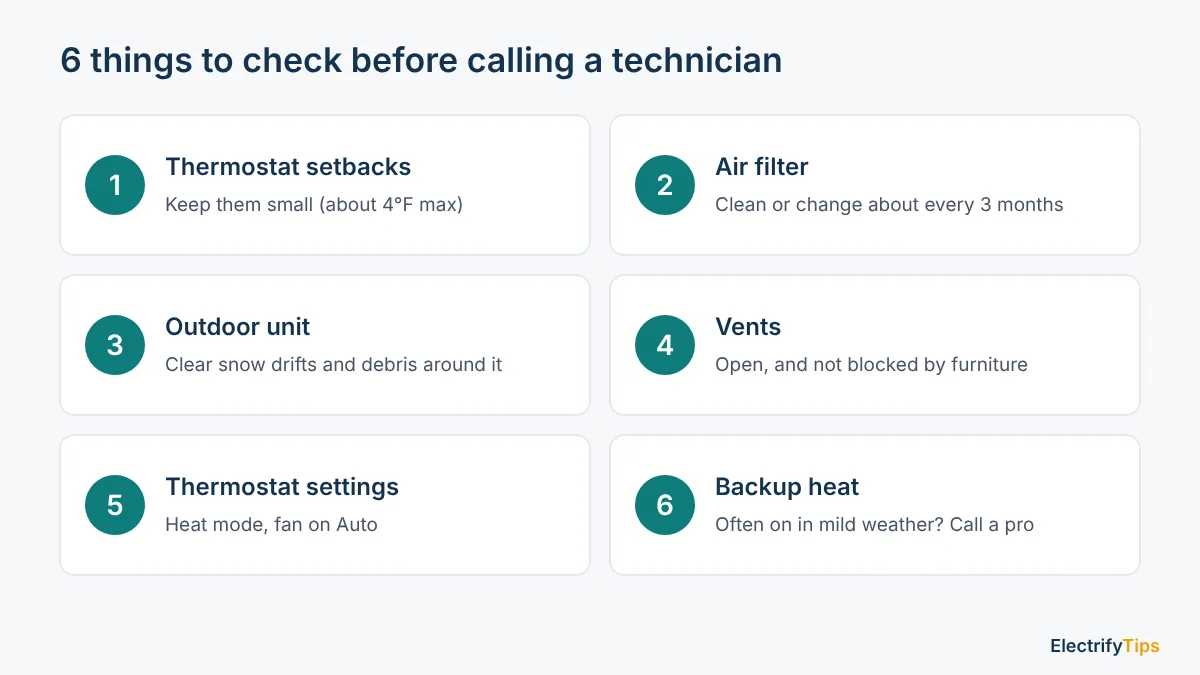
Six things to check yourself
None of these need tools. Turn off power to the unit before touching anything outdoors.
- Thermostat setbacks. Turning the heat down at night or while you’re out, then back up, makes a heat pump work hard to recover. NRCan says heat pumps “have more difficulty responding to deep temperature setbacks” and recommends setbacks of “not more than 2°C” (about 4°F), or a smart thermostat that starts recovery early. DOE is blunter: “Do not set back the heat pump’s thermostat if it causes the backup heating to come on.” Try holding one steady temperature for a few days and see if run times settle.
- The air filter. A clogged filter cuts airflow, so the system runs longer for the same heat. NRCan and DOE both say to clean or change it about every 3 months, or as the manufacturer recommends.
- Snow, ice or debris around the outdoor unit. The outdoor unit needs air flowing through it. DOE says to remove “vegetation, dust, pollen, and clutter from around the outdoor unit.” Efficiency Maine advises: “Clear snow drifts away from outdoor units.” For snow and ice on the unit itself, it says not to worry, because “heat pumps automatically defrost.”
- Blocked or closed vents. Furniture, rugs or closed registers starve the system of airflow. DOE suggests cleaning the supply and return registers and straightening bent fins.
- Thermostat settings. Check that the system is in Heat (not Emergency Heat) and that the set temperature is what you expect. If the fan is set to On instead of Auto, the indoor fan runs all the time even when the heat pump isn’t heating, which can feel like constant running.
- How often backup heat comes on. Many thermostats show “Aux” or “Aux heat” when the backup heat is running. Some of that on the coldest days is expected. If it’s on often in mild weather, something isn’t right. DOE notes backup heat such as electric resistance or strip heaters is “usually more expensive to operate because they are less efficient.”
When the heat pump is the wrong size
Size affects run time in both directions:
- Too small: NRCan says “if a heat pump is undersized, you will notice that the supplemental heating system will be used more frequently.” The heat pump runs constantly and still needs a lot of backup heat.
- Too big: an oversized unit “produces too much heat and the unit cycles on and off”, NRCan says, which means discomfort and extra wear. That’s the opposite symptom: short, frequent cycles.
If your system has run nonstop and leaned on backup heat since the day it was installed, ask for the load calculation it was sized from. Our guide to what size heat pump you need explains what to look for.
Problems that need a technician
Some causes of long run times can’t be fixed by an owner. DOE lists what a service visit should cover, and several match this symptom:
- Refrigerant charge. DOE says “too much or too little refrigerant” reduces heat pump performance and efficiency, and that systems should be leak-checked at installation and at every service call. So a refrigerant problem can show up as long run times with weak heat.
- Airflow. DOE says efficiency and performance “deteriorate if airflow is much less than 350 cfm per ton.” A technician can measure airflow, clean the indoor coil, and look for duct problems.
- Duct leaks. Heated air escaping into an attic or crawlspace means the system runs longer to heat the rooms you live in. DOE’s checklist includes “Diagnose and seal duct leakage.”
- Defrost and controls. If the outdoor unit stays heavily iced, or the thermostat calls for backup heat when it shouldn’t, the controls may need checking. DOE also notes outdoor units “should be protected from high winds, which can cause defrosting problems.”
When to call
Call a qualified HVAC technician if:
- the house can’t reach the set temperature, especially in mild weather,
- backup or emergency heat comes on often when it isn’t very cold,
- the outdoor unit stays covered in thick ice and doesn’t clear,
- the run time or your bill changed suddenly without a change in weather, or
- you’ve worked through the six checks above and nothing changed.
Natural Resources Canada says “you should have a qualified contractor do annual maintenance on your unit.” Before winter is a sensible time to book it.
Does running constantly mean high bills?
Not necessarily. A heat pump’s efficiency drops as it gets colder, but it usually still delivers more heat per unit of electricity than electric resistance heat. ENERGY STAR Cold Climate models, for example, must reach a COP of at least 1.75 at 5°F, compared with 1 for resistance heat. NRCan explains that COPs are lower in colder weather “as the heat pump must work across a greater temperature difference.” Our SEER2, HSPF2 and COP guide explains what those numbers mean.
The costly case is backup heat. When electric strips are doing much of the work, bills rise quickly. To see what heating with your heat pump should cost at your electricity rate, try our Operating Cost Comparison tool. And if you’re in a very cold region, our cold-climate guide shows how heat pumps performed in DOE field tests.
Frequently asked questions
Is it normal for a heat pump to run constantly in winter?
Often, yes. As it gets colder, a heat pump pulls less heat from outdoor air while the house loses heat faster, so it runs longer. It’s a concern if the house isn’t staying warm or backup heat is on a lot in mild weather.
Should I turn my heat pump down at night?
Only a little, if at all. NRCan recommends setbacks of no more than 2°C (about 4°F), and DOE says not to set back if it makes the backup heat come on. Efficiency Maine says short setbacks such as overnight “will not save money with heat pumps.”
How often should I change my heat pump filter?
DOE says every 3 months or as the manufacturer or installer recommends. A dirty filter cuts airflow and makes the system run longer.
Should I clear snow from my heat pump?
Yes, around it. Efficiency Maine advises clearing snow drifts away from the outdoor unit. Frost on the unit itself is handled by its automatic defrost.
What does “aux heat” mean on my thermostat?
It means the backup heat is running, usually electric resistance heat. Some is expected on the coldest days. Frequent aux heat in mild weather is worth a technician visit.
Keep reading
- Heat pumps: the complete homeowner’s guide
- Do heat pumps work in cold climates?
- What size heat pump do I need?
- SEER2, HSPF2 and COP explained
- Heat pump vs gas furnace
- Operating Cost Comparison tool
- How long do heat pumps last?
- Heat pump maintenance checklist
Sources & references
- https://natural-resources.canada.ca/energy-efficiency/energy-star/heating-cooling-heat-pump
- https://web.archive.org/web/20260529112831/https://www.energy.gov/energysaver/operating-and-maintaining-your-heat-pump
- https://web.archive.org/web/20260602160945/https://www.energy.gov/energysaver/air-source-heat-pumps
- https://www.efficiencymaine.com/at-home/heat-pump-user-tips/
- https://www.energystar.gov/sites/default/files/2025-04/ENERGY STAR Version 6.2 Heat Pump Specification Rev. March 2025.pdf