Quick answer
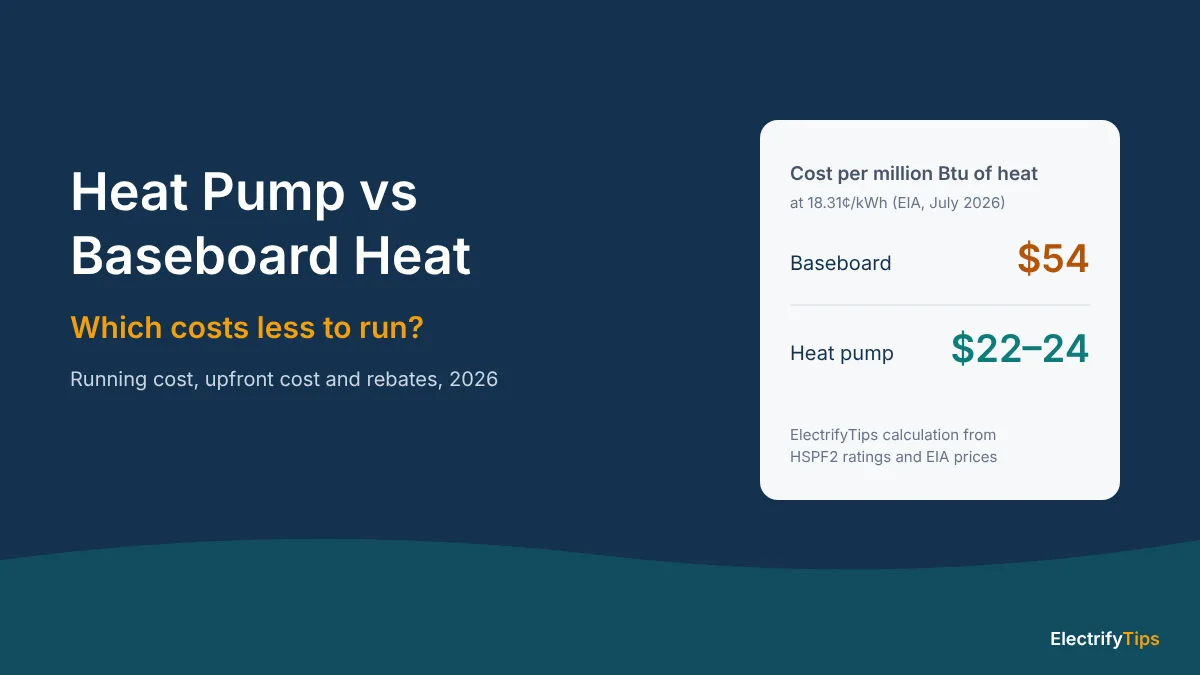
DOE says heat pumps easily cut heating electricity use by 50% compared with electric resistance heat such as baseboards, and by up to 75%. At the July 2026 US average price of 18.31¢ per kWh, a million Btu of heat costs about $54 from baseboards and about $22 to $24 from a heat pump. In a DOE field study, one ductless heat pump cut total heating energy in all-electric homes by 35% to 67%. Replacing baseboard heat is an electric-to-electric upgrade that the HEEHR rebate still covers.
If your home heats with electric baseboards, you’re already paying for electric heat, using the simplest kind: elements that turn electricity straight into heat. A heat pump runs on the same electricity but moves heat instead of making it, so it needs far less power for the same warmth. This guide compares the two on running cost, upfront cost and rebates, using DOE guidance, a DOE field study and current EIA electricity prices. For the basics, see our complete heat pump guide.
The short answer
- A heat pump uses much less electricity for the same heat. DOE says heat pumps “easily cut electricity use by 50% when compared with electric resistance heating,” and that today’s heat pumps can reduce it “by up to 75%.”
- At the July 2026 US average price of 18.31¢ per kWh, a million Btu of heat costs about $54 from baseboards, against about $22–$24 from a heat pump at federal minimum to Cold Climate efficiency (our calculation).
- Real homes saved a lot, even with one unit. In a DOE field study, adding a single ductless heat pump to all-electric homes cut total heating energy by 35% to 67%.
- Ductless mini-splits are the common fit. DOE calls mini-splits “an efficient alternative to baseboard heating” and says that for homes without ductwork they “are generally the best retrofit option.”
- Rebates still apply. Replacing baseboard heat is an electric-to-electric upgrade, which the federal HEEHR rebate still covers since its May 2026 rule change.
How each one heats
Baseboard heaters turn electricity directly into heat. DOE explains that they “contain electric heating elements encased in metal pipes,” and warm air rises from them into the room. DOE calls resistance heating “100% energy efficient in the sense that all the incoming electric energy is converted to heat.” One unit of electricity gives one unit of heat.
A heat pump uses electricity to move heat from the outdoor air into your home. Because it moves heat instead of making it, it delivers more heat than the electricity it uses. Engineers call that ratio COP (coefficient of performance). Baseboard heat always has a COP of 1. A heat pump at the federal minimum rating averages about 2.2 over a heating season, and an ENERGY STAR Cold Climate ductless model about 2.5. Our SEER2, HSPF2 and COP guide explains how those numbers are worked out.
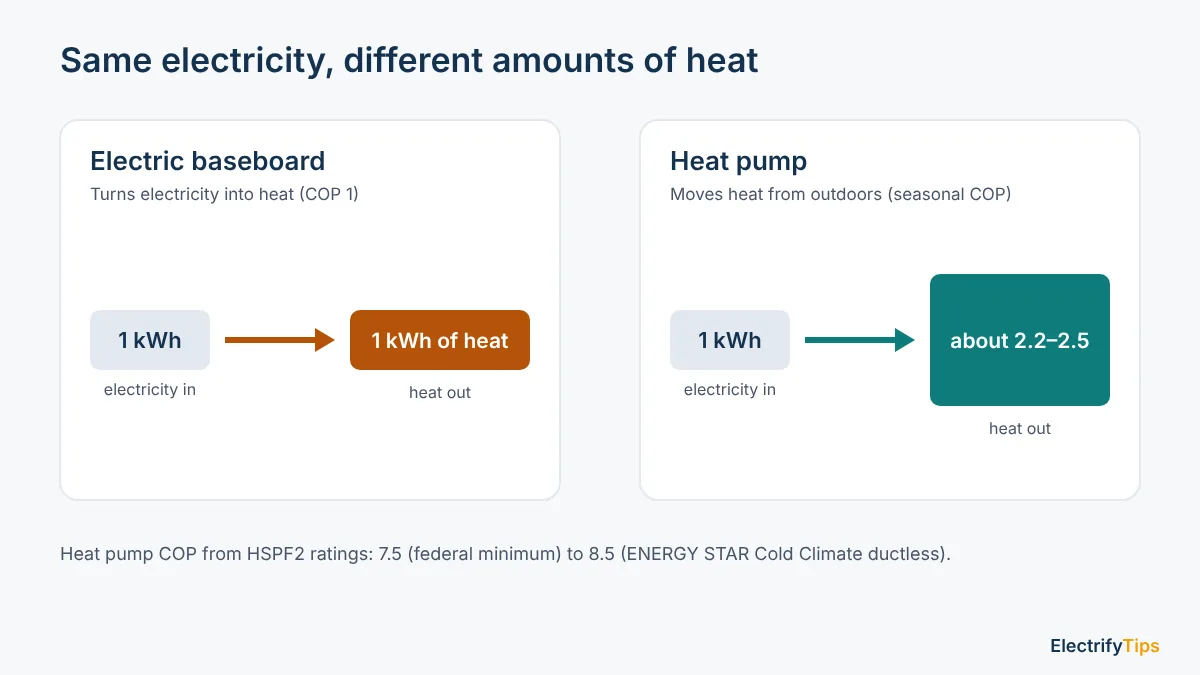
That difference is why DOE says that “if electricity is the only choice, heat pumps are preferable in most climates.”
Running cost: the math at 2026 prices
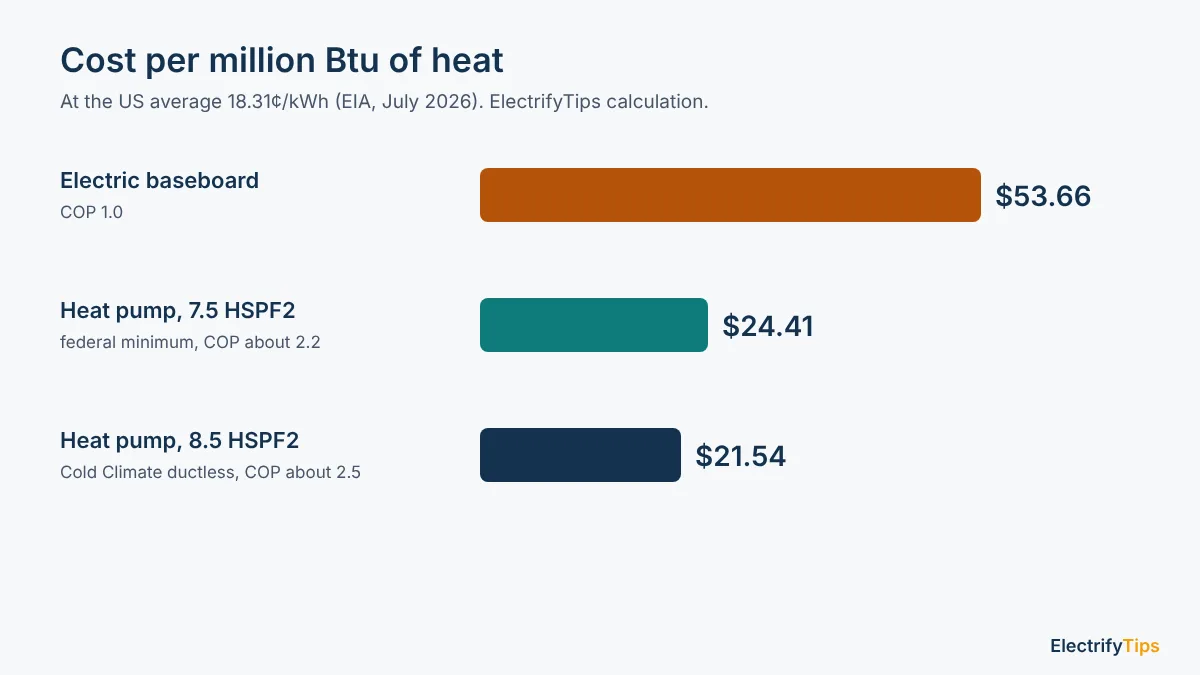
The US average residential electricity price was 18.31¢ per kWh in July 2026, according to EIA (up from 17.45¢ a year earlier). At that price, here’s what a million Btu of delivered heat costs. One kWh equals 3,412 Btu, so a million Btu takes about 293 kWh from baseboards.
| Heating system | Seasonal COP | Electricity per million Btu | Cost per million Btu at 18.31¢/kWh |
|---|---|---|---|
| Electric baseboard (resistance) | 1.0 | 293 kWh | $53.66 |
| Heat pump at the federal minimum (7.5 HSPF2) | about 2.2 | 133 kWh | $24.41 |
| ENERGY STAR Cold Climate ductless heat pump (8.5 HSPF2) | about 2.5 | 118 kWh | $21.54 |
ElectrifyTips calculation. Seasonal COP = HSPF2 ÷ 3.412. Prices: EIA Electric Power Monthly, Table 5.6.A.
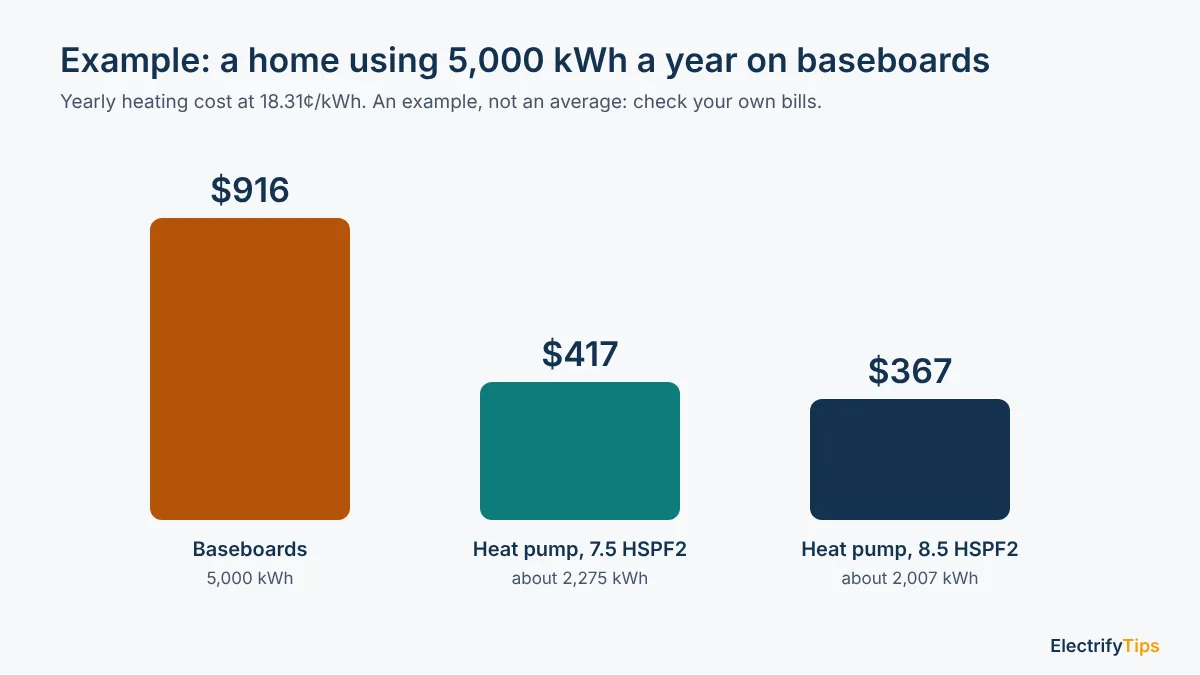
A worked example. Say your baseboards use 5,000 kWh a year for heating. That’s an example, not an average; check your own bills. At 18.31¢, that’s about $916 a year. The same heat from a heat pump would take:
| Heating electricity per year | Cost per year | Saving vs baseboards | |
|---|---|---|---|
| Baseboards | 5,000 kWh | $916 | — |
| Heat pump, 7.5 HSPF2 | about 2,275 kWh | about $417 | about $499 |
| Heat pump, 8.5 HSPF2 | about 2,007 kWh | about $367 | about $548 |
Two cautions:
- Ratings come from a standard test. In a NYSERDA field study of cold-climate mini-splits in New York homes, measured efficiency averaged about 80% of what the units’ HSPF ratings implied. Your real savings depend on your climate, the installation and how you use the system.
- Your price matters. Electricity costs vary a lot by state. Our Operating Cost Comparison tool lets you put in your own rate.
What a real study found
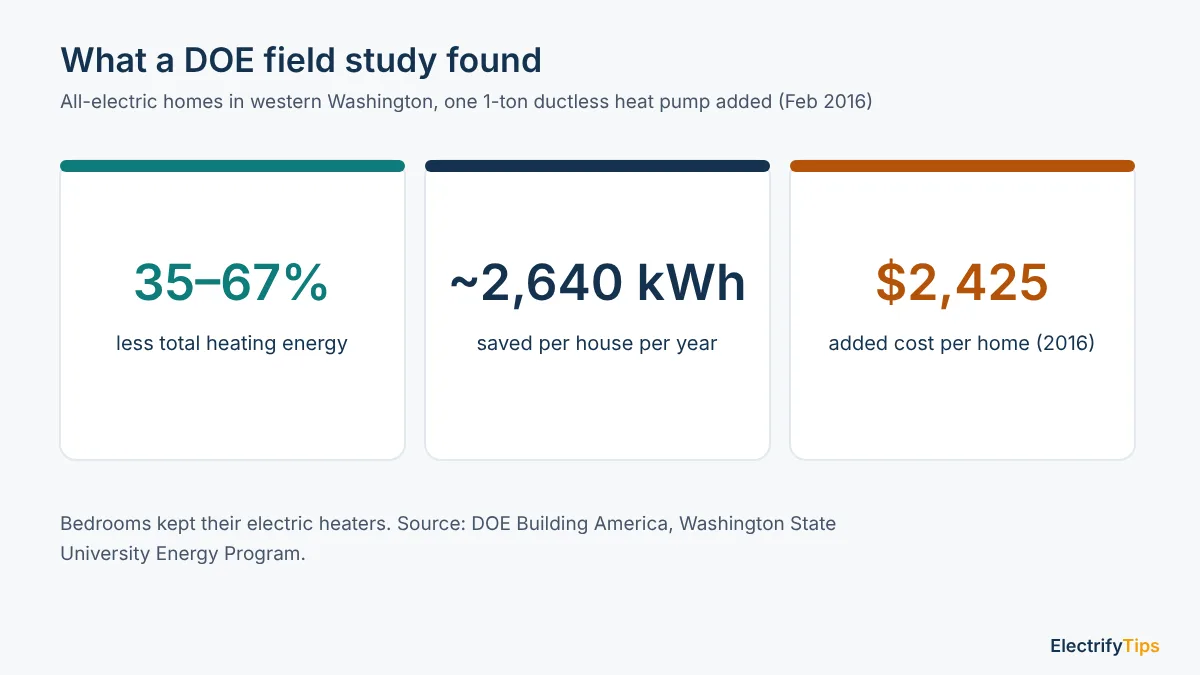
DOE’s Building America program published a field study in February 2016, by the Washington State University Energy Program. It looked at all-electric homes in western Washington heated with baseboard and wall heaters, then added a single 1-ton ductless heat pump in the main living area. The researchers switched between the two heating modes week by week to compare them.
- Total heating energy fell by 35% to 67%, even though the bedrooms still used their electric heaters.
- The estimated saving was about 2,640 kWh per house per year.
- The heat pump added $2,425 per home to the heating system cost at the time (2016 prices, in new affordable homes).
That’s a single indoor unit doing most of the work. Homes that heat more rooms with a heat pump may save more, but they’ll also need more indoor units.
What it costs to switch
If your home has no ducts, the switch is usually to a ductless mini-split, which DOE calls “generally the best retrofit option” for homes without ductwork. The price depends mostly on how many indoor units you need. In a NYSERDA study of whole-home mini-split installs in New York, each indoor unit averaged $3,593 installed (range $2,000 to $5,219, installs from 2017 to 2019). Our mini-split installation cost guide puts several data sets side by side.
Payback depends on your heating use and rebates. Using the worked example above, a heat pump saving about $499 a year would pay back a $12,000 install in about 24 years, or about 12 years if a rebate covered half. A home that uses more heating electricity, or pays more for it, pays back faster. The 2016 DOE study above found a single ductless unit cost-effective for its homebuyers, but those were new homes with a $2,425 added cost. Run your own numbers before deciding.
A heat pump also cools, so if you’d otherwise buy window or wall air conditioners, part of the cost goes toward cooling too. If you’re weighing a ducted system instead, see ducted vs ductless heat pumps.
Rebates in 2026
The federal 25C tax credit doesn’t cover heat pumps installed in 2026. The main federal help is HEEHR (formerly HEAR), the state-run rebate. It pays up to $8,000 toward a heat pump for households at or below 150% of area median income, where your state’s program is open: 100% of the cost below 80% of area median, and 50% from 80% to 150%.
This is one of the cases HEEHR still covers. Since DOE’s May 29, 2026 notice, it pays only for upgrades from existing electric equipment or in new construction, and replacing electric baseboard heat with a heat pump is an electric-to-electric upgrade. You need approval before installation. Our heat pump rebates guide explains who qualifies, state by state, and some utilities add their own rebates on top.
When baseboard heat still makes sense
DOE names a few cases where electric resistance heating can be reasonable:
- A home addition, “if it is not practical to extend the existing heating system to supply heat to the new addition.”
- Climates “with so few heating days” that the cost of resistance heating “is not significant.”
If you keep your baseboards, DOE says zone heating, warming only the rooms you’re using, “can produce energy savings of more than 20% compared to heating the whole area of your house.” You can also keep baseboards as backup in rooms without an indoor unit, as the homes in the DOE study did.
Frequently asked questions
Is a heat pump cheaper to run than electric baseboard heat?
Yes, for the same amount of heat. DOE says heat pumps cut heating electricity use by at least 50% compared with electric resistance heat, and by up to 75%. At July 2026’s average price, that’s about $22–$24 per million Btu with a heat pump against about $54 with baseboards.
Can I replace baseboard heaters with a mini-split?
Yes. DOE says mini-splits offer “an efficient alternative to baseboard heating” and are “generally the best retrofit option” for homes without ductwork.
Should I remove my baseboards after installing a heat pump?
You don’t have to. In the DOE field study, homes kept their bedroom heaters and still cut total heating energy by 35% to 67% with one ductless unit in the main living area.
Will a heat pump replacing baseboards qualify for a rebate in 2026?
It can. Replacing electric resistance heat is an electric-to-electric upgrade, which the federal HEEHR rebate still covers where your state’s program is open and you’re approved first.
Are baseboard heaters 100% efficient?
In one sense, yes: DOE says all the electricity becomes heat. A heat pump goes further by moving heat from outside, so it delivers more heat than the electricity it uses.
Keep reading
- Heat pumps: the complete homeowner’s guide
- How much does a mini-split cost to install?
- Ducted vs ductless heat pumps
- SEER2, HSPF2 and COP explained
- Heat pump vs gas furnace
- Heat pump rebates and incentives (2026)
- Operating Cost Comparison tool
- Heat pump vs propane furnace
Sources & references
- https://web.archive.org/web/20260505022240/https://www.energy.gov/energysaver/electric-resistance-heating
- https://web.archive.org/web/20260531150702/https://www.energy.gov/energysaver/heat-pump-systems
- https://www1.eere.energy.gov/buildings/publications/pdfs/building_america/65073.pdf
- https://www.eia.gov/electricity/monthly/epm_table_grapher.php?t=table_5_06_a
- https://www.eia.gov/energyexplained/units-and-calculators/british-thermal-units.php
- https://www1.eere.energy.gov/buildings/appliance_standards/pdfs/2023_CAC_Standards_FAQ_10-5-2022_Final.pdf
- https://www.energystar.gov/sites/default/files/2025-04/ENERGY STAR Version 6.2 Heat Pump Specification Rev. March 2025.pdf
- https://www.nyserda.ny.gov/-/media/Project/Nyserda/Files/Publications/PPSER/Program-Evaluation/22-04-Replacing-Fossil-Fuel-Heat-with-Mini-Split-Heat-Pumps-in-Urban-House-Stock.pdf
- https://www.govinfo.gov/link/uscode/42/18795a
- https://www.energy.gov/documents/program-notice-26-2