Quick answer
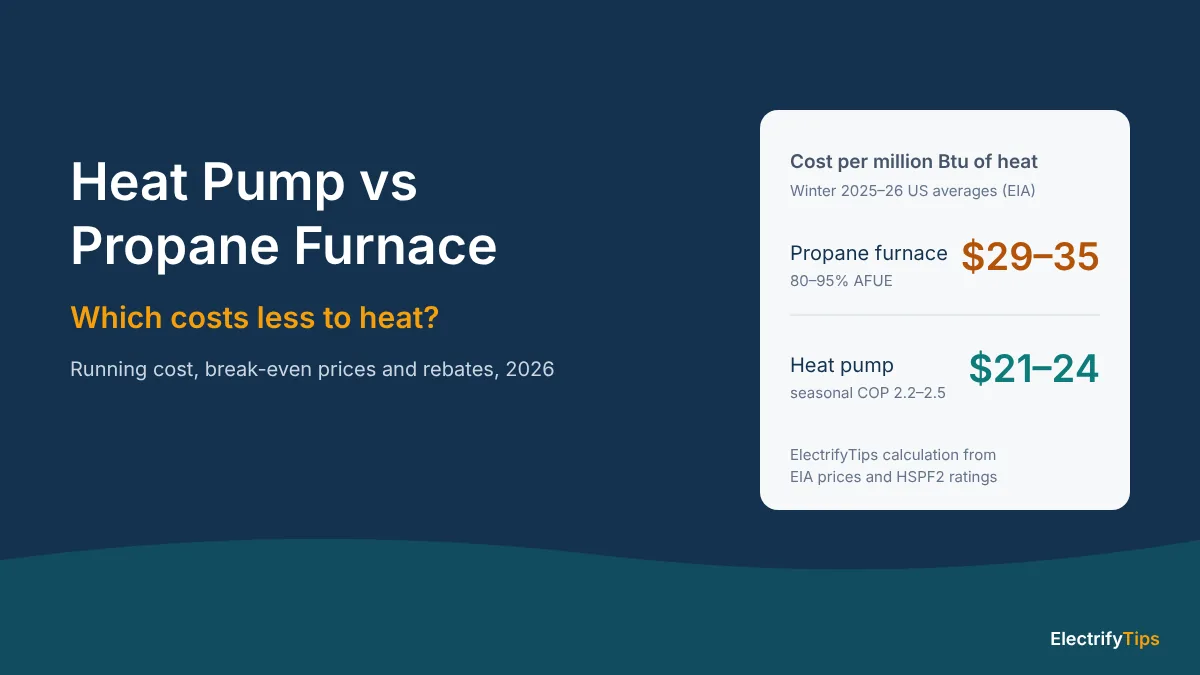
At winter 2025–26 average US prices (propane about $2.55 a gallon, electricity 17.78¢ per kWh), a heat pump delivered heat for about $21 to $24 per million Btu, against about $29 from a 95% propane furnace and $35 from an 80% one. A minimum-rated heat pump stays cheaper than a 95% propane furnace unless electricity costs more than about 22¢ per kWh. The gap narrows on very cold days. Since May 29, 2026, the federal HEEHR rebate no longer pays for replacing propane heating with a heat pump.
If you heat with propane, every tank delivery shows you what your heat costs. A heat pump runs on electricity and moves heat in from outdoors instead of burning fuel. This guide compares the two at last winter’s prices, works out the propane price at which they cost the same to run, and explains why the federal HEEHR rebate no longer pays for this switch. For the basics, see our complete heat pump guide.
The short answer
- A heat pump cost less to run last winter. At winter 2025–26 average US prices (propane about $2.55 a gallon, electricity 17.78¢ per kWh), a heat pump delivered heat for about $21–$24 per million Btu. A 95% propane furnace cost about $29, and an 80% one about $35 (our calculation from EIA prices).
- The break-even point: against a 95% propane furnace, a heat pump at the federal minimum rating stays cheaper unless propane drops below about $2.06 a gallon, or electricity rises above about 22¢ per kWh.
- Very cold weather narrows the gap. At 5°F, an ENERGY STAR Cold Climate heat pump must reach a COP of at least 1.75. At that level its heat costs about $30 per million Btu, close to a 95% propane furnace.
- You can keep propane as backup. DOE describes dual-fuel systems where the heat pump handles milder weather “while the furnace takes over during colder temperatures.”
- The federal HEEHR rebate no longer pays for this switch. Since DOE’s May 29, 2026 notice, it doesn’t cover replacing non-electric heating such as propane.
How each one heats
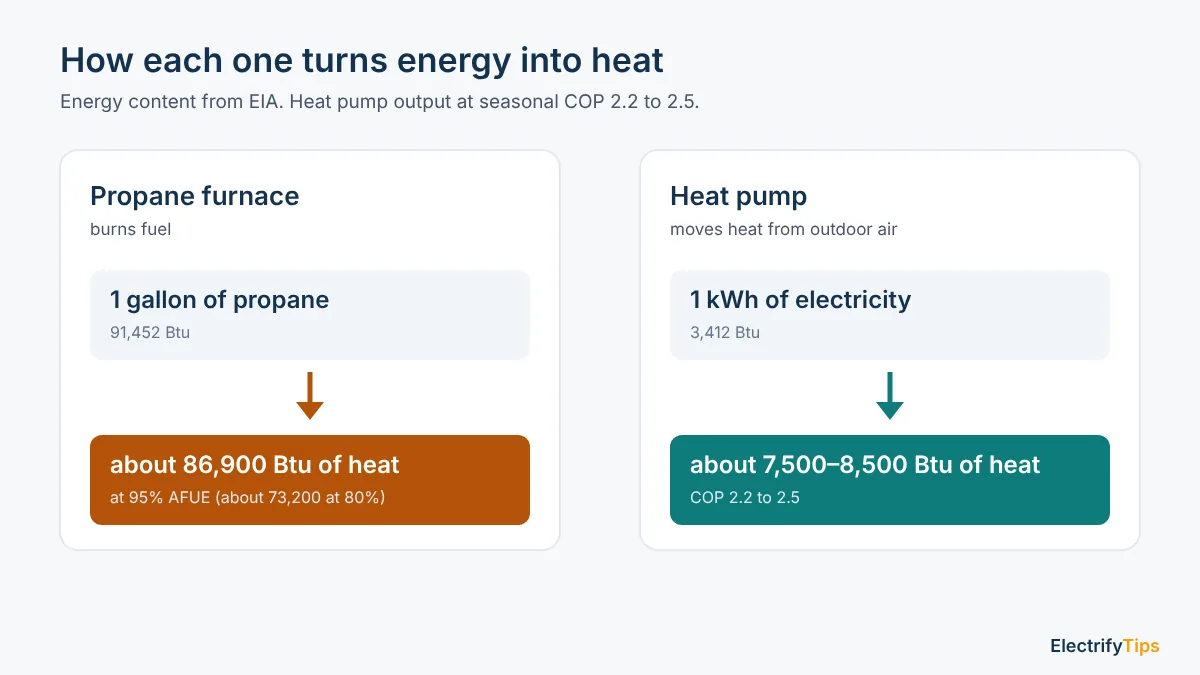
A propane furnace burns fuel to make heat. Its efficiency is its AFUE: the share of the fuel’s energy that ends up as heat in your home. DOE puts old furnaces at 56% to 70% AFUE, mid-efficiency models at 80% to 83%, and high-efficiency condensing furnaces at 90% to 98.5%. A gallon of propane holds 91,452 Btu, according to EIA. So a 95% furnace gets about 86,900 Btu of heat from each gallon, and an 80% furnace about 73,200.
A heat pump uses electricity to move heat from the outdoor air into your home. Because it moves heat instead of making it, it delivers more heat than the electricity it uses. That ratio is called COP (coefficient of performance). A heat pump at the federal minimum rating (7.5 HSPF2) averages a COP of about 2.2 over a heating season, and an ENERGY STAR Cold Climate ductless model (8.5 HSPF2) about 2.5. Our SEER2, HSPF2 and COP guide explains how these numbers are worked out.
The catch is the weather. Natural Resources Canada explains that “as the outdoor air temperature drops, COPs are lower,” because the heat pump has to work across a bigger temperature difference. That’s why the comparison changes in a cold snap, and why some homes keep the furnace for the coldest days.
Running cost at last winter’s prices
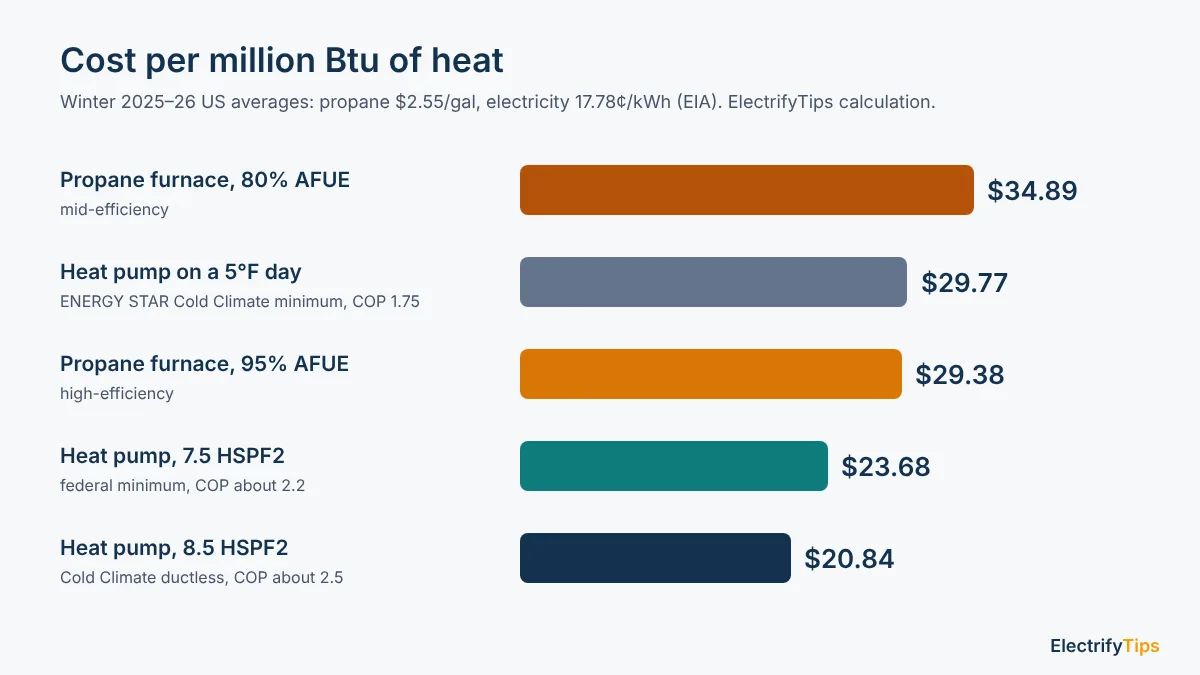
EIA tracks residential propane prices every week of the heating season. From October 2025 to March 2026 the US average ran from $2.417 to $2.678 a gallon, averaging about $2.55. Residential electricity averaged 17.78¢ per kWh over the same six months. At those prices, here’s what a million Btu of heat delivered to your rooms costs:
| Heating system | Efficiency | Fuel for a million Btu of heat | Cost per million Btu |
|---|---|---|---|
| Propane furnace, mid-efficiency | 80% AFUE | 13.7 gallons | $34.89 |
| Heat pump on a 5°F day (ENERGY STAR Cold Climate minimum) | COP 1.75 | 167 kWh | $29.77 |
| Propane furnace, high-efficiency | 95% AFUE | 11.5 gallons | $29.38 |
| Heat pump at the federal minimum (7.5 HSPF2) | seasonal COP about 2.2 | 133 kWh | $23.68 |
| ENERGY STAR Cold Climate ductless heat pump (8.5 HSPF2) | seasonal COP about 2.5 | 117 kWh | $20.84 |
ElectrifyTips calculation using EIA winter 2025–26 averages: propane $2.553 per gallon, the exact average of EIA’s 26 weekly prices, rounded to $2.55 in the text (91,452 Btu), electricity 17.78¢ per kWh (3,412 Btu). Seasonal COP = HSPF2 ÷ 3.412. These are illustrations, not test results for any model.
A worked example. Say your 80% furnace burns 800 gallons a year. That’s an example, not an average; check your delivery receipts. At $2.55 a gallon, that’s about $2,040. The same amount of heat would cost:
| Option | Fuel per year | Cost per year | Saving vs your 80% furnace |
|---|---|---|---|
| Keep the 80% propane furnace | 800 gallons | $2,042 | — |
| New 95% propane furnace | about 674 gallons | about $1,720 | about $322 |
| Heat pump, 7.5 HSPF2 | about 7,800 kWh | about $1,386 | about $656 |
| Heat pump, 8.5 HSPF2 | about 6,860 kWh | about $1,220 | about $822 |
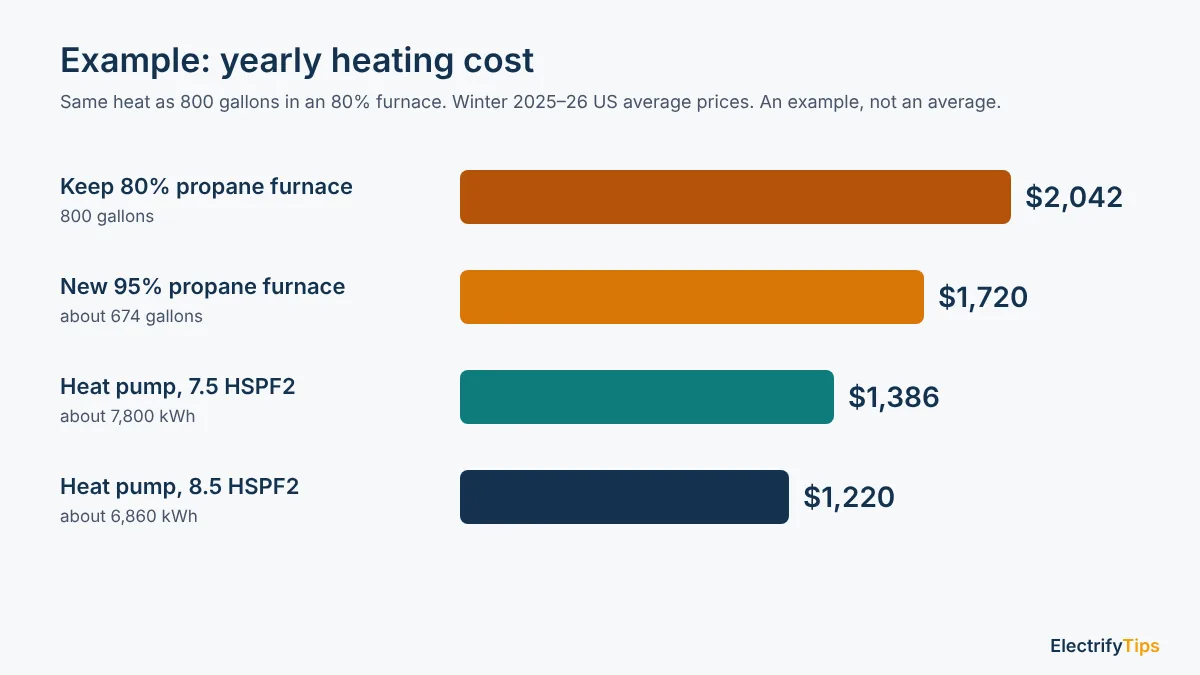
Compared with a new 95% furnace, the heat pumps save about $334 and $500 a year. Those are the fair numbers if your furnace needs replacing anyway.
What could change this answer
Your propane and electricity prices. These are US averages, and both vary a lot. In July 2026 alone, residential electricity ranged from 12.72¢ per kWh in Louisiana to 48.00¢ in Hawaii, according to EIA. Here’s the electricity price at which a heat pump costs the same to run as propane at $2.55 a gallon:
| Your furnace | Heat pump at COP 2.2 | Heat pump at COP 2.5 |
|---|---|---|
| 80% AFUE | 26.2¢ per kWh | 29.8¢ per kWh |
| 95% AFUE | 22.1¢ per kWh | 25.1¢ per kWh |
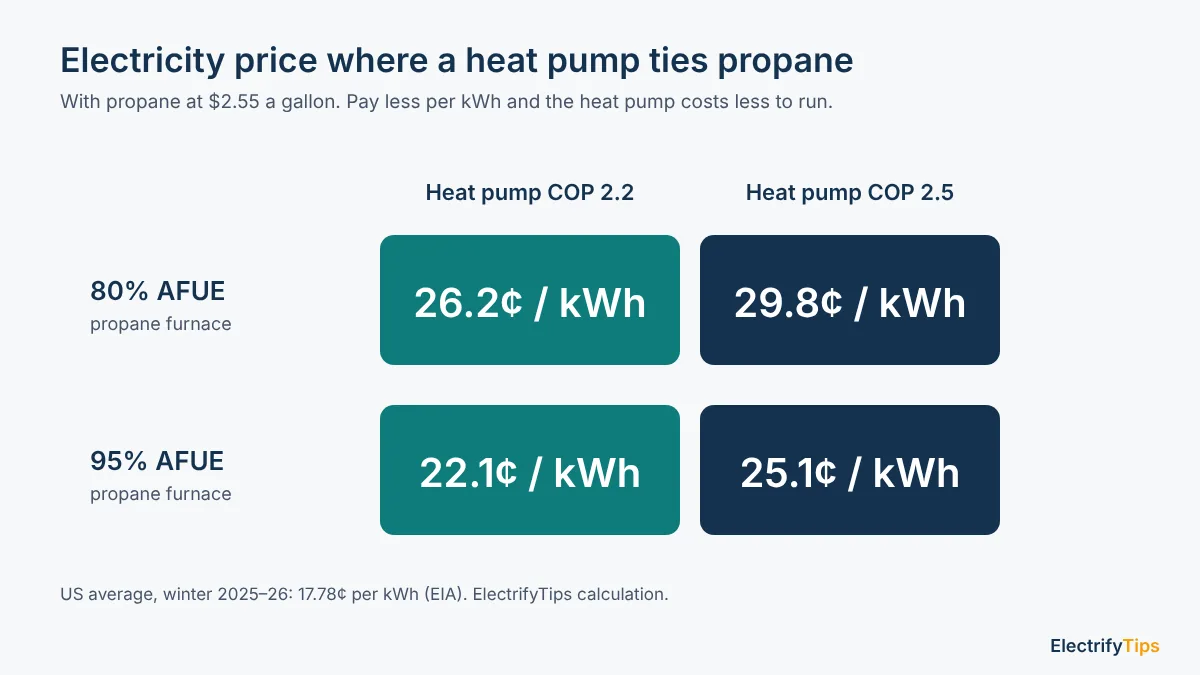
Pay less than that, and the heat pump costs less to run. Our Operating Cost Comparison tool lets you put in your own prices.
Real-world efficiency. Ratings come from a standard test. In a NYSERDA field study of cold-climate mini-splits in New York homes, measured efficiency averaged about 80% of what the ratings implied. If a minimum-rated heat pump ran at 80% of its rating, its heat would cost about $29.60 per million Btu, roughly the same as a 95% propane furnace.
How cold your winters get. The colder your winters, the more of the season falls in the temperatures where a heat pump’s COP is lowest. Our cold climate heat pump guide covers models built for those conditions.
Your house. DOE advises homeowners replacing a gas heating system with a heat pump to weatherize their homes first.
Upfront cost
What you pay depends on the type of system, its size and how many rooms it serves. Our heat pump installation cost guide and mini-split cost guide set out published price data. With a dual-fuel setup you keep your existing furnace, so you’re buying only the heat pump. A heat pump also cools, so if your central air conditioner is due for replacement, part of the cost goes toward cooling you’d pay for anyway.
Rebates in 2026: the rules changed
The federal 25C tax credit doesn’t cover heat pumps installed in 2026. The state-run HEEHR rebate (formerly HEAR) changed too. DOE’s May 29, 2026 notice removed rebates for “fuel-switching (i.e. replacement of non-electric appliances).” Replacing a propane furnace with a heat pump is a fuel switch, so HEEHR no longer pays for it.
The same notice allows homes to “retain existing fossil-fuel HVAC systems when installing a heat pump.” Whether a heat pump added beside your propane furnace qualifies depends on how your state applies the new rules. North Carolina, for example, says fuel switching projects are not allowed for applications that hadn’t reached rebate reservation by Sept. 1, 2026. HEEHR also now requires insulation and air sealing first, unless your home already meets your state’s level. Check with your state energy office before you sign a contract. Our heat pump rebates guide tracks state programs, and some utilities offer their own rebates.
Which one fits your home
A heat pump is likely the better choice when:
- your electricity price is below the break-even level in the table above
- your furnace or central air conditioner needs replacing soon
- you want cooling as well as heating
Propane, or a dual-fuel system that keeps it, may make more sense when:
- your electricity costs more than the break-even price
- your winters are long and very cold
- your furnace is fairly new and working well
In a dual-fuel system, the heat pump and furnace take turns. Natural Resources Canada notes that in these hybrid systems “either the heat pump operates or the gas/oil furnace operates,” not both at once. For a natural gas home, see heat pump vs gas furnace.
Frequently asked questions
Is a heat pump cheaper to run than a propane furnace?
At winter 2025–26 average US prices, yes. Heat from a heat pump cost about $21–$24 per million Btu, against about $29 from a 95% propane furnace and $35 from an 80% one. Your own prices can change that, so check the break-even table.
At what propane price is a heat pump worth it?
With electricity at 17.78¢ per kWh, a heat pump at the federal minimum rating matches a 95% propane furnace when propane costs about $2.06 a gallon. Above that, the heat pump costs less to run. Against an 80% furnace, the break-even is about $1.73.
Can I keep my propane furnace as a backup?
Yes. That’s a dual-fuel system: DOE describes the heat pump handling milder weather “while the furnace takes over during colder temperatures.”
Will the HEEHR rebate pay to replace my propane furnace with a heat pump?
No. Since DOE’s May 29, 2026 notice, HEEHR doesn’t pay for replacing non-electric heating. Some utility rebates may still apply.
Do heat pumps work in cold climates?
Yes. DOE says cold climate heat pumps “are designed to perform in temperatures as low as 5°F.” Their efficiency is lower on the coldest days, which is why some homes keep a furnace as backup.
Keep reading
- Heat pumps: the complete homeowner’s guide
- Heat pump vs gas furnace
- Heat pump vs electric baseboard heat
- Cold climate heat pumps
- SEER2, HSPF2 and COP explained
- How much does a heat pump cost to install?
- Heat pump rebates and incentives (2026)
- Operating Cost Comparison tool
- Dual fuel heat pump systems
Sources & references
- https://www.eia.gov/dnav/pet/hist/LeafHandler.ashx?n=PET&s=W_EPLLPA_PRS_NUS_DPG&f=W
- https://www.eia.gov/electricity/monthly/epm_table_grapher.php?t=table_5_03
- https://www.eia.gov/electricity/monthly/epm_table_grapher.php?t=table_5_06_a
- https://www.eia.gov/energyexplained/units-and-calculators/british-thermal-units.php
- https://web.archive.org/web/20260531015158/https://www.energy.gov/energysaver/furnaces-and-boilers
- https://web.archive.org/web/20260531150702/https://www.energy.gov/energysaver/heat-pump-systems
- https://natural-resources.canada.ca/energy-efficiency/energy-star/heating-cooling-heat-pump
- https://www1.eere.energy.gov/buildings/appliance_standards/pdfs/2023_CAC_Standards_FAQ_10-5-2022_Final.pdf
- https://www.energystar.gov/sites/default/files/2025-04/ENERGY STAR Version 6.2 Heat Pump Specification Rev. March 2025.pdf
- https://www.nyserda.ny.gov/-/media/Project/Nyserda/Files/Publications/PPSER/Program-Evaluation/22-04-Replacing-Fossil-Fuel-Heat-with-Mini-Split-Heat-Pumps-in-Urban-House-Stock.pdf
- https://www.energy.gov/documents/program-notice-26-2
- https://www.govinfo.gov/link/uscode/42/18795a
- https://www.deq.nc.gov/energy-climate/state-energy-office/energy-saver-north-carolina/program-changes
- https://www.irs.gov/credits-deductions/energy-efficient-home-improvement-credit