Quick answer
A heat pump cools exactly like a central air conditioner, but a reversing valve lets it heat too. In a 2024 California contractor survey, a 3-ton heat pump cost $1,424 more than a new AC, and only $583 more than replacing both an AC and a gas furnace. High-efficiency heat pumps also dehumidify better than standard AC (DOE).
In summer, you can’t tell a heat pump from an air conditioner. Both use the same outdoor unit, the same refrigerant loop and the same idea: pull heat out of your house and dump it outside. The difference shows up in winter. A heat pump can run the cycle in reverse and bring heat in, so one system heats and cools your home. An air conditioner only cools, so it needs a furnace or other heater beside it.
The short answer
- Same cooling, extra heating. A heat pump cools the way an AC does, and a reversing valve lets it heat too.
- It can cool better in humid weather. DOE says high-efficiency heat pumps dehumidify better than standard central air conditioners.
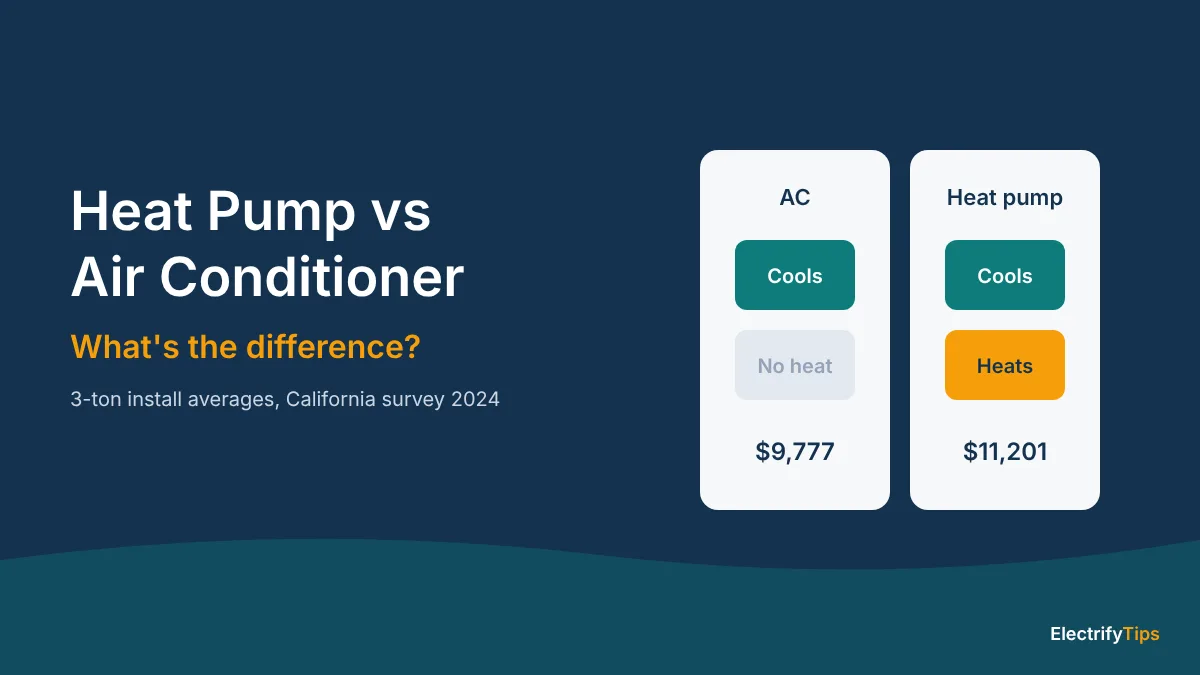
- It costs a bit more than a new AC. In a 2024 California contractor survey, a 3-ton heat pump averaged $11,201 installed, against $9,777 for a new central AC. That’s about $1,400 more.
- Replacing an AC and a furnace? The gap almost disappears. The same survey found one heat pump cost only $583 more than a new AC plus a new furnace.
- Rebates apply only to the heat pump. HEEHR (formerly HEAR) pays up to $8,000 toward a heat pump for eligible households. Since May 2026 it covers only upgrades from existing electric equipment, not from gas, oil or propane. There’s no matching rebate for a plain AC.
How both work
An air conditioner and a heat pump both run a refrigerant loop between an indoor coil and an outdoor coil, with a compressor doing the pumping.
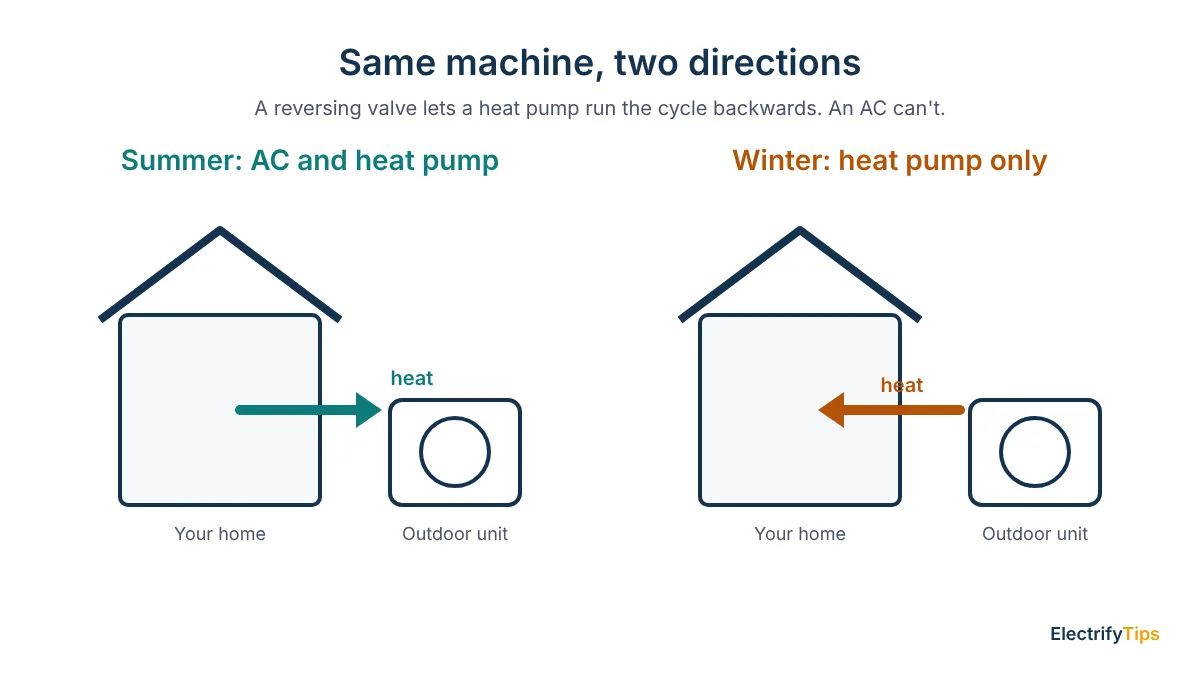
In cooling mode, they’re the same machine. Refrigerant in the indoor coil soaks up heat from your home’s air. The compressor pushes it outside, and the outdoor coil releases that heat. DOE describes it this way: during the cooling season, heat pumps “move heat from your house to the outdoors.”
In heating mode, only the heat pump keeps going. A heat pump has a reversing valve that, in DOE’s words, “changes the direction of refrigerant flow for cooling and for the winter defrost cycle.” Now the outdoor coil pulls heat from outside air, even cold air, and the indoor coil releases it into your home. An air conditioner has no reversing valve, so it can’t do this.
Side by side
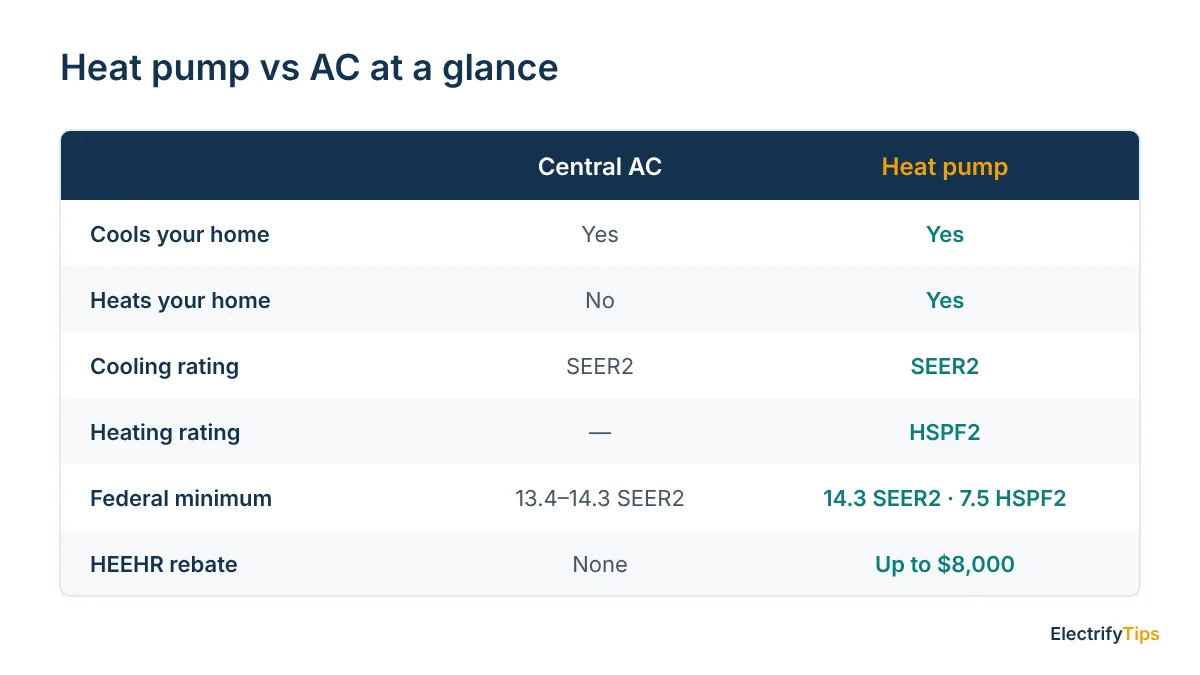
| Central air conditioner | Air-source heat pump | |
|---|---|---|
| Cools your home | Yes | Yes, the same way |
| Heats your home | No, needs a furnace or other heater | Yes, using a reversing valve |
| Cooling efficiency rating | SEER2 | SEER2 |
| Heating efficiency rating | — | HSPF2 |
| Federal minimum (since 2023) | 13.4–14.3 SEER2, depending on region and size | 14.3 SEER2 and 7.5 HSPF2, nationwide |
| Dehumidifying | Standard | Better in high-efficiency models (DOE) |
| Typical 3-ton install (California survey, 2024) | $9,777 | $11,201 |
| Federal rebate (HEEHR) | None | Up to $8,000 for eligible households |
Does a heat pump cool as well as an AC?
Yes. Cooling efficiency for both is measured the same way, with SEER2 (seasonal energy efficiency ratio). A heat pump and an AC with the same SEER2 rating use about the same electricity to cool your home. A heat pump that cools well doesn’t cost more to run in summer just because it can also heat.
DOE also points to a comfort edge: high-efficiency heat pumps “dehumidify better than standard central air conditioners, resulting in less energy usage and more cooling comfort in summer months.” In humid climates, that’s worth asking about.
Efficiency ratings and federal minimums
Two ratings matter:
- SEER2 for cooling. Both systems have it. Higher is better.
- HSPF2 for heating. Only heat pumps have it. Higher is better.
Since January 1, 2023, new equipment has had to meet federal minimums (DOE):
| Equipment | Minimum |
|---|---|
| Split-system central AC, North | 13.4 SEER2 |
| Split-system central AC, Southeast and Southwest (under 45,000 Btu/h) | 14.3 SEER2 |
| Split-system central AC, Southeast and Southwest (45,000 Btu/h and up) | 13.8 SEER2 |
| Split-system heat pump, all regions | 14.3 SEER2 and 7.5 HSPF2 |
In the South, the AC rules apply by installation date. A unit installed on or after January 1, 2023 has to meet the new minimum. DOE also notes that higher SEER and HSPF ratings mean a higher price for the unit, so efficiency is a trade-off between upfront cost and running cost.
What each costs to install
The clearest like-for-like price data comes from TECH Clean California’s 2024 survey of contractors on 3-ton jobs. It asked what each swap costs, then what a heat pump would cost instead:
| What you’re replacing | Replace like-for-like | Replace with a heat pump | Extra cost of the heat pump |
|---|---|---|---|
| Central AC only | $9,777 (new AC) | $11,201 | $1,424 |
| AC + gas furnace | $12,698 (new AC + furnace) | $13,281 | $583 |
| Gas furnace only | $5,951 (new furnace) | $14,909 | $8,958 |
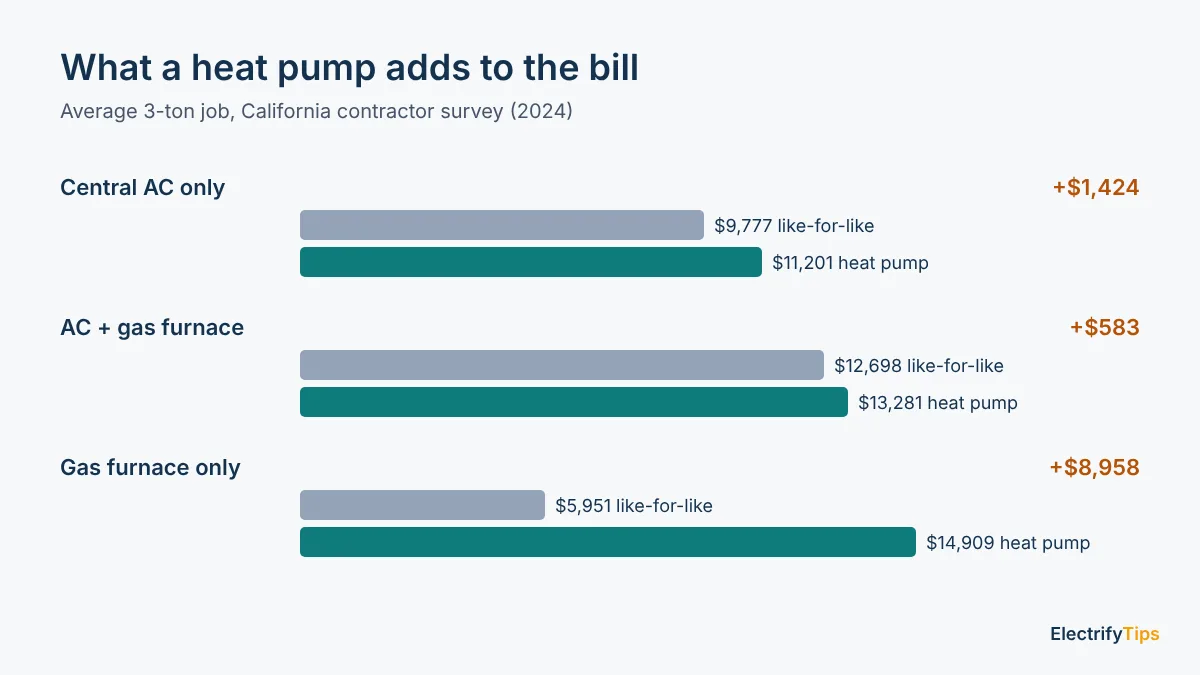
The pattern is clear. If your AC is due for replacement, a heat pump costs a little more. If both the AC and furnace are due, it costs almost the same. The expensive case is replacing only a furnace. There the heat pump is a full heating and cooling system replacing a heater alone, and the price reflects that.
These are California averages from 64 contractors, and they exclude panel upgrades and new ductwork. Use them to see the pattern, not as a quote. Our installation cost article has national ranges.
When to choose which
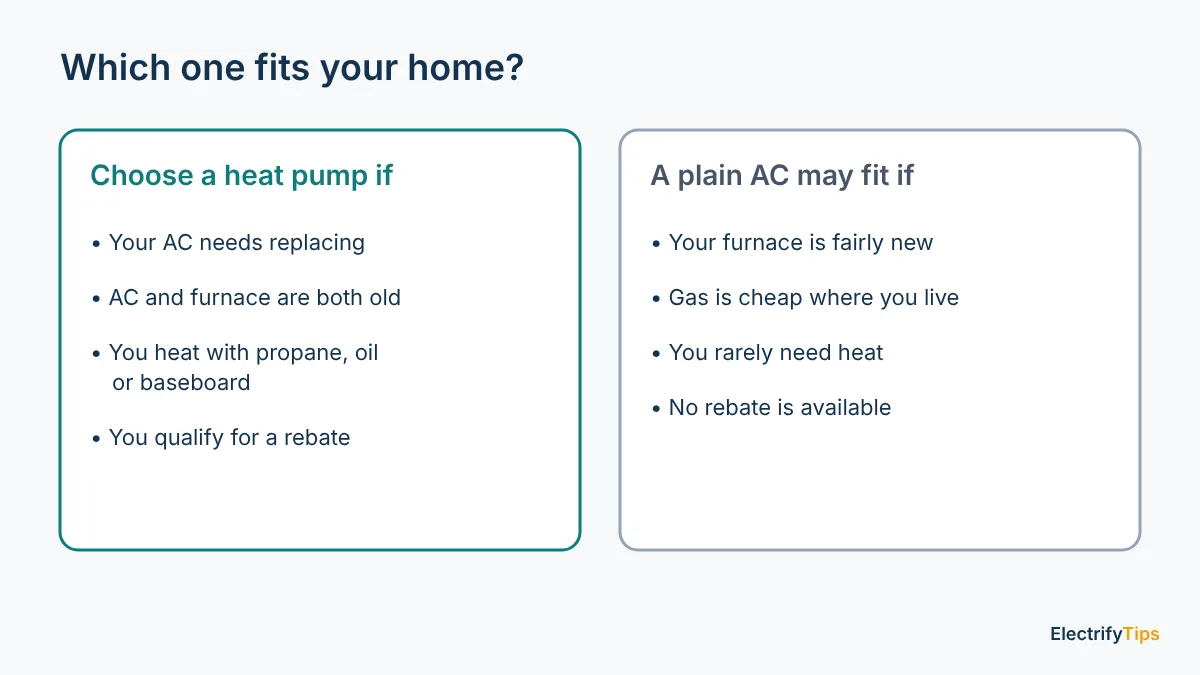
A heat pump usually makes sense when:
- your central AC needs replacing anyway (about $1,400 more in the California survey),
- your AC and furnace are both near the end (about $600 more),
- you heat with propane, oil or electric baseboard, which are expensive per unit of heat, or
- you qualify for HEEHR or a utility rebate, which can wipe out the price difference.
A plain AC may still fit when:
- your furnace is fairly new and gas is cheap where you live (our heat pump vs furnace guide has a quick rule to check this),
- you rarely need heat at all, or
- your budget is tight and no rebate is available.
Replacing an AC with a heat pump: what to ask
Swapping a central AC for a heat pump is one of the simplest ways to switch, because the heat pump can usually go where the AC was. Before you sign, ask the installer:
- Is it sized for heating as well as cooling? A heat pump does both jobs, so the load calculation should cover winter as well as summer. Our sizing calculator gives you a starting estimate.
- Can my existing ducts and indoor coil be reused? Leaky ducts waste energy in both seasons. DOE recommends sealing and insulating ducts in unheated spaces.
- What happens to my furnace? You can remove it or keep it as backup. DOE describes dual-fuel systems where the heat pump handles milder weather and the furnace takes over in colder temperatures.
- Is my electrical panel big enough? Ask for it in writing. HEEHR can pay up to $4,000 toward a panel upgrade for eligible households.
- Am I approved for rebates first? HEEHR requires approval before installation. The federal 25C tax credit doesn’t cover heat pumps installed in 2026. See our rebates guide.
Frequently asked questions
Is a heat pump the same as an air conditioner?
In cooling mode, yes: it moves heat from inside your home to the outdoors the same way. The difference is a reversing valve that lets a heat pump run the cycle backwards in winter and heat your home. An AC can only cool.
Does a heat pump cost more to run than an AC in summer?
Not if the two have the same SEER2 rating. SEER2 measures cooling efficiency the same way for both, so equal ratings mean about the same electricity use for cooling.
How much more does a heat pump cost than a new AC?
In a 2024 survey of California contractors, a 3-ton heat pump averaged $11,201 installed, against $9,777 for a new central AC. That’s $1,424 more. When both an AC and a gas furnace needed replacing, one heat pump cost only $583 more than replacing both.
Can I keep my furnace if I switch to a heat pump?
Yes. This is called a dual-fuel or hybrid system. DOE describes it as the heat pump handling most heating in milder weather, with the furnace taking over in colder temperatures.
What efficiency rating should I look for?
SEER2 for cooling and HSPF2 for heating. Since 2023, new split-system heat pumps must meet at least 14.3 SEER2 and 7.5 HSPF2 nationwide. Higher ratings cost more up front but use less electricity.
Keep reading
- Ducted vs ductless mini-split heat pumps
- Do heat pumps work in cold climates?
- Heat pumps: the complete homeowner’s guide
- How much does a heat pump cost to install?
- Heat pump vs furnace: which is cheaper to run?
- Heat pump rebates and incentives: complete guide (2026)
- Heat Pump Cost Calculator
- SEER2, HSPF2 and COP explained
Sources & references
- https://web.archive.org/web/20260531150702/https://www.energy.gov/energysaver/heat-pump-systems
- https://web.archive.org/web/20260602160945/https://www.energy.gov/energysaver/air-source-heat-pumps
- https://www1.eere.energy.gov/buildings/appliance_standards/pdfs/2023_CAC_Standards_FAQ_10-5-2022_Final.pdf
- https://techcleanca.com/documents/4258/TECH_Cost_Study_-_FINAL_Phase_I_Findings_2.12.24_2.pdf
- https://web.archive.org/web/20260613031412/https://www.energy.gov/energysaver/minimizing-energy-losses-ducts
- https://www.govinfo.gov/link/uscode/42/18795a
- https://www.irs.gov/credits-deductions/energy-efficient-home-improvement-credit