Quick answer
Size a heat pump from an ACCA Manual J load calculation, not your square footage. DOE warns against floor-area estimates and says oversized systems cost more, cycle too often, control humidity poorly and wear out faster. One ton equals 12,000 Btu/h. In cold climates, a heat pump that is the only heat source should be sized to the design heating load.
Most sizing advice online starts with a chart: so many square feet equals so many tons. It’s simple, and it’s the wrong place to start. Two houses with the same floor area can need very different heat pumps, depending on climate, insulation, windows and air leaks. DOE puts it bluntly: “Beware of casual sizing estimates based on home floor area or contractor ‘experience.'” This guide explains how heat pump size is measured, how a proper load calculation works, and how to check whether the size in your quote makes sense.
The short answer
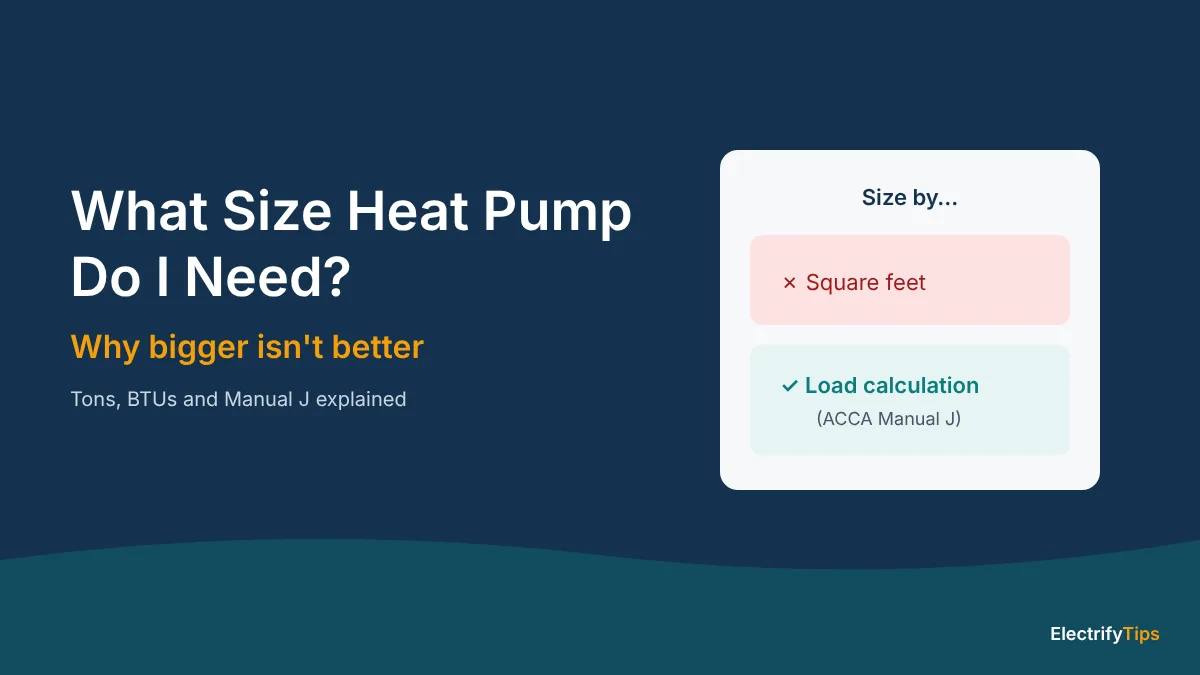
- Your heat pump should be sized from a load calculation, not your square footage. The US standard is ACCA Manual J. ACCA says building codes in most places require a Manual J calculation.
- Bigger is not better. DOE says an oversized system costs more to buy and run, cycles on and off too often, controls humidity poorly and wears out faster.
- Matching your old unit’s size isn’t a calculation either. In one large survey cited by DOE, nearly 40% of contractors said they oversized equipment on purpose.
- In cold climates, heating usually decides the size. DOE’s cold-climate guidance says that if the heat pump is your only heat source, size it to meet the design heating load.
- Use a calculator only as a starting point. Our Heat Pump Sizing Calculator gives a rough estimate you can check a quote against. It doesn’t replace a Manual J.
What “tons” and “BTUs” mean
Heat pump size means capacity: how much heat it can move in an hour.
- It’s measured in Btu per hour (Btu/h). A Btu is a small unit of heat.
- It’s also quoted in tons. One ton equals 12,000 Btu/h (NIST). So a “3-ton” heat pump moves about 36,000 Btu/h.
| Tons | Btu per hour |
|---|---|
| 1.5 | 18,000 |
| 2 | 24,000 |
| 2.5 | 30,000 |
| 3 | 36,000 |
| 4 | 48,000 |
| 5 | 60,000 |
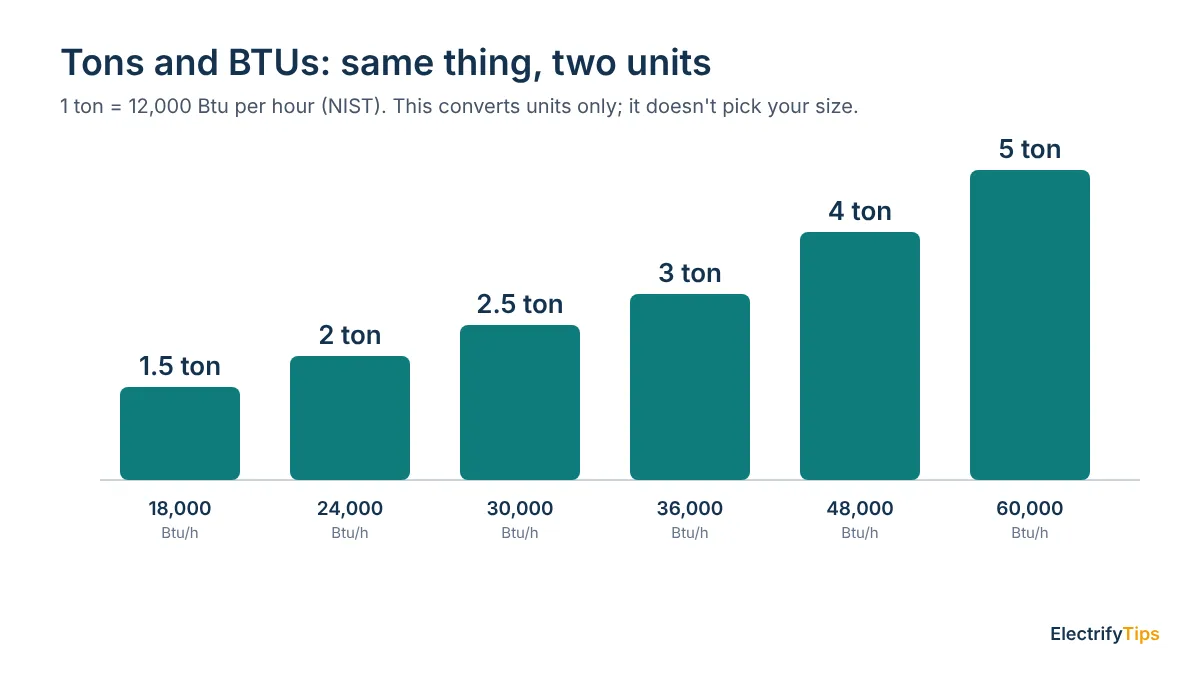
This table only converts units. It doesn’t tell you which size your home needs.
Why square-foot rules get it wrong
A rule like “one ton per X square feet” assumes every home loses and gains heat at the same rate. They don’t. These things change the answer, often by a lot:
- Climate: how cold your winter design temperature is and how hot your summers get.
- Insulation and air leaks: a drafty 1960s house can need far more heat than a new, tight one of the same size.
- Windows: how many, how big, which way they face and how well they insulate.
- Ducts: leaky ducts in an attic or crawlspace add load.
- Ceiling height, layout and number of people.
These are the same factors a Manual J calculation measures. DOE’s cold-climate guidance also warns that rules of thumb “too often” lead to “excessively oversized systems”.
What a Manual J load calculation looks at
Manual J, from the Air Conditioning Contractors of America (ACCA), is the national (ANSI) standard for working out how much heating and cooling a home needs. ACCA says a proper Manual J calculation “is required by national building codes and most state and local jurisdictions”.
A Manual J works through the house room by room. It looks at:
- Design conditions: the outdoor temperatures your system must handle on a cold winter day and a hot summer day where you live.
- Walls, roof and floors: how much heat passes through them, based on insulation.
- Windows and skylights: size, orientation and type.
- Air leakage (infiltration) and ventilation.
- Ducts: where they run and how much they leak or lose.
- Internal heat: people and appliances.
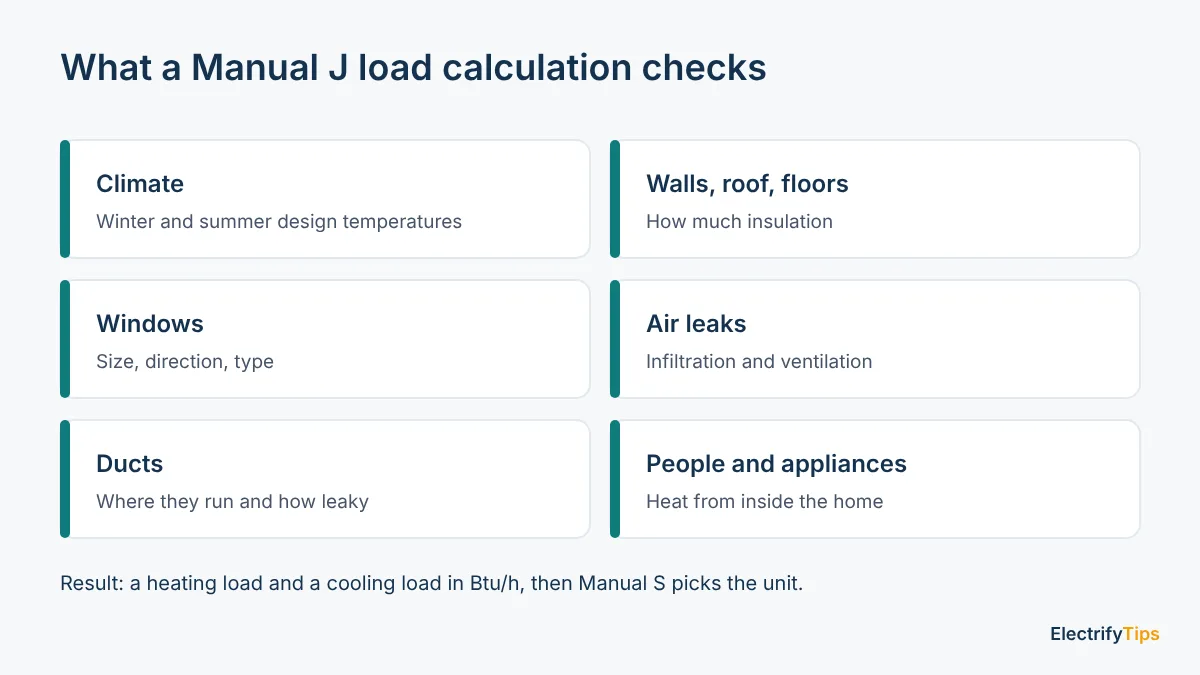
The result is two numbers: a heating load and a cooling load, in Btu/h. A second ACCA procedure, Manual S, is then used to pick equipment that matches those loads. DOE recommends both: “Insist that documented sizing calculations be performed on your home using the ACCA Manual J procedure. Manual S should be used to select equipment.”
Too big or too small: what goes wrong
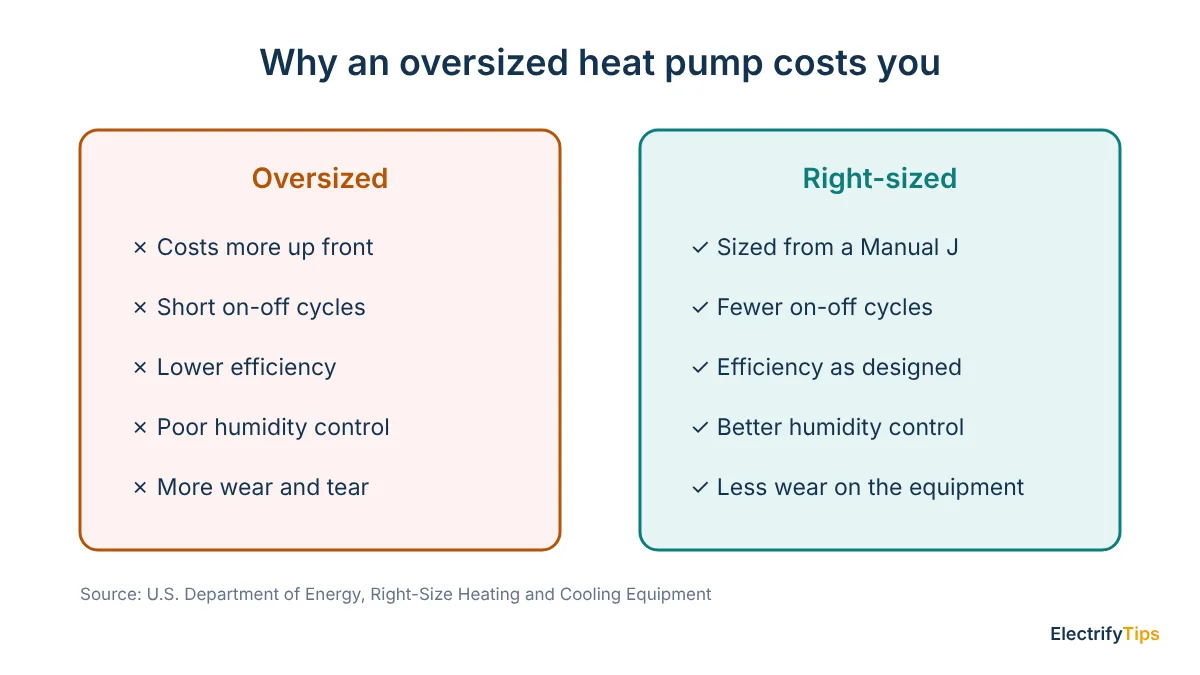
Oversized is the more common problem. DOE says nearly 40% of contractors in one large survey admitted oversizing on purpose, for reasons like avoiding callbacks. DOE lists what it costs you:
- Higher price up front for the bigger unit.
- Lower efficiency and higher bills: “the overall efficiency of an air conditioner, furnace, or heat pump is reduced by excessive cycling.”
- Poor humidity control in summer: short cycling “can lead to poor humidity control”, so the house can feel cool but clammy.
- More wear: “More starts and stops accelerate wear and tear on the equipment, which can lead to premature failure.”
Undersized has its own cost, especially in winter. If the heat pump can’t keep up on the coldest days, backup heat makes up the difference. In DOE’s 2022–2024 cold-climate field test, even the top cold-climate units in the test used backup heat about 25% of the time between −10°F and 0°F. Electric backup strips use far more electricity per unit of heat than the heat pump itself (DOE), so a unit that’s too small can raise winter bills.
The goal is a heat pump sized to your actual loads, not padded “just in case” and not trimmed to save money on the quote.
Sizing in a cold climate
A central AC is sized for cooling only. A heat pump has to handle both, and in cold climates the heating load can be the larger of the two. DOE’s cold-climate sizing guidance for professionals boils down to three cases:
| Your plan | How DOE says to size it |
|---|---|
| The heat pump is your only heat source | Size it to meet the design heating load |
| The heat pump does most of the heating, with a furnace or other backup for the coldest days | Size it to meet most of the design heating load |
| Choosing a unit by its heating capacity | Make sure its minimum cooling capacity is higher than the design heating load, to avoid short cycling |
Two more points from the same guidance:
- Cold-climate models hold their output better. The ENERGY STAR cold-climate label requires at least 70% of rated heating capacity at 5°F. Compare capacity at your winter design temperature, not just the rated number.
- Very efficient homes are a special case. DOE notes their loads can be so small they “fall outside manufacturers’ range of capacities”. If you’ve just insulated and air sealed, the right heat pump may be smaller than you expect.
Our cold-climate guide covers backup heat and DOE’s field-test results.
Ducts and zones change the math
Ducted systems need enough airflow. DOE’s sizing fact sheet notes that ducted systems need roughly 400 to 500 cubic feet per minute of airflow per ton of cooling capacity. Ask whether your ducts can carry the airflow the new unit needs.
Ductless systems are sized zone by zone. Each indoor unit should match the load of the room or area it serves. DOE warns that “an oversized system is more expensive to buy and operate”, and that applies to each zone too. Our ducted vs ductless guide covers zoning in more detail.
How to check your installer’s number
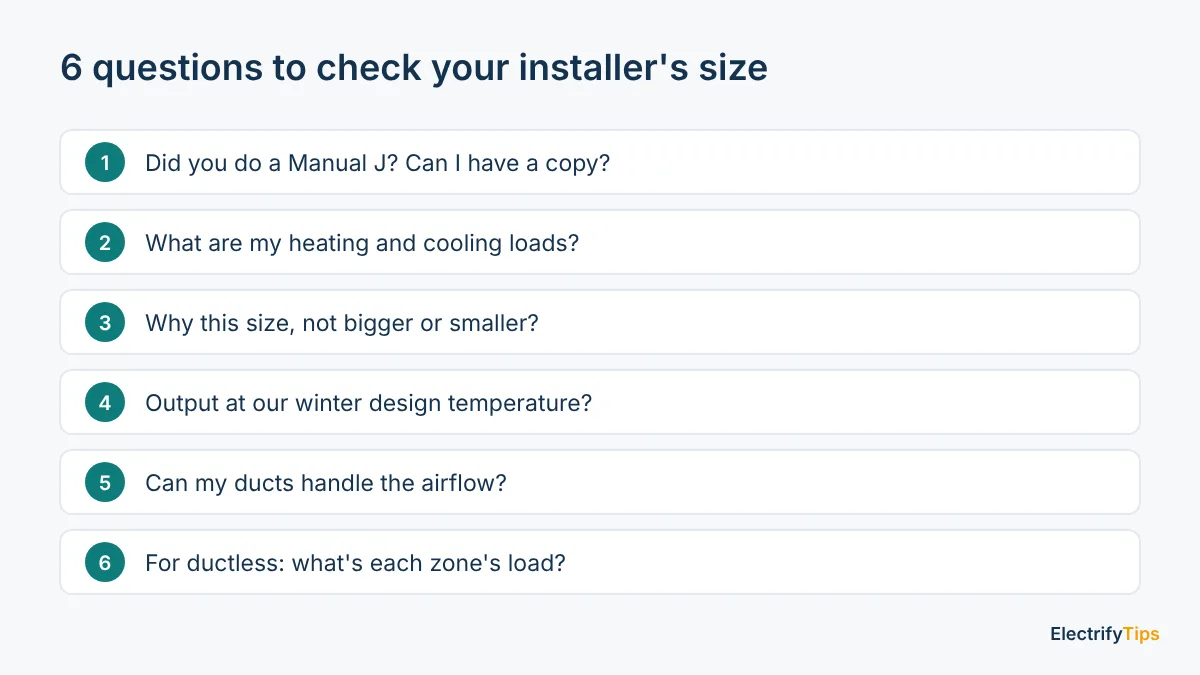
You don’t need to do a Manual J yourself. You need to know whether your installer did one. Ask these questions:
- “Did you do a Manual J load calculation for my home? Can I have a copy?” DOE advises homeowners to insist on documented calculations.
- “What are my heating and cooling loads in Btu/h?” The size you’re quoted should be based on these numbers, not on your old unit.
- “Why this size?” If the answer is “it’s what you had” or “bigger is safer”, ask again.
- “How much heat does this model put out at our winter design temperature?” This matters most for cold-climate homes.
- For ducted systems: “Can my ducts handle this unit’s airflow?”
- For ductless: “What’s the load for each zone?”
Then compare quotes. If three installers quote 2.5, 3 and 4 tons for the same house, ask each one to show the calculation behind their number. Our Heat Pump Sizing Calculator gives you a rough starting estimate to sense-check the range. It’s not a replacement for a Manual J. To compare prices, see how much a heat pump costs to install.
Frequently asked questions
What size heat pump do I need for a 2,000 sq ft house?
There’s no reliable answer from square footage alone. Two 2,000 sq ft homes can need very different sizes, depending on climate, insulation, windows and air leaks. DOE warns against sizing estimates based on floor area. Ask for a Manual J load calculation, and use our sizing calculator only as a rough starting point.
What does a 3-ton heat pump mean?
It describes capacity, not weight. One ton equals 12,000 Btu per hour (NIST), so a 3-ton heat pump moves about 36,000 Btu of heat per hour.
Is it better to get a bigger heat pump?
No. DOE says oversized equipment costs more, cycles on and off too often, loses efficiency, controls humidity poorly and wears out faster. The right size comes from a load calculation.
Should my new heat pump be the same size as my old AC?
Not automatically. Your old unit may have been oversized: in one survey cited by DOE, nearly 40% of contractors said they oversized on purpose. A heat pump also has to heat, so its size should come from both your heating and cooling loads.
Do I need a Manual J?
Yes, ask for one. ACCA says a Manual J load calculation is required by national building codes and most state and local jurisdictions, and DOE advises homeowners to insist on a documented calculation.
Keep reading
- Heat pumps: the complete homeowner’s guide
- Do heat pumps work in cold climates?
- Ducted vs ductless mini-split heat pumps
- How much does a heat pump cost to install?
- Heat Pump Sizing Calculator
- SEER2, HSPF2 and COP explained
- Why is my heat pump running constantly in winter?
- How much does a mini-split cost to install?
- How long do heat pumps last?
Sources & references
- https://www.acca.org/standards/technical-manuals/manual-j
- https://www1.eere.energy.gov/buildings/publications/pdfs/building_america/31318.pdf
- https://bsesc.energy.gov/training-modules/hvac-cold-climate-heat-pump-sizing
- https://bsesc.energy.gov/problem-sets/cold-climate-heat-pumps-sizing-problem-set-31
- https://www.nist.gov/pml/special-publication-811/nist-guide-si-appendix-b-conversion-factors/nist-guide-si-appendix-b9
- https://web.archive.org/web/20260603064036/https://www.energy.gov/energysaver/ductless-minisplit-heat-pumps
- https://www.energystar.gov/sites/default/files/2025-04/ENERGY STAR Version 6.2 Heat Pump Specification Rev. March 2025.pdf
- https://www.pnnl.gov/main/publications/external/technical_reports/PNNL-37127.pdf
- https://web.archive.org/web/20260531150702/https://www.energy.gov/energysaver/heat-pump-systems