Quick answer
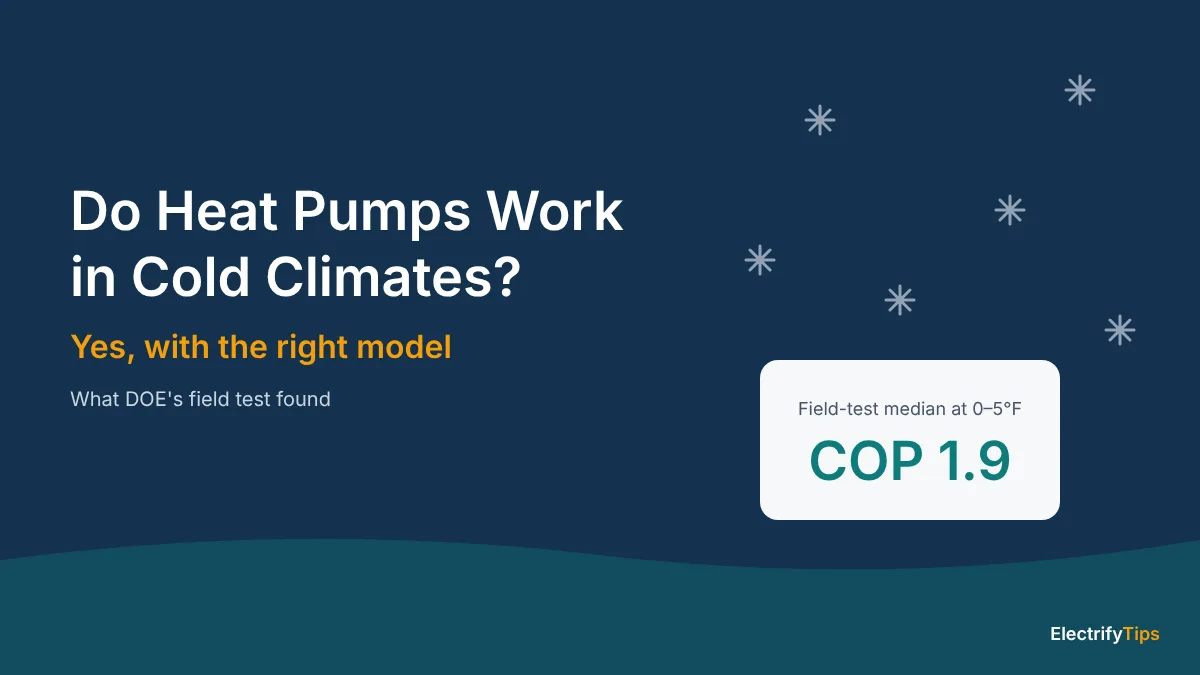
Yes, with a cold-climate model. In DOE's 2022–2024 field test of 22 cold-climate heat pumps, units ran at a median COP of 1.9 between 0°F and 5°F, nearly twice as efficient as electric baseboard, and used backup heat about 25% of the time below 0°F. Look for the ENERGY STAR cold-climate label: COP of at least 1.75 at 5°F.
You may have heard that heat pumps are fine in Georgia but useless in Minnesota. DOE doesn’t see it that way any more. It says air-source heat pumps have advanced to the point where they’re “a legitimate space heating alternative in colder regions.” A recent DOE field test put real numbers on that. This guide covers what happens to a heat pump as the temperature drops, what the test found, and how to pick and set one up for a cold winter.
The short answer
- Yes, if you buy a cold-climate model. DOE says cold-climate heat pumps are designed to work in temperatures as low as 5°F.
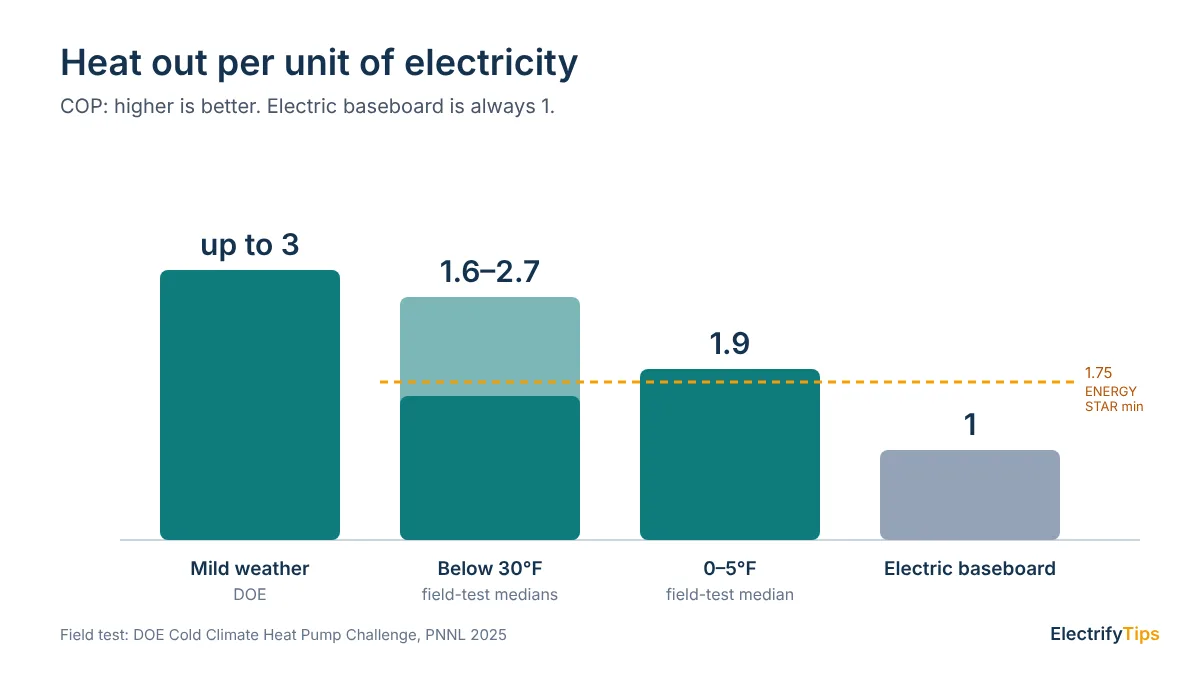
- They stay efficient in the cold. In DOE’s 2022–2024 field test, cold-climate units ran at a median COP of 1.9 between 0°F and 5°F. That means about 1.9 units of heat for every unit of electricity, nearly twice as efficient as electric baseboard heat.
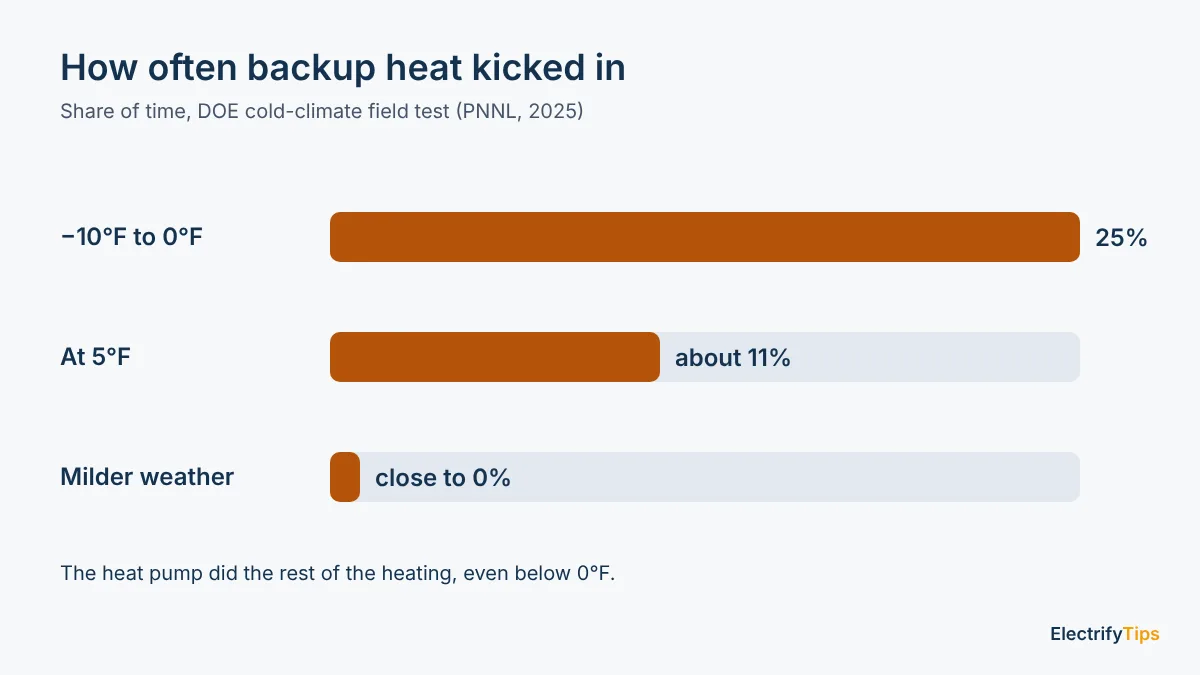
- Backup heat still has a small job. In the same test, units leaned on backup heat about 25% of the time between −10°F and 0°F, about 11% at 5°F, and almost never in milder weather.
- Look for the ENERGY STAR cold-climate label. It requires a COP of at least 1.75 and at least 70% of rated heating capacity at 5°F.
- Running cost on the coldest days depends on your fuel. At 0–5°F, a heat pump still beats propane, oil and baseboard heat on cost. Cheap natural gas can beat it.
What happens to a heat pump as it gets colder
A heat pump doesn’t make heat. It moves heat that’s already in the outdoor air into your home. Even at 0°F, outdoor air holds heat a heat pump can collect. But the colder it gets, the harder the heat pump has to work, and two things happen:
- Efficiency (COP) falls. In mild weather a heat pump delivers several times as much heat as the electricity it uses: at 46°F (8°C), Natural Resources Canada says COPs typically range from 2.0 to 5.4. In deep cold, that ratio drops.
- Heating capacity can fall. A standard heat pump puts out less heat in deep cold, right when your house needs more. Cold-climate models are built to hold their output.
That second point is what separates a cold-climate heat pump from a standard one.
What “cold-climate” means: the official bar
“Cold-climate” isn’t just a marketing word. Two official benchmarks give it meaning:
| Benchmark | Efficiency at 5°F | Heat output at 5°F (vs rated output at 47°F) |
|---|---|---|
| ENERGY STAR cold-climate label | COP of at least 1.75 | At least 70% |
| DOE Cold Climate Heat Pump Challenge target | COP of 2.1–2.4 | 100% |
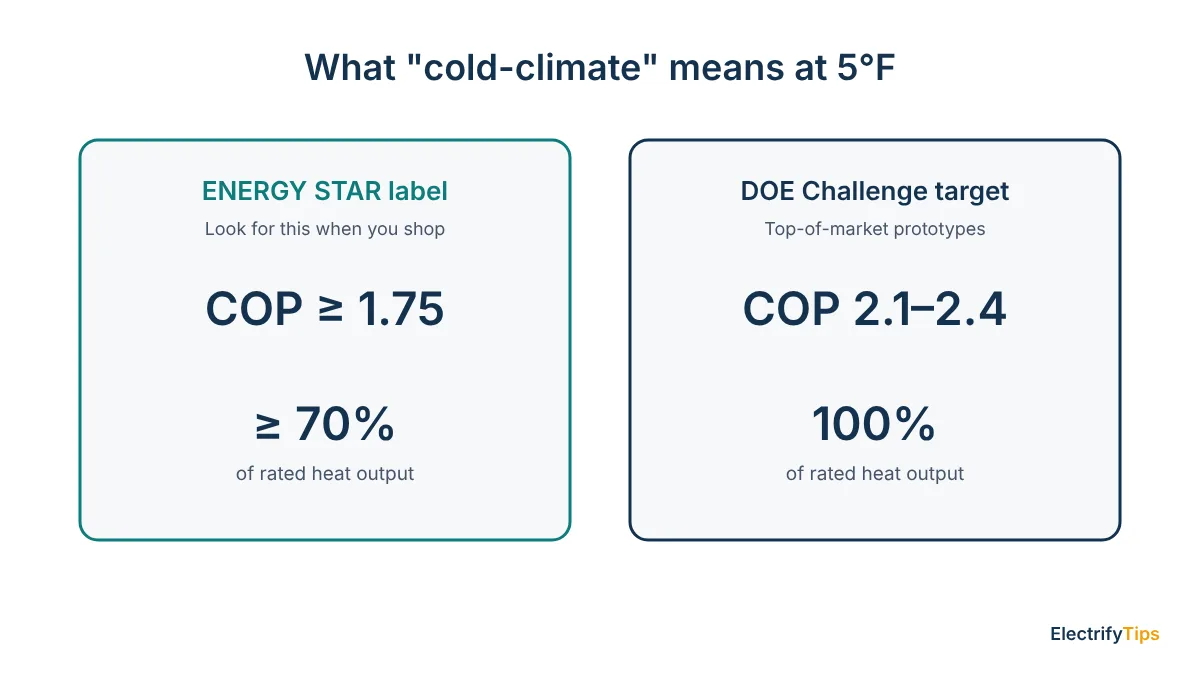
The ENERGY STAR label is the one to look for when you shop. The DOE Challenge was a tougher target that nine major manufacturers committed to meet: Carrier, Daikin, Johnson Controls, Lennox, LG, Midea, Mitsubishi Electric, Rheem and Trane Technologies. PNNL’s January 2025 report says all the challenge prototypes kept a COP above 2.1 or 2.4 at 5°F and delivered at least 100% of their rated heating capacity at 5°F.
What the DOE field test found
Lab ratings are one thing. Real homes in real winters are another. So DOE had 22 cold-climate units from the Challenge installed in homes in the US and Canada, and measured them through the 2022–2024 heating seasons. Pacific Northwest National Laboratory published the results in January 2025.
| Outdoor temperature | What the units did |
|---|---|
| Below 30°F | Median COP between 1.6 and 2.7 across all sites |
| 0°F to 5°F | Median COP of 1.9 |
| 5°F | Backup heat ran about 11% of the time (median) |
| −10°F to 0°F | Backup heat ran about 25% of the time |
| Milder weather | Backup heat use fell toward 0% |
Three honest caveats:
- These were the top of the market. They were Challenge prototypes from major manufacturers, not the cheapest units you can buy.
- Deep cold was rare in the test. Only 8 of the 22 sites logged 10 or more hours of heating below 0°F.
- The study didn’t measure bills. PNNL notes that utility billing analysis was outside its scope.
Still, the core finding is clear: at 0–5°F, these heat pumps were still producing nearly twice as much heat as the electricity they used.
Defrost: why the outdoor unit steams and pauses
In cold, damp weather, frost builds up on the outdoor coil. To clear it, the heat pump runs a short defrost cycle, and you may see steam rising from the unit. That’s normal.
Defrost does cost some energy. In the DOE field test, defrost used a median of about 5–8% of energy at outdoor temperatures between 5°F and 35°F.
DOE’s advice to keep defrost in check:
- Choose a heat pump with demand-defrost control. It defrosts only when needed, which DOE says reduces both supplementary and heat pump energy use.
- Protect the outdoor unit from high winds, which DOE says can cause defrosting problems.
Backup heat: do you still need it?
In a cold climate, plan on some backup. The field test showed why: even top cold-climate units used backup heat about a quarter of the time below 0°F.
There are two common setups:
- Electric backup (resistance strips) built into the indoor unit. It’s simple, but expensive to run: it works at COP 1, so every unit of heat costs a full unit of electricity. You want it to run as little as possible.
- Dual fuel: keep (or add) a gas furnace for the coldest days. DOE describes these as systems that “combine the efficiency of a heat pump with the reliability of a gas furnace.” The heat pump handles milder weather, and the furnace takes over in colder temperatures.
A properly sized cold-climate heat pump keeps backup use low. A heat pump that’s too small for the house is more likely to lean on backup heat.
What it costs to run when it’s freezing
Here’s the cost of 1 million Btu of heat at 2025 US average prices: electricity at 17.30¢/kWh and natural gas at $15.34 per thousand cubic feet (EIA). Propane and oil use EIA’s March 30, 2026 prices.
| Heating source | Cost per million Btu |
|---|---|
| Heat pump in mild weather (COP 3) | $16.90 |
| Heat pump at 0–5°F (COP 1.9, field-test median) | $26.69 |
| Heat pump at 5°F (COP 1.75, ENERGY STAR minimum) | $28.97 |
| Gas furnace, 95% efficient | $15.59 |
| Propane furnace, 95% efficient | $30.78 |
| Oil furnace, 80% efficient | $49.95 |
| Electric baseboard or backup strips (COP 1) | $50.70 |
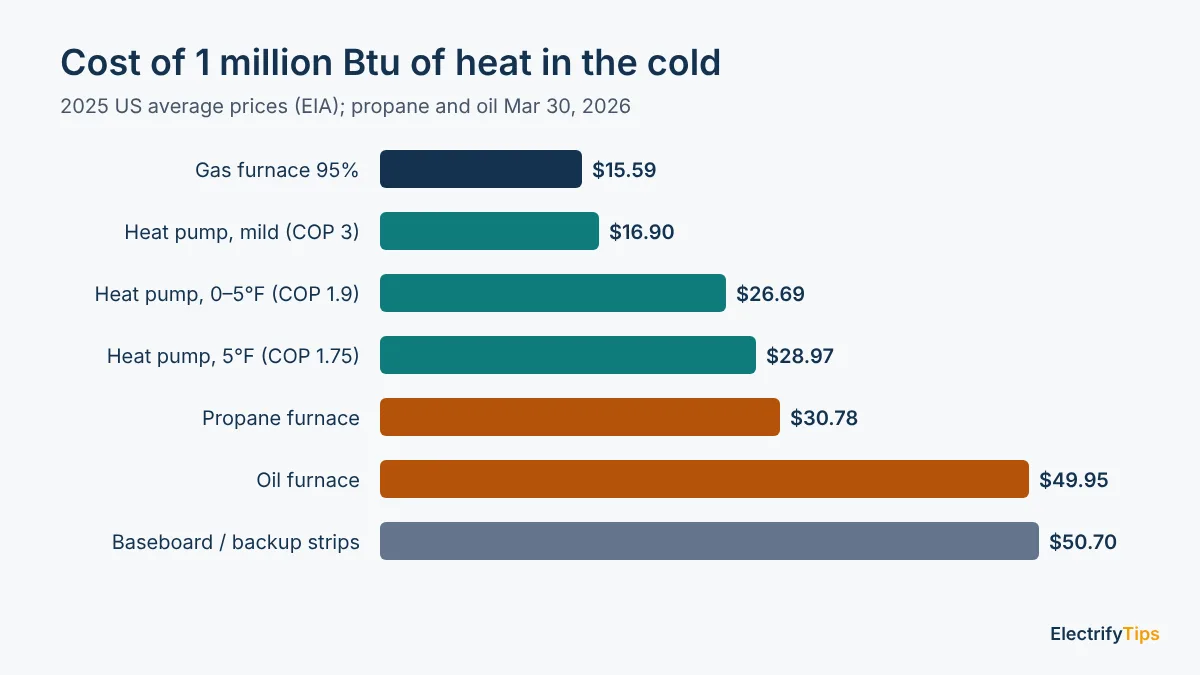
What this tells you:
- Against propane, oil or baseboard heat, the heat pump is cheaper even at 0–5°F.
- Against cheap natural gas, gas wins on the coldest days. That’s why dual fuel can make sense where gas is cheap.
- Most heating hours aren’t the coldest hours. Your winter bill depends on how many hours you spend at each temperature, not only the coldest night.
To test your own rates, our heat pump vs furnace guide has a simple break-even rule, and our Operating Cost Comparison tool lets you enter your own COP and prices.
How to choose and install a heat pump for a cold climate
- Buy a cold-climate model. Look for the ENERGY STAR cold-climate label: COP of at least 1.75 and at least 70% of rated capacity at 5°F.
- Size it for your coldest weather. Ask for a proper load calculation, not a guess based on your old system. Our Heat Pump Sizing Calculator gives you a starting estimate to check against.
- Ask about the compressor. DOE lists inverter-driven compressors, which “adjust infinitely between low and high speeds,” among the advances behind today’s more efficient heat pumps.
- Insist on demand-defrost control (DOE recommends it).
- Place the outdoor unit out of high winds (DOE).
- Decide on backup heat: electric strips, or dual fuel with a gas furnace.
- Seal and insulate first, if you can. A tighter house needs less heat, so a smaller heat pump can carry it further into the cold.
- Check rebates before you sign. HEEHR (formerly HEAR) pays up to $8,000 toward a heat pump for eligible households, but only with approval before installation, and since May 2026 not for replacing gas, oil or propane heating. See our rebates guide.
Frequently asked questions
At what temperature does a heat pump stop working?
There’s no single cut-off. DOE says cold-climate models are designed to work down to 5°F. In DOE’s field test, cold-climate units kept running at a median COP of 1.9 between 0°F and 5°F, with backup heat helping about 25% of the time between −10°F and 0°F.
What is a cold-climate heat pump?
One built to hold its efficiency and heat output in deep cold. The ENERGY STAR cold-climate label requires a COP of at least 1.75 and at least 70% of rated heating capacity at 5°F.
Do I need backup heat with a cold-climate heat pump?
In most cold climates, plan for some. Even top units in DOE’s field test used backup heat about a quarter of the time below 0°F, and about 11% of the time at 5°F. The backup can be electric strips or a gas furnace (dual fuel).
Why is steam coming from my heat pump in winter?
It’s usually the defrost cycle clearing frost from the outdoor coil, which is normal. A demand-defrost control, which DOE recommends, keeps these cycles to what’s needed.
Is a heat pump expensive to run in very cold weather?
It costs more per unit of heat than in mild weather. At 2025 US average prices and the field-test median COP of 1.9, heat costs about $26.69 per million Btu. That’s still cheaper than propane ($30.78), oil ($49.95) or electric baseboard ($50.70), but more than a 95% gas furnace ($15.59).
Keep reading
- What size heat pump do I need?
- Ducted vs ductless mini-split heat pumps
- Heat pumps: the complete homeowner’s guide
- Heat pump vs furnace: which is cheaper to run?
- How much does a heat pump cost to install?
- Heat pump vs air conditioner: what’s the difference?
- Heat pump rebates and incentives: complete guide (2026)
- SEER2, HSPF2 and COP explained
- Why is my heat pump running constantly in winter?
- Heat pump vs propane furnace
- Dual fuel heat pump systems
- Heat pump maintenance checklist
Sources & references
- https://www.pnnl.gov/main/publications/external/technical_reports/PNNL-37127.pdf
- https://www.energy.gov/cmei/buildings/articles/residential-cold-climate-heat-pump-technology-challenge-fact-sheet
- https://www.energystar.gov/sites/default/files/2025-04/ENERGY STAR Version 6.2 Heat Pump Specification Rev. March 2025.pdf
- https://web.archive.org/web/20260602160945/https://www.energy.gov/energysaver/air-source-heat-pumps
- https://web.archive.org/web/20260531150702/https://www.energy.gov/energysaver/heat-pump-systems
- https://www.eia.gov/electricity/monthly/epm_table_grapher.php?t=table_5_03
- https://www.eia.gov/dnav/ng/ng_pri_sum_a_EPG0_PRS_DMcf_a.htm
- https://www.eia.gov/petroleum/heatingoilpropane/
- https://www.govinfo.gov/link/uscode/42/18795a
- https://natural-resources.canada.ca/energy-efficiency/energy-star/heating-cooling-heat-pump